Stories of Hýpnos
Hýpnos is a minor but indispensable power. Gods call on him when they need a mortal or immortal to fall unconscious, and poets love him as the brother who daily rescues humanity from wakefulness — and nightly rehearses its death.
In Iliad 14, Hera needs Zeus unconscious, and she knows where to shop. She finds Hypnos on Lemnos and begs his help; the god refuses, remembering the last time — when he lulled Zeus to aid Heracles, the king of gods hunted him and would have hurled him from heaven into the sea, had not Nyx, swift Night, taken him in: even Zeus shrinks from offending Night (Iliad 14.249–261). Hera offers what a personification of desire cannot refuse — Pasithea, one of the younger Graces, as his bride — and swears it by Styx (14.267–276). Hypnos accepts, pours sleep over Zeus's eyes as the golden cloud closes around the embracing pair on Ida, and Poseidon rallies the Greeks unchecked. The episode is the Iliad's one glimpse of Olympus's backstairs: heaven itself, the poem admits, runs on bribes, grudges, and the judicious administration of oblivion.
When Patroklos kills Zeus's son Sarpedon, the father cannot save him — fate forbids — so Zeus does the next thing: he tells Apollo to wash the gore from the body, anoint it, and clothe it in immortal raiment, then hand it over. And there come the gentlest hands in Homer: Hypnos and Thanatos, Sleep and Death, 'swift as thought', bear the hero away to Lycia, land of the broad barley-fields, to his brothers and kinsmen for tomb and stele (Iliad 16.454, 666–683). The scene caught the painters for a thousand years: the krater of Euphronios (c. 515 BCE) shows the twins lifting the limp hero, one at his head, one at his heels, their wings folded with practiced care. Homer gives death its tenderest image by splitting it in two — Thanatos takes the body, but Hypnos takes the pain: the sleep in which nothing hurts is the twin that walks ahead.
Hesiod lodges Hypnos in the family of Night and a geography of gloom. In the Theogony (211–225) he is one of the children Nyx bears without a father — alongside Thanatos, the Keres, Dreams, Blame, and Woe — and near the poem's end (758–761) the poet gives him a house: there have their dwellings Sleep and Death, dread gods; never does the shining sun look upon them with his beams, neither rising nor setting. Homer had already planted the same sunset geography in the Odyssey: at the world's edge lie the land and people of the Cimmerians, wrapped in cloud and mist, on whom the sun never looks (Odyssey 11.14–19). Sleep lives at the far edge of the map because every night the whole human world travels there. The cave of Hypnos is where the sun goes when it leaves us — and the daily rehearsal of that journey is why mortals greet his brother without surprise.
Ovid gives the Roman god his full establishment. When Ceyx drowns at sea, his wife Alcyone prays at Juno's altar, and Iris is dispatched through the gloom to the land of the Cimmerians, to a palace high in the mountains where Somnus lies sunk on an ebony couch in a silence so deep that not even a river stirs (Metamorphoses 11.410–748). Iris rouses him with difficulty; he summons from his thousand dream-sons Morpheus, 'the shaper', who can take any face, and Morpheus appears to Alcyone as her drowned husband and tells her the truth. She finds the true body on the shore, and the gods change both into halcyon kingfishers — whose calm midwinter days, the 'halcyon days', still bless the storm-locked sea in our language. Ovid's Somnus runs a bureau of tailored apparitions: every sleeper is a correspondent, and every dream a message shaped to be believed.
Sleep, Dreams, Release
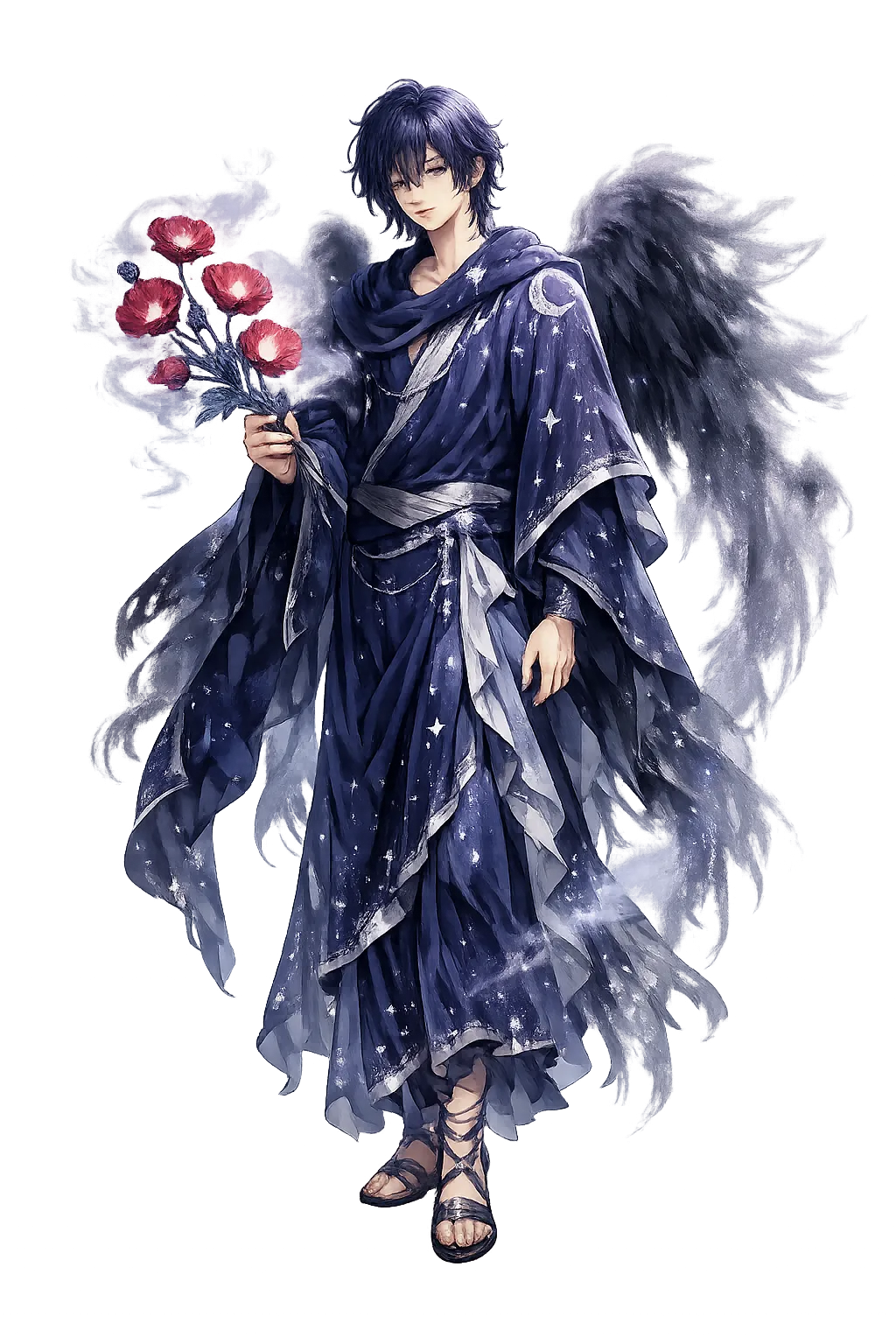
Hýpnos is the personification of sleep, the gentle twin of death who brings rest to gods and mortals. He moves through the world on silent wings, touching tired eyelids with a branch or a whisper.
One of the children of Nyx; sleep comes to all equally, slave and king.
Often shown with wings at his temples or heels, swift and soundless.
He opens the gates through which the Oneiroi, dream-spirits, pass to sleeping mortals.
Thanatos and Hypnos together carry the dead from the battlefield.
From the original script to the living URL
Ὕπνος
The name in its original Greek form. Hýpnos (Ὕπνος) is attested in the source tradition — “Sleep”. Its acute accents carry the full phonetic and orthographic weight of the source tradition.
hypnos
Reduced to plain hypnos, the name loses everything that made it specific: acute accents. What remains is an ASCII string that machines can parse but that no longer speaks with its original voice.
Hýpnos
The Unicode restoration recovers what ASCII flattened. Hýpnos restores acute accents, returning the name to its original written dignity. The domain encodes to Punycode, but the browser displays the truth.
Hýpnos.com → xn--hpnos-qva.com
The non-ASCII characters in Hýpnos are encoded while the ASCII remains visible. To the DNS, it is Punycode. To humanity, it is Hýpnos.
Owned, ideal, and ASCII forms of Hýpnos
Hýpnos
Restores Ὕπνος. The live temple domain — hýpnos.com.
hypnos
Flattens Ὕπνος. The plain ASCII fallback — what DNS and legacy systems see.
How Hýpnos was spoken
How Hýpnos is preserved in writing
A bespoke provenance study for Hýpnos is being prepared by the PUNICODEX scholarly team.
Contribute scholarly provenance →The lore you have read is the living myth. Extended Lore opens the scholarly vault beneath it: the cult and its material remains, a history of the image, the name after antiquity, a meditation on what the name still means, and the full scholarly apparatus — etymology, orthography, sources.
Enter Extended Lore