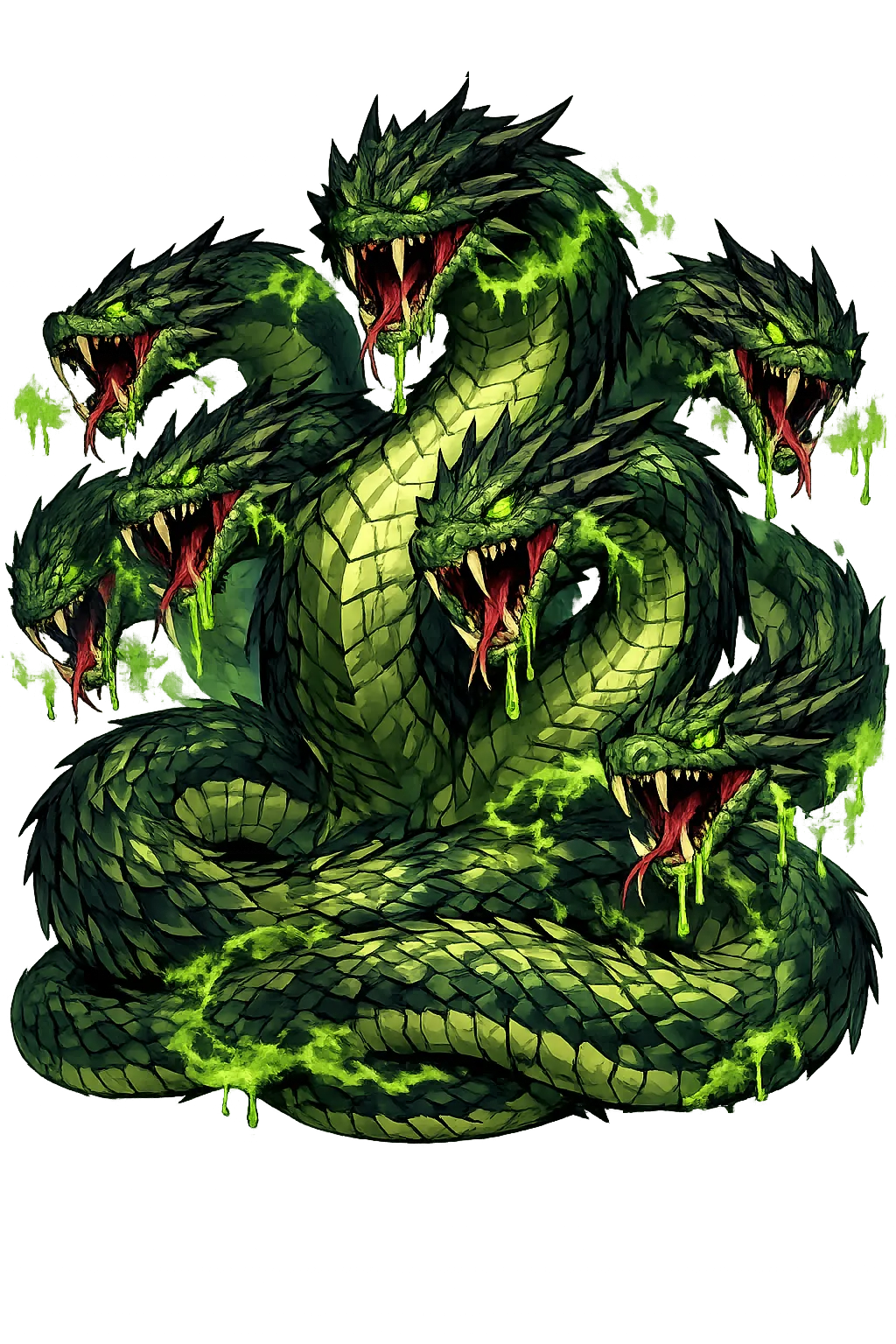
Stories of Hýdra
Hýdra's myth is a labor of escalation. Herakles must discover that brute force alone feeds the monster; victory comes only when fire meets flesh at the exact moment of severance.
Hesiod gives the Hydra a monstrous pedigree. She is the child of Typhon and Echidna — the storm-fiend and the she-viper — and thus the sister of Cerberus and the Chimaera, 'whom the white-crested Hera reared' against Herakles (Theogony 313–318, 333–335). Her home was the marsh of Lerna, beside the Alcyonian lake, a water so deep and foul that antiquity said its bottom had never been seen; Pausanias (2.36–37) records the ground's ill repute and the sanctuary of the Lernaean Demeter beside it. The genealogy is the myth's point: the Hydra is not a freak but a family — bred from the union of storm and serpent, fostered by a goddess with a grudge, and set down in stagnant water where sickness gathers. Before Herakles ever raises his club, the monster is already a theological statement: some evils are raised deliberately, in the dark, by powers that mean to test a hero.
Eurystheus, king of Tiryns, sent Herakles against the Hydra as his second labor — a commission made hopeless by its own terms, for the beast had nine heads, or fifty, or a hundred, depending on the teller, and one of them was immortal. Heracles began as heroes begin: he lured the serpent from its lair with arrows, closed, and smashed the heads with his club (Apollodorus, Bibliotheca 2.5.2). For every head that fell, two grew back. Hera, the monster's foster-mother, sent a crab to fasten on Herakles' foot — the sidelong nip of panic at a hero's heel, immortalized in the constellation Cancer. The labor undoes the hero's entire method: where force had always answered, force now feeds the enemy. Apollodorus adds the bitter footnote that Eurystheus later refused to count the labor, precisely because Herakles accepted help. The myth's lesson arrives early: some trials are designed so that strength alone disqualifies you.
The turn comes from outside the hero. Iolaos, Herakles' nephew and charioteer, saw what strength could not see: that each wound had to be burned shut the instant it was made. He brought fire, and as Herakles struck off each head, Iolaos cauterized the neck with a burning brand; the severed heads could no longer multiply (Apollodorus 2.5.2). In the fuller iconographic tradition Athena stands by as divine adviser — on scores of archaic vases the goddess directs the fire while the two men work. The immortal head Herakles cut off last and buried beneath a great rock on the road from Lerna to Elaious, where Apollodorus says it lay still breathing its poison. The episode is the Greek hymn to technique over force: fire, timing and partnership defeat what the club could not. But the victory has a price the hero must accept — the labor must be shared, and so must the credit, or the hero dies.
Herakles then did the thing that would unmake him. He cut open the Hydra's body and steeped his arrows in its gall, making of each shaft a sure death (Apollodorus 2.5.2, 2.7.7). Years later the centaur Nessos, dying by one of those arrows, told Deianeira to keep his blood — now poisoned by the Hydra — as a love-charm; smeared on Herakles' robe, it consumed the hero on his own pyre (Sophocles, Women of Trachis 555–581). The bow passed to Philoctetes, whose festering wound the Greeks could not heal, and it was one of these arrows that killed Paris and broke the siege of Troy (Apollodorus, Epitome). The myth follows the poison across a whole career: the weapon that won the labor became the agent of the hero's death, the army's curse, and the war's end. The Greeks kept the receipt — triumph always carries its toxin forward. The hydra's real head was never buried: it was dipped, and it traveled.
Regeneration, Stagnant Water, Heroic Trial
Hýdra is the monstrous water-serpent of Lerna, whose heads grew back when cut off. For Herakles, killing it required more than strength; it required fire, teamwork, and the recognition that some evils multiply when opposed directly.
Cut off one head and two grew back; the monster embodied the paradox of unending struggle.
A marshy, stagnant region near Argos; the Hydra personifies corrupted water and hidden disease.
The greatest of Greek heroes defeated the Hydra with torch and club, aided by Iolaos.
One head could not be killed; Herakles buried it beneath a rock, still hissing.
From the original script to the living URL
Ὕδρα
The name in its original Greek form. Hýdra (Ὕδρα) is attested in the source tradition — “Water serpent”. Its acute accents carry the full phonetic and orthographic weight of the source tradition.
hydra
Reduced to plain hydra, the name loses everything that made it specific: acute accents. What remains is an ASCII string that machines can parse but that no longer speaks with its original voice.
Hýdra
The Unicode restoration recovers what ASCII flattened. Hýdra restores acute accents, returning the name to its original written dignity. The domain encodes to Punycode, but the browser displays the truth.
Hýdra.com → xn--hdra-5ra.com
The non-ASCII characters in Hýdra are encoded while the ASCII remains visible. To the DNS, it is Punycode. To humanity, it is Hýdra.
Owned, ideal, and ASCII forms of Hýdra
Hýdra
Restores Ὕδρα. The live temple domain — hýdra.com.
hydra
Flattens Ὕδρα. The plain ASCII fallback — what DNS and legacy systems see.
How Hýdra was spoken
How Hýdra is preserved in writing
A bespoke provenance study for Hýdra is being prepared by the PUNICODEX scholarly team.
Contribute scholarly provenance →The lore you have read is the living myth. Extended Lore opens the scholarly vault beneath it: the cult and its material remains, a history of the image, the name after antiquity, a meditation on what the name still means, and the full scholarly apparatus — etymology, orthography, sources.
Enter Extended Lore