PuniCodex

Extended Lore

Ὕδρα Hýdra

Etymology · Orthography · Cult · Iconography · Reception · Sources

Tier 2 Hýdra.com
Hýdra — Many-Headed Serpent
01

Quick Facts

Essential information about Hýdra, Many-Headed Serpent

Original ScriptὝδρα
Unicode RestorationHýdra
Reconstructed Pronunciation/hý.dra/
PantheonGreek
DomainMany-Headed Serpent
MeaningWater serpent
ClassificationTier 2
Primary DomainHýdra.com
Sacred SymbolsSerpent heads, Torch, Lerna swamp, Crab
02

Etymology & Word Family

From original script to Unicode restoration

Original Script Ὕδρα Hýdra — "Water serpent"
Unicode Restoration Hýdra Restored stress, length, and script
Modern ASCII hydra Plain-ASCII fallback

The name Hýdra carries the orthographic signature of the greek tradition: Ὕδρα. Unicode restoration recovers what ASCII flattens.

03

Unicode Character Breakdown

Character-by-character philological analysis

CharacterUnicodeNameBlockPhonetic Role
HU+0048Latin Capital Letter HBasic LatinH uppercase
ýU+00FDLatin Small Letter Y with AcuteLatin-1 SupplementAcute on y
dU+0064Latin Small Letter DBasic Latind same
rU+0072Latin Small Letter RBasic Latinr same
aU+0061Latin Small Letter ABasic Latina same

The Tier 2 classification reflects how much of the original phonology this restoration preserves — stress and vowel length for Greek names, distinctive letters and diacritics for every other tradition.

04

Cult & Worship

How the sacred was kept — rites, sanctuaries, remains

The Cult

No one worshipped the Hýdra; Greeks feared what it inhabited. The monster's lair was real ground: the marsh of Lerna below the Argive hills, beside the Alkyonian lake, a stretch of foul water that Pausanias reports even the divers of Nero's expedition could not fathom. Lerna was simultaneously a cult place — Pausanias describes the sacred grove there, images of Demeter Prosymnē and Dionysos, and mysteries celebrated by night — so the serpent haunted a landscape already dense with ritual, the unwholesome water set against the goddess's grove like a parody of sanctuary. The myth reads the terrain epidemiologically: stagnant water breeds disease, and the hero's labor is, in one ancient sense, drainage. Herakles himself had cult in the Argolid, but the beast drew no altar, no priest and no festival; it was feared, fought and buried, never adored. Its immortality is textual and stellar — which is more than most monsters manage.

In the Earth

The Lerna region in the Argolid preserves Bronze Age remains and a late mythic association with the Hydra. The combat was a favorite subject in Greek vase painting from the Archaic period onward, showing Herakles and Iolaos attacking the multi-headed serpent, often with Athena directing the fire. The constellation Hydra was catalogued by Ptolemy and transmitted through medieval and Renaissance star atlases.

05

Iconography

How Hýdra was imaged across the ages

The Image

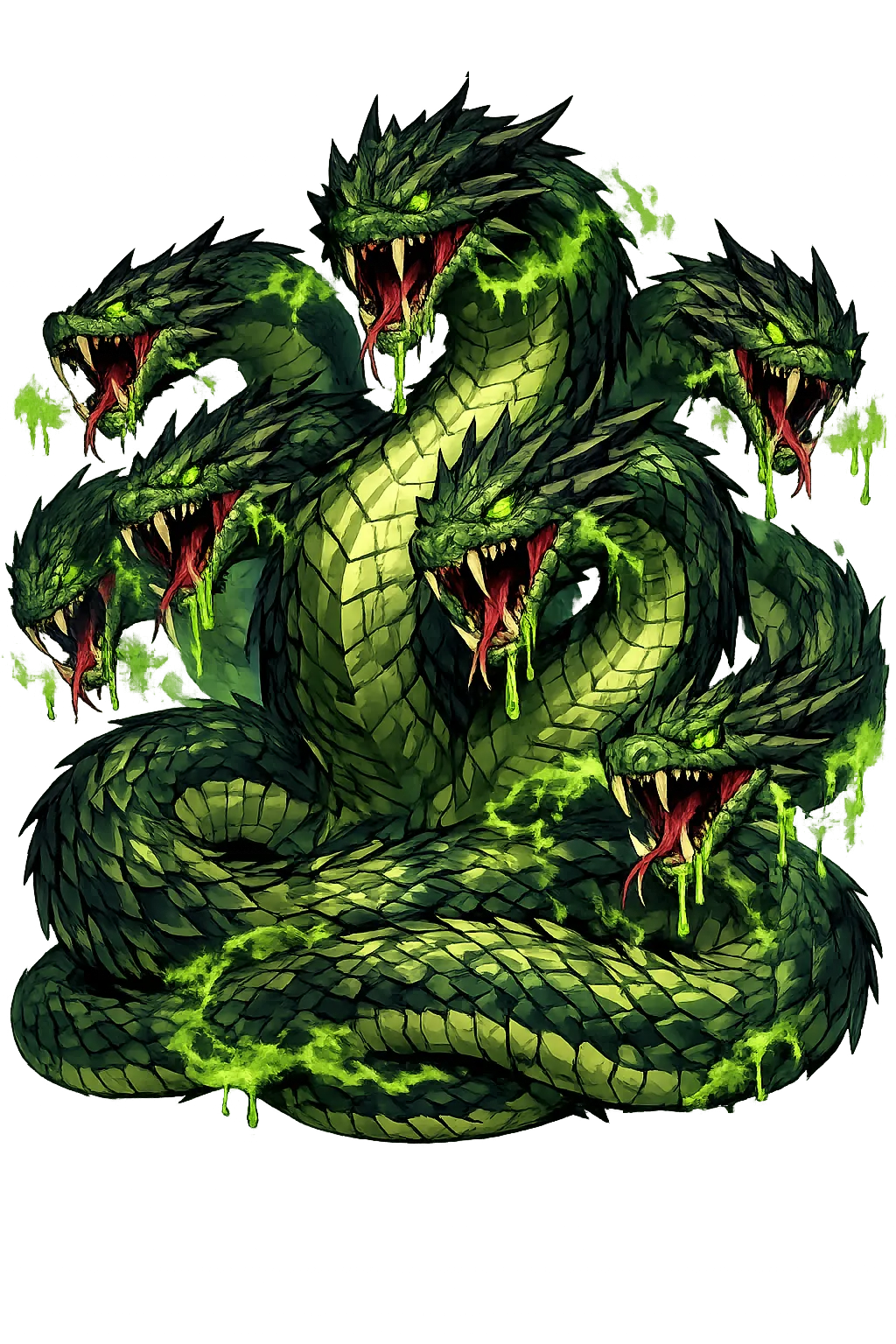
The labor was painted within a generation of the first Greek storytelling: Corinthian and Attic vase painters of the late seventh and sixth centuries BCE already show the full scheme — Herakles clubbing, Iolaos thrusting a burning brand at each fresh neck, Athena presiding with calm instruction. The earliest hydrai are modest, sometimes a single snake-head or three; the canonical many-headed beast is the painter's arithmetic, heads multiplying across centuries into a fan of hissing necks, while the crab Hērē sent nips at the hero's heel as her signature. The labor's most monumental ancient image is the metope of the Temple of Zeus at Olympia (c. 460 BCE): a still, broad composition — Iolaos with the torch, the coiled body underfoot — carved for a Panhellenic audience. Etruscan gems, South Italian vases and Roman mosaics repeat the trio to the empire's end. The monster individualizes less than the partnership, because the image's true subject was never the beast but the method that beat it.

06

Reception & Transformation

The name after its own age — transmission, translation, survival

Afterlives

The labor escaped its labor-cycle early. Hesiod names the Hýdra among Echidna's brood, and by Roman times the name was already an idiom of the intractable; Seneca's Hercules Oetaeus made the hydra's gall the instrument of the hero's end for the tragic stage. The medieval Ovide Moralisé folded the labor into moral allegory — the regenerating heads read as vices that multiply under clumsy attack — and Renaissance Europe restored the visual cycle with a vengeance: Antonio Pollaiuolo's small panel of Hercules and the Hydra (c. 1475, Uffizi) fixed the writhing silhouette for the printmakers whose labor-series spread the trio across every court. When Linnaeus catalogued the regenerating freshwater polyp in 1758, zoology absorbed the myth wholesale — testimony to how completely the image had detached from Argos. The journey runs one way: from marsh to moral emblem to scientific name, each age inheriting not the monster but the lesson that force alone feeds it.

Identifications Across Traditions

The Hydra has no independent cult but belongs to a broader Greek and Near Eastern tradition of multi-headed water serpents defeated by storm-gods or heroes. The Lernaean Hydra influenced later dragon lore, including medieval accounts of regenerating dragons. In modern biology, 'hydra' names a genus of freshwater cnidarian capable of remarkable regeneration — a scientific tribute to the myth. The constellation Hydra preserves the serpent in the southern sky.

Modern Legacy

'Hydra-headed' has become an idiom for any problem that grows worse when attacked. The monster appears in comic books, films, and political metaphors as the image of resilient, multiplying evil. Its scientific namesake, the hydra, makes the myth literal: a tiny animal that regenerates from fragments, immortal in its own small way.

07

The Meditation

What Hýdra means — beyond the dictionary

Hýdra is the lesson that some enemies cannot be defeated by the same energy that animates them. Cut a head and the body grows stronger; meet rage with rage and the conflict feeds itself. The myth recommends precision, partnership, and the right tool at the right moment.

Yet there is also humility in the labor. Herakles needs help. The greatest hero cannot do it alone. And one head remains unkillable, buried rather than destroyed — a reminder that some dangers are managed, not solved. The Hydra teaches both strategy and acceptance: fight with fire, but know that the immortal head still breathes beneath the stone.

08

Frequently Asked Questions

Common questions about Hýdra, Many-Headed Serpent, and Unicode restoration

01How do you pronounce Hýdra?

In reconstructed pronunciation, Hýdra is /hý.dra/ — approximately 'HOO-drah' — the first syllable is pitched high and begins with a rough 'h'; the final -a is short.

02What does Hýdra mean?

Hýdra means Water serpent in the greek tradition.

03What are the symbols of Hýdra?

Hýdra is associated with Serpent heads (Multiplicity, regeneration, and the seemingly endless forms of evil), Torch (The fire used by Iolaos to cauterize the stumps and prevent regrowth), Lerna swamp (Stagnant water as the breeding ground of plague and monster), Crab (The crab sent by Hera to harass Herakles during the combat).

04Why restore Hýdra in Unicode?

Plain ASCII hydra strips the stress, length, and script that make the name specific. Unicode restoration returns the name to its original written dignity.

05What is the most important myth about Hýdra?

“The Brood of Typhon and Echidna” — the Genealogy story that anchors the mythology of Hýdra, told in full on the lore page.

09

Scholarly Sources

The philological foundations of this restoration

Every claim on this page is grounded in established scholarship. The orthographic restorations follow disciplinary convention. The etymological chain follows the best available reference works. This is not invention — it is resurrection through scholarship.

◈

Lexicography & Philology

  • Liddell, H. G., Scott, R., & Jones, H. S. A Greek-English Lexicon. Oxford: Clarendon Press, 9th ed. 1996.
◎

Primary Texts

  • Hesiod
  • Apollodorus, Bibliotheca
  • Hesiod, Theogony 313–318, 333–335
  • Pausanias 2.36–37
  • Sophocles, Women of Trachis 555–581
◉

Archaeology & Art History

  • Material evidence — iconography, inscriptions, and temple archaeology — for Hýdra and related cults.
✦

Religious Studies

  • Beekes, Etymological Dictionary of Greek
Return

The Surface Awaits

You have traced the name from its earliest attestation to its Unicode restoration. Now return to the myth. The story is where the name lives.

Back to Lore
Hýdra mascot