
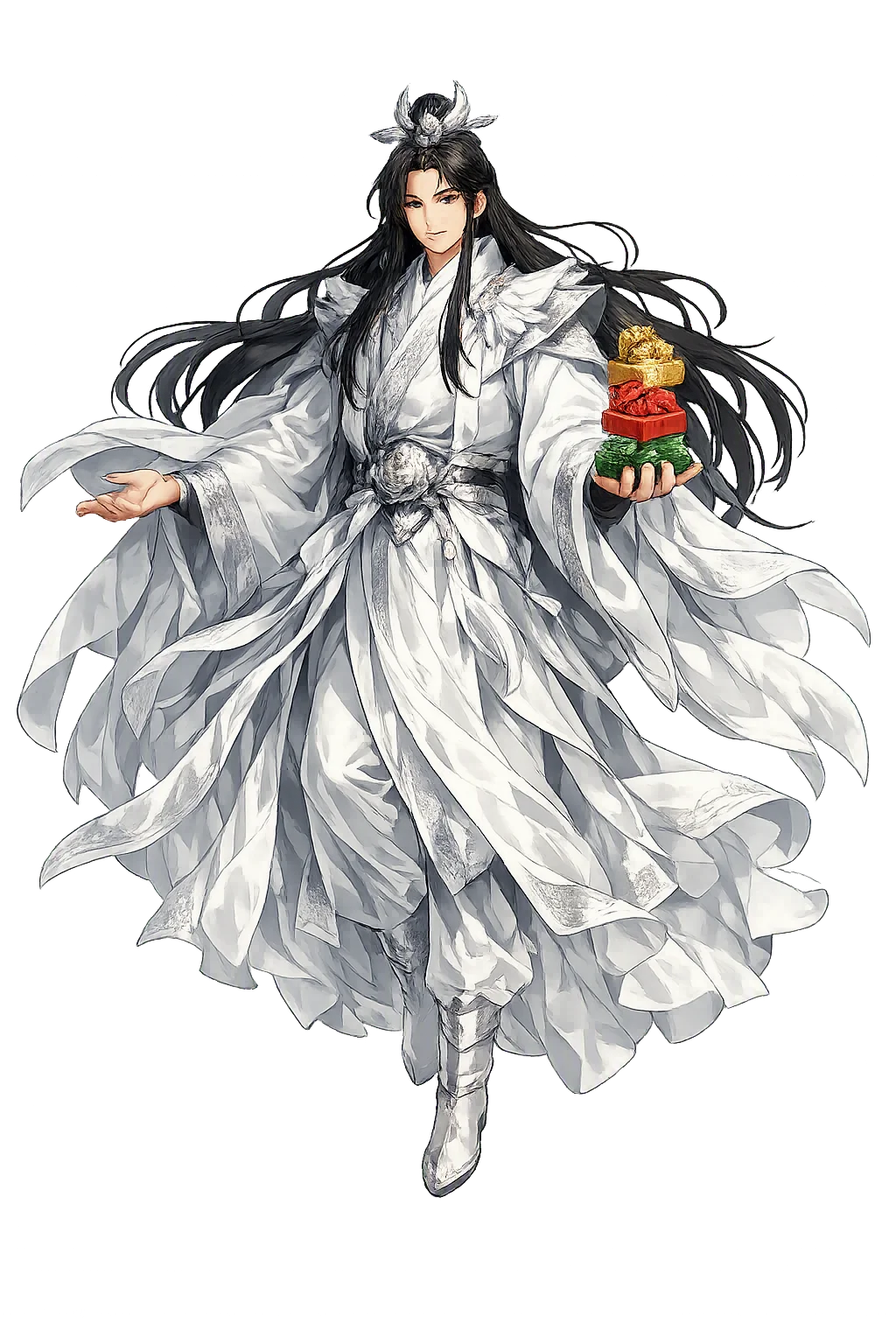
Hwanung: the stories first, then the spelling
Before the spelling, the story. Hwanung earns its restoration the old way — through what was actually told.
The Stories That Carry the Name
Three Thousand Follow One Prince. In the Samguk Yusa (Wanggok, 'Ancient Kingdoms' chapter), Hwanung, son of Hwanin — the Lord of Heaven — looks down upon the world of human beings and longs to govern it. He asks his father's leave; Hwanin grants him three heavenly seals and three thousand retainers, and the prince descends. His landing place is a sandalwood tree on the summit of Taebaek-san, where he founds the City of the Gods (Sin-si) and rules the affairs of humankind: wind, rain, cloud, and grain.
Wind, Rain, Cloud, and Grain. Hwanung's government is a civilisation kit. The Samguk Yusa credits him with teaching the people the fundamental arts: agriculture and the calendar, the loom and the making of clothing, the curing of disease, and the rules by which society lives. When drought strikes, he prays at the altar and the rains come.
Garlic and Mugwort for a Hundred Days. A bear and a tiger, sharing a cave, pray to Hwanung to become human. The prince gives them twenty cloves of garlic and a bundle of mugwort, commanding them to eat of these and stay out of the sunlight for one hundred days. The tiger cannot endure the dark and abandons the test; the bear obeys, and on the twenty-first day her dark hair falls away and she stands a woman — Ungnyeo, 'the bear-woman'.
And Here Is What the Spelling Preserves
At a Glance
- Restored name: Hwanung
- ASCII form: hwanung
- Meaning: "Heavenly prince"
- Domain of influence: Son of Heaven, Descended
- Pantheon: Korean
- Classification: Tier 2
- Original script: 환웅 (桓雄)
- Series: The Restoration Files, No. 222 of 548
The Name Travels
Confucian readers of the Joseon era found in Hwanung a model of hyo — the son who serves his father's will by governing well — and the Samguk Yusa itself, written by the monk Iryeon, frames the descent through Buddhist eyes as a bodhisattva-like mission of compassion toward suffering beings. Daoist parallels came easily: an immortal descending to a sacred mountain and founding a city of gods reads like the Korean cousin of the Queen Mother of the West's mountain courts.
The Address It Earned
The temple of Hwanung stands at /hwanung/ — lore, scholars, patterns — because a name carrying this much story deserves more than a parking page. One decisive feature survives — a single, honest mark — which places the restoration in Tier-2: exact, and exactly labeled.
The File Continues
Read the founding dispatch for the name's full story, the Resonance File for the archetype at work — or the whole archive in one sitting.
Continue the series — previous file: Huītzilōpōchtli (read it here) · next file: Hýdra (read it here).
The Restoration Files are written from the same canonical record as the temples themselves: the lexicon, the lore catalog, the pattern atlas, and the cited scholarly sources. If a file ever disagrees with its temple, the temple is right — tell us, and the file will be corrected.