PuniCodex

Extended Lore

환웅 (桓雄) Hwanung

Etymology · Orthography · Cult · Iconography · Reception · Sources

Tier 2 Hwanung
Hwanung — Son of Heaven, Descended
01

Quick Facts

Essential information about Hwanung, Son of Heaven, Descended

Original Script환웅 (桓雄)
Unicode RestorationHwanung
Reconstructed Pronunciation/hwa.nuŋ/
PantheonKorean
DomainSon of Heaven, Descended
MeaningHeavenly prince
ClassificationTier 2
Primary DomainHwanung
Sacred SymbolsSandalwood tree, Three heavenly seals, Wind, rain, clouds, grain, Clouds and mist
02

Etymology & Word Family

From original script to Unicode restoration

Original Script 환웅 (桓雄) Hwanung — "Heavenly prince"
Unicode Restoration Hwanung Canonical scholarly spelling — ASCII-identical
Modern ASCII hwanung Plain-ASCII fallback

The name Hwanung reaches the modern world through scholarly transliteration of the korean tradition. Because the conventional spelling uses only Latin letters, its Unicode and ASCII forms coincide — the tradition it carries is in the name itself, not in diacritics.

03

Unicode Character Breakdown

Character-by-character philological analysis

CharacterUnicodeNameBlockPhonetic Role
HU+0048Latin Capital Letter HBasic LatinSame, capitalized
wU+0077Latin Small Letter WBasic LatinSame
aU+0061Latin Small Letter ABasic LatinSame
nU+006ELatin Small Letter NBasic LatinSame
uU+0075Latin Small Letter UBasic LatinSame
nU+006ELatin Small Letter NBasic LatinSame
gU+0067Latin Small Letter GBasic LatinSame

The Tier 2 classification here reflects fidelity to the attested tradition, not recovered diacritics: every character of Hwanung already survives in ASCII. What the restoration preserves is the canonical spelling itself — the form scholarship standardised.

04

Cult & Worship

How the sacred was kept — rites, sanctuaries, remains

The Cult

No ancient cult of Hwanung is directly attested. The myth records him as the son of Hwanin who descends to earth to found a sacred city on Taebaeksan; this narrative later licensed mountain rituals rather than documented temples. The Chamseongdan altar on Taebaeksan, rebuilt in stone in later centuries, and the larger Chamseongdan on Manisan, Ganghwa Island, became sites where Korean kings offered sacrifice to Heaven. These rites are ancestral to Hwanung's story rather than proof of it: they show a long tradition of heavenly descent mythology that the Samguk Yusa later attached to his name.

In the Earth

No artefact names Hwanung: the myth's only early witness is textual, in Iryeon's Samguk Yusa of 1281, which preserves older oral and ritual material. The material anchor is the ritual landscape. The Chamseongdan — 'altar of the heavenly deity' — on Taebaeksan, rebuilt in stone in later centuries, marks the traditional descent site, and the great Chamseongdan on Manisan, Ganghwa Island, where Joseon kings performed the state sacrifices, stands in the same cultic geography. In 1993–94 North Korea reconstructed the supposed mausoleum of Dangun at Kangdong near Pyongyang as a monumental shrine. Modern reenactments at Taebaeksan each Gaecheonjeol give the myth a living present: the mountain itself, not any object, is the evidence Koreans point to.

05

Iconography

How Hwanung was imaged across the ages

The Image

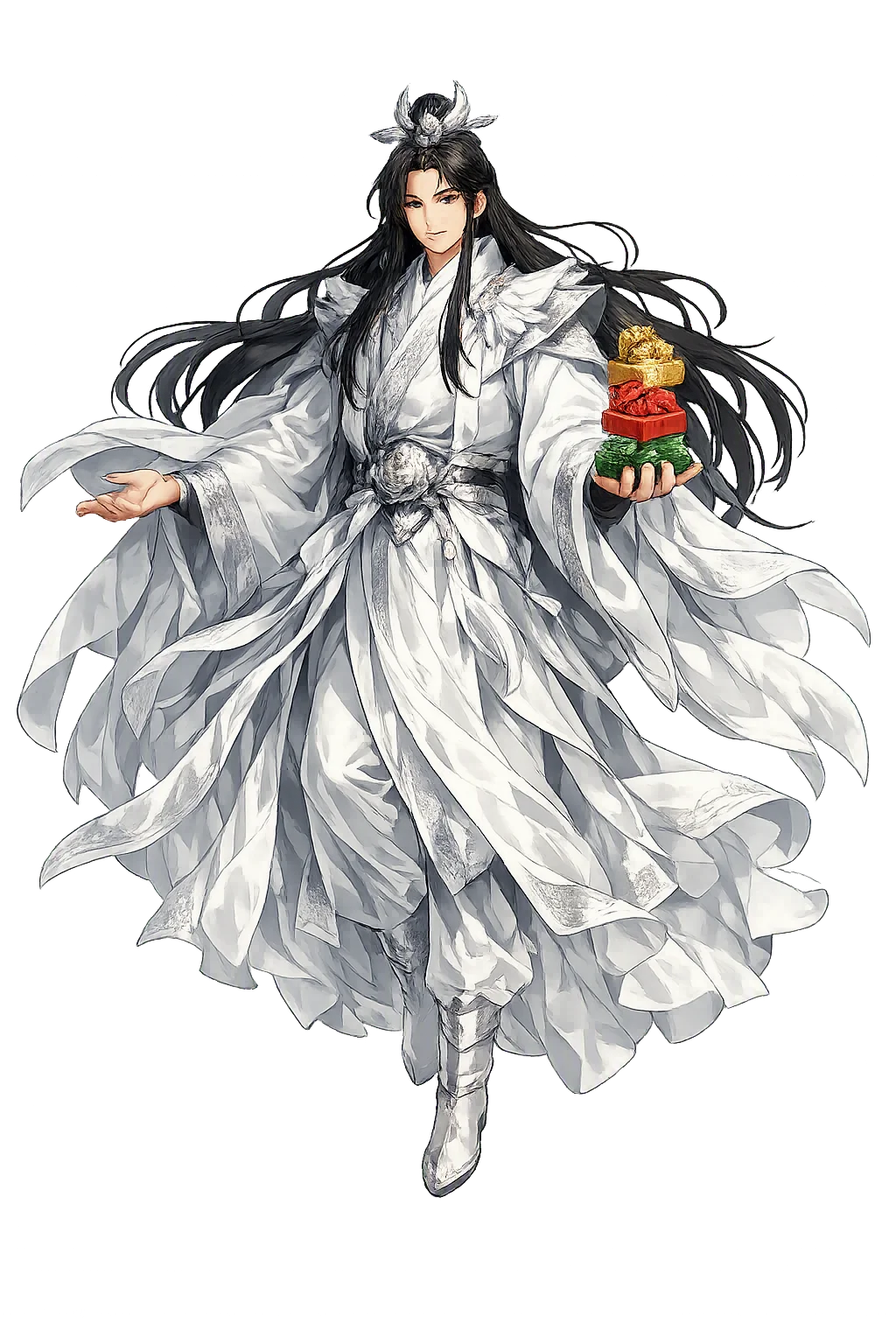
Hwanung has no pre-modern iconography. The Goguryeo tomb murals of the fourth to sixth centuries CE depict celestial beings, sun-and-moon riders, and mountain deities in a cosmology compatible with the myth of descent from heaven, but none are labeled Hwanung. Later visualization is modern and nationalist: illustrations of the descent to Taebaeksan, altar reconstructions at Chamseongdan, and didactic imagery for National Foundation Day. The figure remains a narrative presence whose visual tradition was invented long after the myth was written.

06

Reception & Transformation

The name after its own age — transmission, translation, survival

Afterlives

Hwanung appears only in Iryeon's 1281 Samguk Yusa, which preserves a medieval Korean account of the descent from heaven. The story served Joseon Confucian state ritual, for which the Manisan Chamseongdan became the main altar for offerings to Heaven. In the modern period, Hwanung was folded into nationalist historiography as the divine ancestor of the Korean people and the father of Dangun. North and South Korean scholarship have produced competing readings: the former treats the myth as literal ancient history, the latter as a foundation legend shaped by medieval and colonial imagination. His name also circulates in Korean Christian theology, where the heavenly descent has been read as a prefiguration of incarnation. Hwanung's afterlife is thus textual, ritual, and deeply political.

Identifications Across Traditions

Confucian readers of the Joseon era found in Hwanung a model of hyo — the son who serves his father's will by governing well — and the Samguk Yusa itself, written by the monk Iryeon, frames the descent through Buddhist eyes as a bodhisattva-like mission of compassion toward suffering beings. Daoist parallels came easily: an immortal descending to a sacred mountain and founding a city of gods reads like the Korean cousin of the Queen Mother of the West's mountain courts. Under the twentieth century the story was nationalised: the religion of Daejonggyo, founded in 1909, worships Hwanin, Hwanung, and Dangun as a trinity, and Korean nationalists dated events by the Dangun calendar; in North Korea the reconstructed tomb of Dangun at Kangdong (1994) claims the lineage for the state. What began as a monk's charter became a modern identity.

Modern Legacy

Hwanung's legacy is celebrated every 3 October, Gaecheonjeol — 'Festival of the Opening of Heaven' — when the descent is reenacted at the Chamseongdan altars, most famously on Taebaeksan, the traditional landing site, and at the Manisan Chamseongdan on Ganghwa Island, where Joseon kings once offered prayer. The myth anchors Korean educational culture: foundation pageants, museum dioramas, and school curricula from Seoul to Pyongyang stage the bear's transformation and the descent beneath the sandalwood. The name lives on in institutions — universities, mountain lodges, cultural foundations — and in the phrase 'Dangun minjok', the Dangun nation, still current in identity discourse. Few foundation myths anywhere remain so busy: thirteen centuries after Iryeon wrote it down, the story of the prince who asked to come down still organises how Koreans imagine where they come from.

07

The Meditation

What Hwanung means — beyond the dictionary

Hwanung is the ruler who asked permission to rule. Other founding myths in the neighbourhood begin with conquest, theft, or disaster; the Korean charter begins with a request. The prince sees the suffering world below, petitions his father, and descends not as master but as delegate — carrying seals, not a sword. His myth quietly proposes a theory of government: authority is legitimate only when it is asked for on behalf of others, and it is proven only by service — rain prayed down in drought, medicine taught, law spoken. Even his marriage to the bear-woman follows the same grammar: he answers a prayer. The myth thus remembers civilisation itself as a response to need. In an age that too often treats power as a prize, the heavenly prince who knelt to be sent is a quietly radical ancestor.

08

Frequently Asked Questions

Common questions about Hwanung, Son of Heaven, Descended, and Unicode restoration

01How do you pronounce Hwanung?

In reconstructed pronunciation, Hwanung is /hwa.nuŋ/ — approximately 'HWAH-noong' — the second syllable ends in a velar nasal, like the 'ng' in 'song'. The capitalised form marks the heavenly prince as a proper noun.

02What does Hwanung mean?

Hwanung means Heavenly prince in the korean tradition.

03What are the symbols of Hwanung?

Hwanung is associated with Sandalwood tree (The axis at the descent place that links Hwanin's heaven to the Korean earth.), Three heavenly seals (Tokens of delegated sovereignty that authorise Hwanung to rule the human realm.), Wind, rain, clouds, grain (The cosmic departments over which Hwanung presides as culture-bringer.), Clouds and mist (The celestial medium through which the heavenly prince travels between realms.).

04Why restore Hwanung in Unicode?

Hwanung is written entirely in ASCII letters, so its restoration is about canonical fidelity rather than recovered diacritics: the temple fixes the name in its scholarly standard spelling, attested in the source tradition, instead of leaving it to drift.

05What is the most important myth about Hwanung?

“Three Thousand Follow One Prince” — the The Descent story that anchors the mythology of Hwanung, told in full on the lore page.

09

Scholarly Sources

The philological foundations of this restoration

Every claim on this page is grounded in established scholarship. The orthographic restorations follow disciplinary convention. The etymological chain follows the best available reference works. This is not invention — it is resurrection through scholarship.

◈

Lexicography & Philology

  • Samguk Yusa
  • Korean folklore
◎

Primary Texts

  • Primary sources in the korean tradition for Hwanung.
◉

Archaeology & Art History

  • Material evidence — iconography, inscriptions, and temple archaeology — for Hwanung and related cults.
✦

Religious Studies

  • Iryeon, Samguk Yusa (Memorabilia of the Three Kingdoms), 1281; English trans. Ha Tae-Hung and Grafton K. Mintz (1972).
  • Lee, Peter H., ed., Sourcebook of Korean Civilization, vol. 1 (Columbia University Press, 1993).
  • Grayson, James H., Korea: A Religious and Cultural History (Routledge, 2002).
Return

The Surface Awaits

You have traced the name from its earliest attestation to its Unicode restoration. Now return to the myth. The story is where the name lives.

Back to Lore
Hwanung mascot