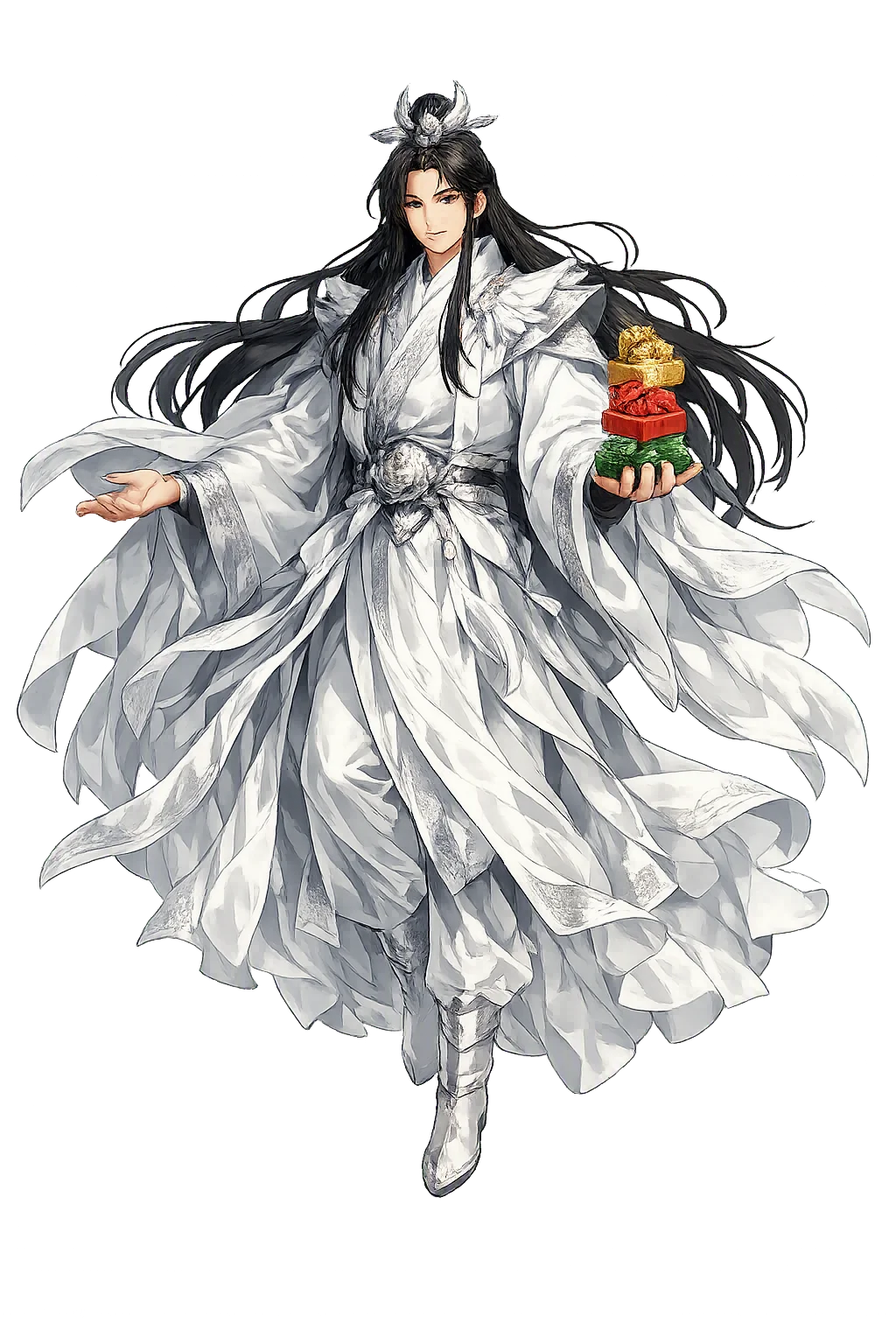
Stories of Hwanung
Hwanung's cycle, preserved in the Samguk Yusa, is the founding charter of Korean civilisation: a heavenly prince descends with seals of delegated authority, teaches law, medicine, and agriculture, and fathers Dangun, first king of the Korean people. The myth binds kingship to cosmic order and anchors the nation to a sacred mountain.
In the Samguk Yusa (Wanggok, 'Ancient Kingdoms' chapter), Hwanung, son of Hwanin — the Lord of Heaven — looks down upon the world of human beings and longs to govern it. He asks his father's leave; Hwanin grants him three heavenly seals and three thousand retainers, and the prince descends. His landing place is a sandalwood tree on the summit of Taebaek-san, where he founds the City of the Gods (Sin-si) and rules the affairs of humankind: wind, rain, cloud, and grain. The descent is not exile but delegation: Hwanung carries his father's mandate, and the seals he bears are the charter of his rule. The myth establishes the Korean pattern of legitimate sovereignty — authority descends from heaven only when a worthy agent asks for it, and it binds the ruler to care for harvests, health, and law rather than to mere dominion.
Hwanung's government is a civilisation kit. The Samguk Yusa credits him with teaching the people the fundamental arts: agriculture and the calendar, the loom and the making of clothing, the curing of disease, and the rules by which society lives. When drought strikes, he prays at the altar and the rains come. His company of three hundred and sixty officers mirrors the round of the year — a bureaucracy as cosmic as it is political. The same chapter-cycle remembers him as judge of the boundary between human custom and animal nature: in the tale of the woodcutter who married a tigress, whose son's filial trials reach Hwanung's tribunal, the prince weighs a son's duty against a mother's beasthood and finds for the human claim. The myth's claim is total: nothing in Korean life — food, cloth, health, justice — stands outside the mandate the prince brought down from heaven.
A bear and a tiger, sharing a cave, pray to Hwanung to become human. The prince gives them twenty cloves of garlic and a bundle of mugwort, commanding them to eat of these and stay out of the sunlight for one hundred days. The tiger cannot endure the dark and abandons the test; the bear obeys, and on the twenty-first day her dark hair falls away and she stands a woman — Ungnyeo, 'the bear-woman'. She has no husband, and prays beneath the sandalwood tree for a child; Hwanung hears her prayer, joins with her, and she bears a son, Dangun. Only one account preserves this narrative in full — the Samguk Yusa of 1281, itself compiling much older material — but its symbolism is transparent: endurance and obedience to the prescribed rite transform the beast, impatience forfeits the prize. The bear who becomes the mother of the nation is Korean myth's charter for the virtue of perseverance.
Dangun grows to found Gojoseon — 'Old Joseon' — and the chronicle tradition, carried by the Samguk Yusa from the Tongguk t'onggam, dates his accession to the year corresponding to 2333 BCE, still celebrated as the founding of the Korean nation. He rules, the sources say, for some fifteen hundred years, until the age of Jizi (Kija), the righteous minister of the Chinese Shang, brings a rival civilisation to the peninsula; then Dangun withdraws from rule and becomes a mountain god (sansin), the guardian numen of the heights. The withdrawal completes the cycle his father began: heaven descended in Hwanung, walked the earth in Dangun, and returned to the mountains as the protective spirit of the land itself. The myth performs the classic work of foundation charters — it converts geography into genealogy, making the Korean landscape the body of a single divine family.
descended bringer of law, grain, and civilisation
Hwanung is the heavenly prince who descends from Hwanin's court to bring law, grain, and the arts of civilisation to earth. In the Samguk Yusa he carries three heavenly seals, founds a sacred city beneath a sandalwood tree, and fathers Dangun, first king of the Korean people.
Hwanung carries the authority of heaven as the delegate of his father, the Lord of Heaven.
He descends beneath a sandalwood tree on a high mountain, the sacred entry point between heaven and earth.
He teaches the people law, grain, medicine, and the crafts that define civilised life.
His union with Ungnyeo produces Dangun, the first ancestor and king of the Korean people.
From the original script to the living URL
환웅 (桓雄)
The name in its original Korean form. Hwanung (환웅 (桓雄)) is attested in the source tradition — “Heavenly prince”. Its original diacritics and script distinctions carry the full phonetic and orthographic weight of the source tradition.
hwanung
The plain hwanung form is identical to the Unicode restoration. Because this name is already written in Latin letters, no diacritics, stress, or script information were lost — only capitalization differs.
Hwanung
The Unicode restoration does not need to recover lost marks for Hwanung. Its value is canonical spelling and consistent cataloguing, not the reconstruction of erased orthography. The domain is readable as-is to both DNS and humanity.
Hwanung.com
This restoration is written entirely in ASCII letters — no Punycode encoding stands between Hwanung and the DNS. The domain reads identically to machines and to human eyes.
Owned, ideal, and ASCII forms of Hwanung
Hwanung
Restores 환웅 (桓雄). The full Unicode restoration. hwanung.com is not in the PuniCodex collection — it is watched for release; if it drops, this temple upgrades to an owned flagship.
How Hwanung was spoken
How Hwanung travels from ancient script to the modern URL
The lore you have read is the living myth. Extended Lore opens the scholarly vault beneath it: the cult and its material remains, a history of the image, the name after antiquity, a meditation on what the name still means, and the full scholarly apparatus — etymology, orthography, sources.
Enter Extended Lore