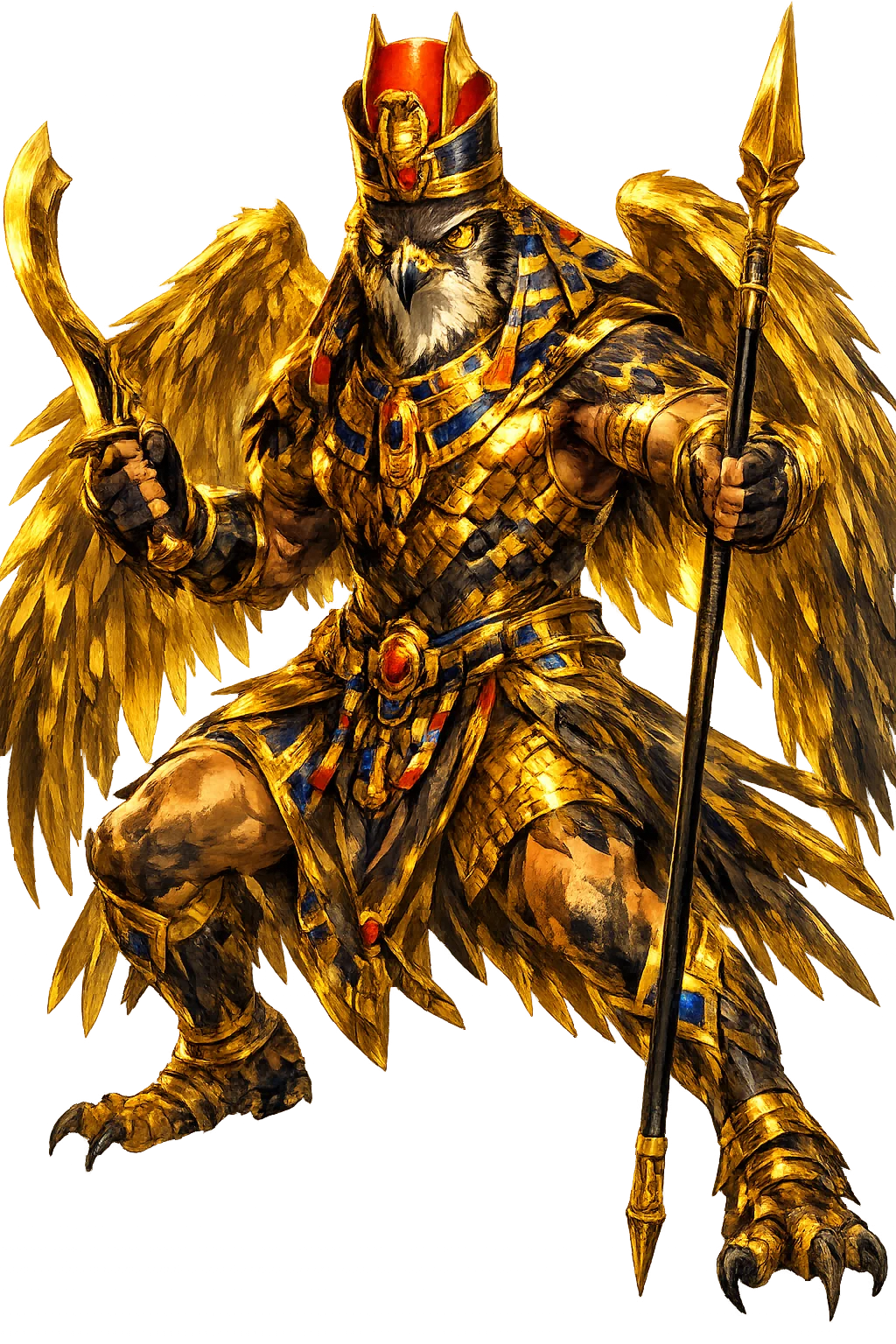
Stories of Ḥr
Horus's mythology is the political theology of Egypt made personal. It tells how the rightful heir, born from a murdered father and a resourceful mother, defeats the usurper and restores the throne. The story was never merely entertainment; it was the charter of kingship, replayed in temples for three thousand years.
Two falcons answer to the name Ḥr, and the Egyptians rarely troubled to separate them. Horus the Elder (Ḥr-wr) is the primordial sky of the Pyramid Texts, brother of Osiris and Set, whose eyes are the sun and the moon — when he weeps, the Nile rises. Horus the Younger (Ḥr-pꜣ-ꜥd, 'Horus the child') is the son of Osiris and Isis, avenger of his father. By the New Kingdom the two had merged into a single royal figure: the Horus of Edfu is at once the ancient sky and the young heir. The fusion was not confusion but policy — the king's god had to be older than creation yet younger than his own succession. The myth means that legitimacy in Egypt drew on two wells, antiquity and inheritance, and Horus drew from both.
When Set murders Osiris and seizes the throne, the infant Horus is hidden in the Delta marshes of Chemmis, guarded by Isis and the scorpion Serqet. Grown to manhood, he claims his inheritance, and the dispute goes before the Ennead. The New Kingdom satire The Contendings of Horus and Set (Papyrus Chester Beatty I) turns the cosmic lawsuit into eighty years of grotesque trials: the hippopotamus duel in the river's depths, the shameful episode of the lettuce, Isis disguised as a maiden tricking Set into judging against himself, and the tribunal's own judges oscillating 'like lunatics.' Set tears out Horus's eyes; at last the verdict favours legitimacy over force, and the gods divide the inheritance — Horus the black land, Set the desert. Plutarch retells the whole contest in Greek (De Iside 19–20), already calling it ancient. The myth is Egypt's constitution in narrative form: the crown follows the bloodline of Osiris, and chaos must settle for the frontier.
Set's violence costs Horus his eye — the Pyramid Texts already know the motif (Utterance 478: Horus recovers the wedjat-eye from Set). The eye is buried and sprouts lotuses; Ḏḥwtj heals it, or the goddess Hathor restores it with gazelle's milk, and it becomes the wedjat, 'the whole one.' Later tradition mapped the eye's six parts onto the fractions 1/2, 1/4, 1/8, 1/16, 1/32, and 1/64 — summing to 63/64, the missing sixty-fourth supplied by Thoth's magic, an emblem of the ineradicable remainder that only speech completes. From the gods the restored eye passes to the dead: painted on mummies and worn as amulets from the Middle Kingdom onward, it is Egypt's supreme sign of protection. The myth teaches that what violence breaks, order can make whole again — and that wholeness, not victory, is the true spoil of the war with chaos.
From the Narmer Palette onward the falcon stands behind the king's head, and the serekh — the palace-façade frame holding the Horus-name — is the oldest element of the royal titulary, older than the cartouche. The theology is a relay: the dead pharaoh becomes Osiris, his successor becomes the new Horus, and every coronation re-runs the original victory over Set (Pyramid Texts, Utterance 570, already address the king as 'this Horus'). In life the king is 'the Living Horus,' son of Isis and Osiris by adoption into the divine household. At Edfu, the best-preserved temple in Egypt, the walls still stage the drama annually: the 'Triumph of Horus' over Set and his followers, complete with sacred barque and a hippopotamus of wax. The myth converts politics into cosmology: every reign is the restoration of order, and every usurper a reincarnation of the desert.
The temple of Edfu preserves a myth found nowhere else in this form: Horus of Edfu — Behdety, 'He of the winged disk' — takes the form of the sun's winged disk to hunt the followers of Set who hide in the northern marshes. From the sky he burns them with fire; Set himself is speared and bound, his allies dismembered among the rushes. The king's earthly enemies are written into the drama as the god's enemies, so that every victory of Horus at Edfu is simultaneously a victory of pharaoh. The myth's afterlife is iconographic: from the New Kingdom to the Roman period the winged sun-disk flies above temple gates across Egypt and beyond — an airborne talisman of royal power that sees everywhere and strikes from above. It is the falcon's-eye view of kingship made permanent over every doorway: the sky-god's body become a sign of passage and protection.
Sky · Kingship · Falcon
Ḥr is the falcon of the sky, whose eyes are the sun and the moon, whose wings outspread are the heavens, and whose incarnation on earth is the living pharaoh. He is not one god but a constellation of related gods — Horus the Elder, the primordial sky; Horus the Younger, son of Osiris and Isis; and Re-Horakhty, the solar synthesis. Through all his forms he stands for one thing: legitimate authority defending cosmic order against chaos.
Horus soars across the heavens; his right eye is the sun, his left the moon, and his body the luminous air.
Every pharaoh is the 'Living Horus'; the Horus-name is the first and oldest of the five royal names.
The lanner or peregrine falcon — swift, far-seeing, and deadly — is Horus's living embodiment.
The restored eye of Horus is Egypt's supreme symbol of protection, wholeness, and royal health.
From the original script to the living URL
𓅃
The name in its original Egyptian form. Ḥr (𓅃) is attested in the source tradition — “The Distant One (Egyptian ḥr)”. Its emphatic consonants carry the full phonetic and orthographic weight of the source tradition.
horus
Reduced to plain horus, the name loses everything that made it specific: emphatic consonants. What remains is an ASCII string that machines can parse but that no longer speaks with its original voice.
Ḥr
The Unicode restoration recovers what ASCII flattened. Ḥr restores emphatic consonants, returning the name to its original written dignity. The domain encodes to Punycode, but the browser displays the truth.
Ḥr.com → xn--r-xnm.com
The non-ASCII characters in Ḥr are encoded while the ASCII remains visible. To the DNS, it is Punycode. To humanity, it is Ḥr.
Owned, ideal, and ASCII forms of Ḥr
Ḥr
Restores 𓅃. The live temple domain — ḥr.com.
horus
Flattens 𓅃. The plain ASCII fallback — what DNS and legacy systems see.
How Ḥr was spoken
How Ḥr travels from ancient script to the modern URL
Egyptian Ḥr; the original vocalisation is unknown. The name probably means “the distant/far one", perhaps referring to the soaring falcon.
Sky, Kingship, Falcon
The Unicode restoration Ḥr uses Egyptological characters registrable in .com; hieroglyphs are outside the .com IDN table.
The lore you have read is the living myth. Extended Lore opens the scholarly vault beneath it: the cult and its material remains, a history of the image, the name after antiquity, a meditation on what the name still means, and the full scholarly apparatus — etymology, orthography, sources.
Enter Extended Lore