PuniCodex

Extended Lore

Ḥr — The Deeper Record

Etymology · Orthography · Cult · Iconography · Reception · Sources

Preserves distinctive marks Ḥr.com
Ḥr — Sky, Kingship, Falcon
01

At a Glance

Ḥr — every fact links to its home

PantheonEgyptian
DomainSky, Kingship, Falcon
Original Script𓅃 →
Primary Sources6 cited →
02

Etymology & Word Family

From original script to Unicode restoration — the full etymology page →

Original Script 𓅃 Ḥr — "The Distant One (Egyptian ḥr)"
Unicode Restoration Ḥr Restored stress, length, and script
Modern ASCII horus Plain-ASCII fallback

From Egyptian ḥr, written with the falcon sign and interpreted as 'the distant/high one' or 'falcon'; the original vowels are not recorded in hieroglyphs.

03

Unicode Character Breakdown

Character-by-character philological analysis

CharacterUnicodeNameBlockPhonetic Role
ḤU+1E24Latin Capital Letter H with Dot BelowUnknownH-with-dot: voiceless pharyngeal
—N/ADropped characterEgyptian orthographyDropped: vowel not written
rU+0072Latin Small Letter RBasic LatinSame
—N/ADropped characterEgyptian orthographyDropped: vowel not written
—N/ADropped characterEgyptian orthographyDropped: not in standard

The restoration of Ḥr preserves what it can of the original phonology — stress and vowel length for Greek names, distinctive letters and diacritics for every other tradition.

04

Cult & Worship

How the sacred was kept — rites, sanctuaries, remains

The Cult

Ḥr's cult outlasted every rival theology of the ancient world. The oldest centre was Nekhen, Hierakonpolis, where excavations exposed a Predynastic temple court to the falcon. In the Ptolemaic temple of Edfu, built 237 to 57 BCE and the best-preserved in Egypt, colleges of wab-priests and lectors enacted the daily awakening of the god, washing, clothing, and feeding the cult image in the sanctuary's seclusion.

The calendar's high feast was the Beautiful Reunion (heb nefer): Hathor of Dendera journeyed to Edfu, and their union, celebrated on the temple roof, renewed the kingship each year. Outside the temple, Horus healed: Horus-cippi, stelae showing the god standing on crocodiles and gripping snakes, stood at thresholds and in houses, and water poured over the inscribed spells was drunk as medicine, the rite behind the great Metternich Stela (Metropolitan Museum of Art). When the last temple on Philae closed under Justinian, around 537 CE, the falcon's liturgy had run, with interruptions and revivals, for some three millennia, a continuity nothing else in this catalogue approaches.

In the Earth

The falcon-god Horus is attested from the earliest dynastic period: the Narmer Palette shows a falcon protecting the king, and the serekh with Horus-name became the oldest royal titulary. The temple of Horus at Edfu, built during the Ptolemaic period, preserves the longest surviving ancient Egyptian temple inscription, including the myth of Horus defeating Set. Falcon mummies and votive falcon coffins have been found at Saqqara, Abydos, and Hierakonpolis — the latter city being Horus's ancient cult center.

05

Iconography

How Ḥr was imaged across the ages

The Image

The falcon was his first portrait, and it never stopped being made. Already in the late Predynastic age the Hierakonpolis colossus, a monumental limestone bird now in the Ashmolean Museum, Oxford, shows the god as pure bird.

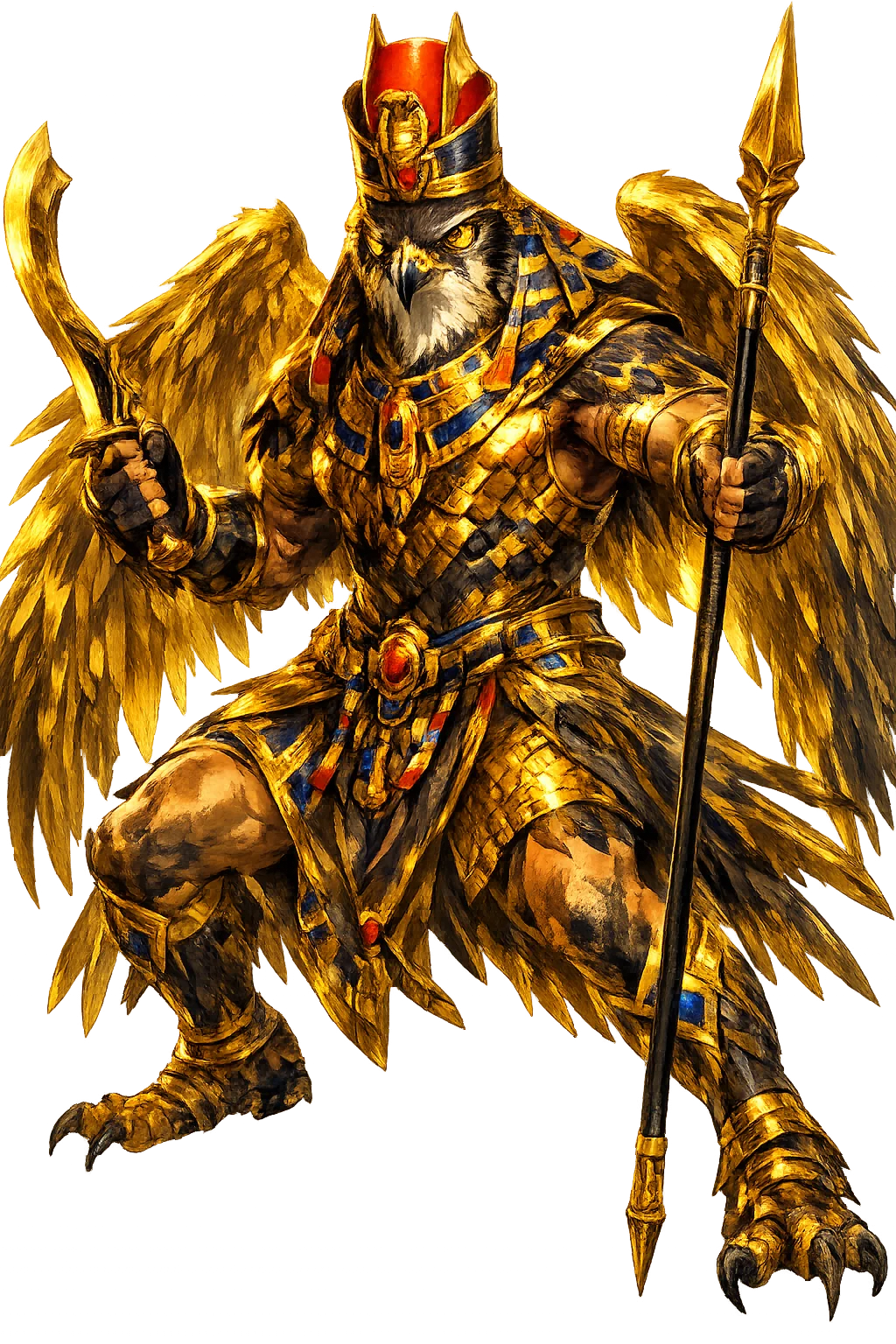
The Old Kingdom added tenderness: on Khafre's diorite statue (Egyptian Museum, Cairo, c. 2500 BCE) the Horus falcon spreads its wings behind the king's head, sheltering the royal body with its own. Thereafter the composite form dominates, the falcon-headed man wearing the double crown of the united Two Lands, or the solar disk as Horakhty, his enemies pinned beneath his feet. Temple avenues bristled with falcon statuary, a colossal granite example of which stands in the Louvre, and from the Late Period the Horus-cippus made the protective image a household object, mass-produced in stone for doorposts and walls.

06

Reception & Transformation

The name after its own age — transmission, translation, survival

Afterlives

Europe met Ḥr late, and the meeting changed both sides. The bridge was Plutarch's De Iside et Osiride (c. 100 CE), which carried the Osiris-Horus cycle into Greek; for eighteen centuries it was the only continuous narrative of the myth the West possessed.

Early-modern Europe read the falcon through fantasy: Athanasius Kircher's Oedipus Aegyptiacus (1652–1654) drowned genuine signs in confident invention. Champollion's decipherment (Lettre à M. Dacier, 1822; Grammaire, 1836–1841) returned the falcon to history: every royal titulary opens with a Horus-name, so Egyptology itself begins, literally, with Horus.

Napoleon's savants published the temples in the Description de l'Égypte (1809–1829); Edfu's relief program, the largest surviving corpus of Egyptian temple texts, is today being translated in full by Dieter Kurth's Edfu project (1998– ). The wedjat's sixty-three sixty-fourths meanwhile found a second career among historians of mathematics, Richard Gillings' Mathematics in the Time of the Pharaohs (1972) giving the fraction series its modern readership. And Gardiner's sign-list made the falcon on its perch the first portrait every student of the language learns.

Identifications Across Traditions

Horus absorbed and was absorbed by many gods. As Re-Horakhty he united the falcon with the solar disk; as Harpocrates he became the finger-to-lips divine child of Greco-Roman Egypt; as Sokar and Montu he shared falcon imagery with other deities of death and war. Plutarch's De Iside et Osiride transmitted the Osiris-Horus myth to the Greek and Roman world, where it influenced conceptions of divine sonship and resurrection. Some later interpreters, from early Christians to modern comparative mythologists, have drawn parallels between Horus and other divine-child figures, though many of these claims are exaggerated or unsupported by Egyptian evidence.

Modern Legacy

The Eye of Horus is arguably the most widely recognised symbol of ancient Egypt. It appears on jewellery, tattoos, amulets, and corporate logos across the globe, usually as a generic sign of protection. In popular culture, Horus features in films, comics, and games as a falcon-headed warrior or sky-god. For modern Kemetics and Egyptian pagans, Horus remains a living deity of kingship, justice, and rightful authority. The name has also entered astronomy: the asteroid 1924 Horus reminds us that the distant one still watches from above.

09

The Original Script Note

What the written record preserves — and what it does not

Original Script

The name ḥr is written with the falcon-on-perch hieroglyph (Gardiner G5), often used as a logogram for the god himself. The initial ḥ is a voiceless pharyngeal fricative; the final r is an alveolar liquid. Because Egyptian does not write vowels, the pronunciation has to be reconstructed from Coptic forms such as ϩⲱⲣ and from Greek Ὧρος. The meaning 'distant one' or 'one on high' is well attested.

10

The Meditation

What Ḥr means — beyond the dictionary

Horus is the god of the long view. The falcon sees what the ground-dweller cannot; the king must see beyond his own reign. To call on Horus is to remember that authority is not merely power but rightfulness — the triumph of ma'at over isfet, of inheritance over usurpation, of the whole over the torn.

The myth of Horus and Set is not a simple story of good versus evil. In some periods Set was the protector of Re's bark; in others he was the murderer of Osiris. The conflict is structural: order and disorder are relatives, not strangers, and their contention is what keeps the world awake. Horus wins not because he is strongest but because he is legitimate. That is the Egyptian lesson: cosmic order is maintained not by force alone but by the recognition of rightful place. The restored eye is the image of that order — broken, then made whole, then worn as a pledge that wholeness can be recovered.

11

Screen & Culture

Where Ḥr echoes through film, television, and games — and how

12

Frequently Asked Questions

Deep-dives into the cult, attestation, reception, and sources of Ḥr

01How do we know how Ḥr was worshipped?

The falcon-god Horus is attested from the earliest dynastic period: the Narmer Palette shows a falcon protecting the king, and the serekh with Horus-name became the oldest royal titulary. The full cult record →

02Where do the earliest attestations of Ḥr come from?

The record rests on Faulkner, The Ancient Egyptian Pyramid Texts, Wörterbuch der ägyptischen Sprache (Wb), ḥr, Gardiner, Egyptian Grammar, among 10 cited works. The full source apparatus →

03How did later traditions reinterpret Ḥr?

Europe met Ḥr late, and the meeting changed both sides. Reception & transformation →

04What do the surviving images of Ḥr actually show?

The falcon was his first portrait, and it never stopped being made. The iconography →

05What does the written record of Ḥr actually preserve?

The name ḥr is written with the falcon-on-perch hieroglyph (Gardiner G5), often used as a logogram for the god himself. The Original Script note →

13

Scholarly Sources

The philological foundations of this restoration

Every claim on this page is grounded in established scholarship. The orthographic restorations follow disciplinary convention. The etymological chain follows the best available reference works. This is not invention — it is resurrection through scholarship.

◈

Lexicography & Philology

  • Faulkner, R. O. A Concise Dictionary of Middle Egyptian. Oxford: Griffith Institute, 1962.
  • Wb
◎

Primary Texts

  • Faulkner, The Ancient Egyptian Pyramid Texts
  • Plutarch, De Iside et Osiride 12–20
  • Pyramid Texts, Utterance 478 (Horus recovers the wedjat eye from Seth)
  • Pyramid Texts, Utterance 570 (the king identified with Horus)
  • Book of the Dead, Spell 125 (Horus presents the justified to Osiris)
  • Metternich Stela / Horus Cippi (healing and protective heka of Horus)
◉

Archaeology & Art History

  • Robins, G. The Art of Ancient Egypt; Hornung, E. Conceptions of God in Ancient Egypt.
✦

Religious Studies

  • Wörterbuch der ägyptischen Sprache (Wb), ḥr
  • Gardiner, Egyptian Grammar
  • Allen, Genesis in Egypt
  • The Contendings of Horus and Set (Papyrus Chester Beatty I)
Return

The Surface Awaits

You have traced the name from its earliest attestation to its Unicode restoration. Now return to the myth. The story is where the name lives.

Back to Lore
Ḥr mascot