PuniCodex

Extended Lore

𓅃 Ḥr

Etymology · Orthography · Cultural Legacy · Reception · Primary Sources

Tier 1 Ḥr.com
Ḥr — Sky, Kingship, Falcon
01

Quick Facts

Essential information about Ḥr, Sky, Kingship, Falcon

Original Script𓅃
Unicode RestorationḤr
Reconstructed Pronunciation/ˈħaːru/
PantheonEgyptian
DomainSky, Kingship, Falcon
MeaningThe Distant One (Egyptian ḥr)
ClassificationTier 1
Primary DomainḤr.com
Sacred SymbolsFalcon, Double crown (pschent), Wedjat eye, Serekh, Sun disk with wings
02

Etymology & Word Family

From original script to Unicode restoration

Original Script 𓅃 Ḥr — "The Distant One (Egyptian ḥr)"
Unicode Restoration Ḥr Restored stress, length, and script
Modern ASCII horus Plain-ASCII fallback

From Egyptian ḥr, written with the falcon sign and interpreted as 'the distant/high one' or 'falcon'; the original vowels are not recorded in hieroglyphs.

03

Unicode Character Breakdown

Character-by-character philological analysis

CharacterUnicodeNameBlockPhonetic Role
U+1E24Latin Capital Letter H with Dot BelowUnknownH-with-dot: voiceless pharyngeal
N/ADropped characterEgyptian orthographyDropped: vowel not written
rU+0072Latin Small Letter RBasic LatinSame
N/ADropped characterEgyptian orthographyDropped: vowel not written
N/ADropped characterEgyptian orthographyDropped: not in standard

The Tier 1 classification reflects how much of the original phonology this restoration preserves — stress and vowel length for Greek names, distinctive letters and diacritics for every other tradition.

04

Cultural Significance

From ancient cult to modern memory

Ḥr in Later Traditions

Horus absorbed and was absorbed by many gods. As Re-Horakhty he united the falcon with the solar disk; as Harpocrates he became the finger-to-lips divine child of Greco-Roman Egypt; as Sokar and Montu he shared falcon imagery with other deities of death and war. Plutarch's De Iside et Osiride transmitted the Osiris-Horus myth to the Greek and Roman world, where it influenced conceptions of divine sonship and resurrection. Some later interpreters, from early Christians to modern comparative mythologists, have drawn parallels between Horus and other divine-child figures, though many of these claims are exaggerated or unsupported by Egyptian evidence.

Modern Legacy

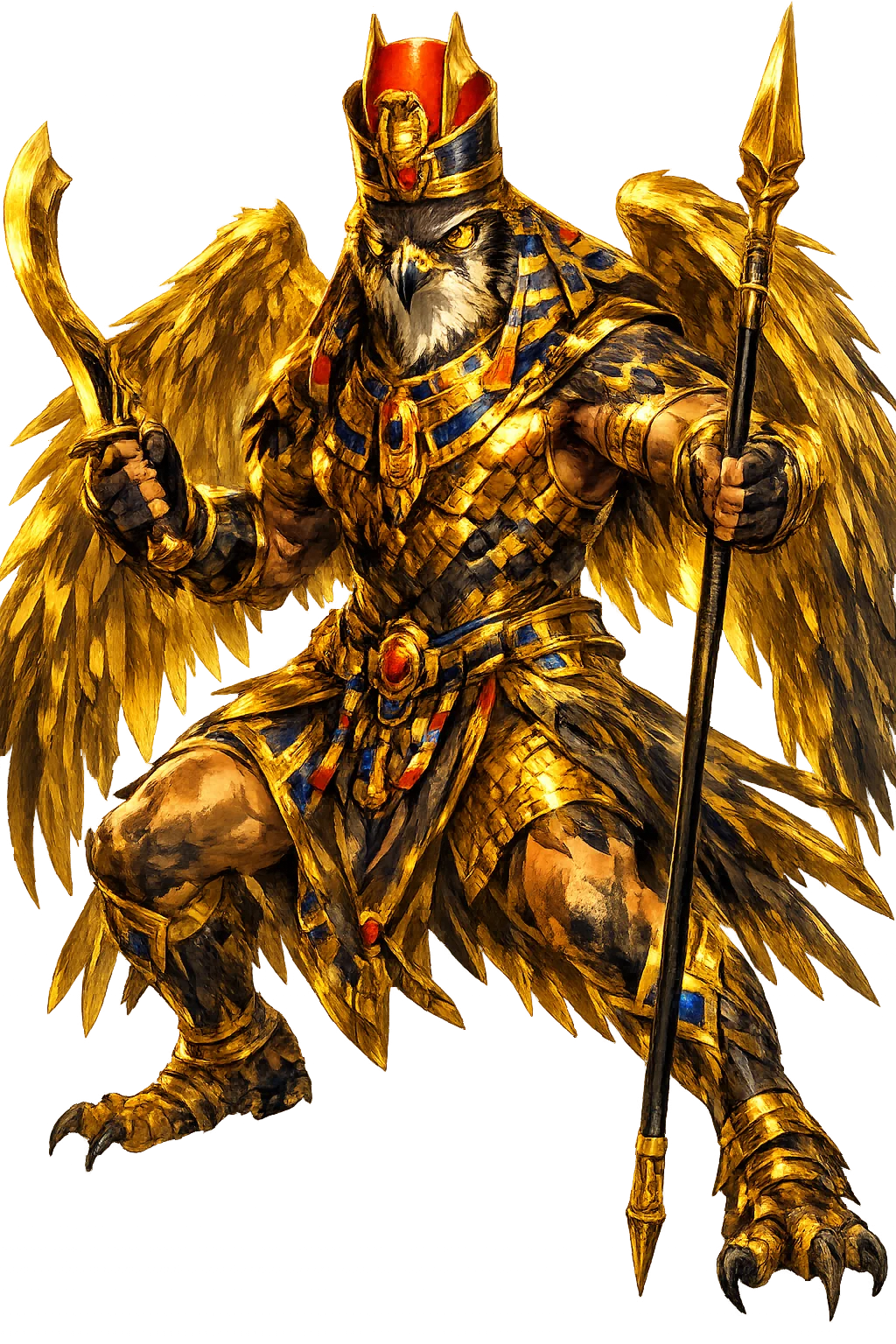
The Eye of Horus is arguably the most widely recognised symbol of ancient Egypt. It appears on jewellery, tattoos, amulets, and corporate logos across the globe, usually as a generic sign of protection. In popular culture, Horus features in films, comics, and games as a falcon-headed warrior or sky-god. For modern Kemetics and Egyptian pagans, Horus remains a living deity of kingship, justice, and rightful authority. The name has also entered astronomy: the asteroid 1924 Horus reminds us that the distant one still watches from above.

In the Earth

The falcon-god Horus is attested from the earliest dynastic period: the Narmer Palette shows a falcon protecting the king, and the serekh with Horus-name became the oldest royal titulary. The temple of Horus at Edfu, built during the Ptolemaic period, preserves the longest surviving ancient Egyptian temple inscription, including the myth of Horus defeating Set. Falcon mummies and votive falcon coffins have been found at Saqqara, Abydos, and Hierakonpolis — the latter city being Horus's ancient cult center.

05

The Meditation

What Ḥr means — beyond the dictionary

Horus is the god of the long view. The falcon sees what the ground-dweller cannot; the king must see beyond his own reign. To call on Horus is to remember that authority is not merely power but rightfulness — the triumph of ma'at over isfet, of inheritance over usurpation, of the whole over the torn.

The myth of Horus and Set is not a simple story of good versus evil. In some periods Set was the protector of Re's bark; in others he was the murderer of Osiris. The conflict is structural: order and disorder are relatives, not strangers, and their contention is what keeps the world awake. Horus wins not because he is strongest but because he is legitimate. That is the Egyptian lesson: cosmic order is maintained not by force alone but by the recognition of rightful place. The restored eye is the image of that order — broken, then made whole, then worn as a pledge that wholeness can be recovered.

06

Screen & Culture

Where Ḥr echoes through film, television, and games — and how

07

Frequently Asked Questions

Common questions about Ḥr, Sky, Kingship, Falcon, and Unicode restoration

01How do you pronounce Ḥr?

In reconstructed pronunciation, Ḥr is /ˈħaːru/ — approximately 'HAH-roo' — the first syllable is throaty and drawn out, the second light and ascending, like a falcon rising.

02What does Ḥr mean?

Ḥr means The Distant One (Egyptian ḥr) in the egyptian tradition.

03What are the symbols of Ḥr?

Ḥr is associated with Falcon (The sky itself and the king's predatory vigilance), Double crown (pschent) (The unity of Upper and Lower Egypt under Horus's rule), Wedjat eye (Healing, restoration, and protection; the eye wounded by Set and made whole by Thoth), Serekh (The palace-façade frame that encloses the king's Horus-name), Sun disk with wings (Re-Horakhty, Horus fused with the sun-god Re).

04Why restore Ḥr in Unicode?

Plain ASCII horus strips the stress, length, and script that make the name specific. Unicode restoration returns the name to its original written dignity.

05What is the most important myth about Ḥr?

“Elder and Younger” — Horus's mythology is the political theology of Egypt made personal. It tells how the rightful heir, born from a murdered father and a resourceful mother, defeats the usurper and restores the throne. The story was never merely entertainment; it was the charter of kingship, replayed in temples for three thousand years. The full telling lives on the lore page.

08

Scholarly Sources

The philological foundations of this restoration

Every claim on this page is grounded in established scholarship. The orthographic restorations follow disciplinary convention. The etymological chain follows the best available reference works. This is not invention — it is resurrection through scholarship.

Lexicography & Philology

  • Faulkner, R. O. A Concise Dictionary of Middle Egyptian. Oxford: Griffith Institute, 1962.
  • Wb

Primary Texts

  • Faulkner, The Ancient Egyptian Pyramid Texts
  • Plutarch, De Iside et Osiride 12–20
  • Pyramid Texts, Utterance 478 (Horus recovers the wedjat eye from Seth)
  • Pyramid Texts, Utterance 570 (the king identified with Horus)
  • Book of the Dead, Spell 125 (Horus presents the justified to Osiris)
  • Metternich Stela / Horus Cippi (healing and protective heka of Horus)

Archaeology & Art History

  • Material evidence — iconography, inscriptions, and temple archaeology — for Ḥr and related cults.

Religious Studies

  • Wörterbuch der ägyptischen Sprache (Wb), ḥr
  • Gardiner, Egyptian Grammar
  • Allen, Genesis in Egypt
  • The Contendings of Horus and Set (Papyrus Chester Beatty I)
Return

The Surface Awaits

You have traced the name from its earliest attestation to its Unicode restoration. Now return to the myth. The story is where the name lives.

Back to Lore
Ḥr mascot