The Living Myth
Hearth, Home, Family · The Eternal Flame · Center of the Home
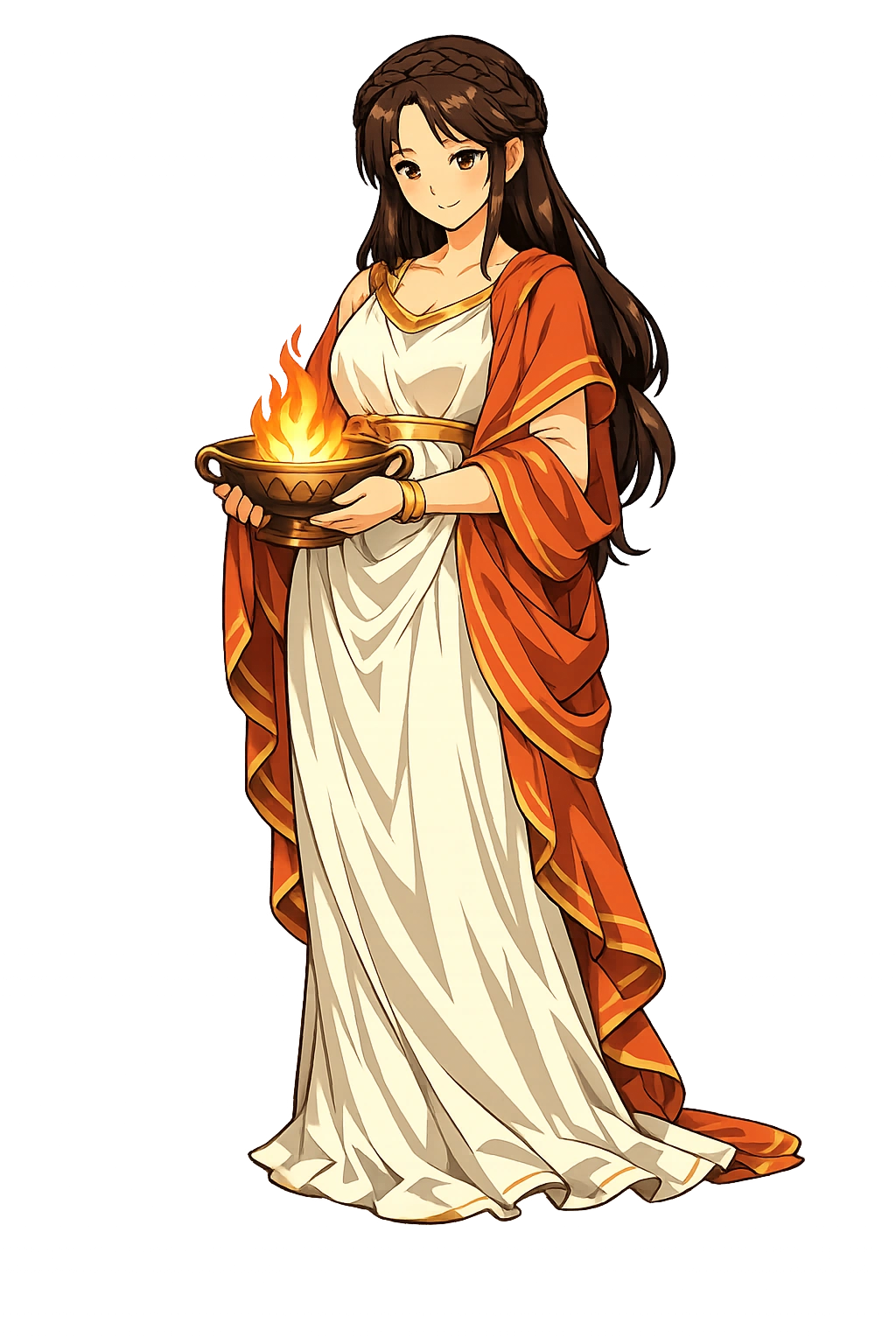
Stories of Hestía
Hestía has almost no myths of her own, and that absence is her meaning: she is not a narrative goddess but a presence, the fire that must never go out. Her few stories all concern her refusal to leave the center — and the honors that refusal earned her.
Apollo and Poseidon both sought to marry Hestia, and the Homeric Hymn to Aphrodite explains why they failed: Aphrodite's power runs over all gods and men — 'but of the three maidens the mind of Aphrodite cannot win nor ensnare' — Athena, Artemis, and Hestia, who sits 'in the center of the house' and receives the richest portion (Homeric Hymn to Aphrodite 7–44). Hestia swore a great oath before Zeus to remain a virgin, and Zeus accepted the oath and gave her instead what no marriage could: precedence. She is honored first in every prayer and receives the first and last libation at every sacrifice, while her hearth sits at the geometric center of the divine household. The myth's logic is institutional, not personal. Where other gods trade in stories, Hestia trades in order — her virginity is the price and the proof of her precedence.
Hesiod makes Hestia the eldest child of Kronos and Rhea — 'their firstborn, and after her wise Zeus' (Theogony 453–458) — which means she was the first to be swallowed by her father and the last to be disgorged when Zeus forced him to surrender his children. Ancient commentators drew the conclusion her worship already implied: because she went in first and came out last, she receives the first and last portion of every sacrifice, and every libation runs to her before any other god. Plato's Socrates plays with the same idea, deriving her name from the essence of things, ousia — the being in which all existence is 'seated' (Cratylus 401c–d), a folk etymology but a revealing one. Philosophers kept the image: for the Pythagoreans the central fire of the cosmos was Hestia's hearth, the still point around which the planets move. She is the rare Olympian whose theology matters more than her mythology.
Hestia's fire never goes out, yet it travels. When a Greek city founded a colony — Syracuse from Corinth, Cyrene from Thera, Byzantium from Megara — the colonists lit torches from the mother city's public hearth and carried the flame across the sea to ignite the new settlement's prytaneion. The rite is described in the sources on colonization and implied by the colonies' own cults: the new city's Hestia was literally the same fire as the old one's, and the bond between mother city and colony was a family tie written in flame. No god crossed the water so often. This is the myth of Hestia told in ritual instead of story: identity is portable only because it has a fixed center, and the hearth is the one possession a people can carry that is not a possession at all but a continuity.
The Roman cult of Vesta preserved Hestia's most important rite and gave it an institutional form Greece never matched: six priestesses, the Vestal Virgins, consecrated as girls and sworn to thirty years of service, tended a flame in a circular temple in the Roman Forum that had to burn every hour of every day (Dionysius of Halicarnassus, Roman Antiquities 2.64–67; Ovid, Fasti 6). If the flame went out, Rome itself was held to be in mortal danger, and the responsible Vestal was scourged by the Pontifex Maximus. The Vestals guarded the penates publici, the sacred objects on which the city's fortune depended, and they alone could enter the innermost sanctuary. The office made them uniquely powerful women — they could own property, testify without oath, and free condemned prisoners with a touch. Their cult outlasted paganism in the Western imagination: the veiled virgin, the tended flame, and the round temple are Hestia's Roman afterlife.
Home, Hearth, Family, and Civic Fire
Hestía is the quietest Olympian. She never leaves Olympus, never quarrels, never takes lovers. She is the hearth-fire itself — the fixed point around which the family, the city, and the world are organized. Every sacrifice begins and ends with her.
The fire at the center of every home; the place where family gathers and offerings are made.
The prytaneion in every Greek city housed her eternal flame; colonists carried her fire to new lands.
The first libation and the final prayer of every sacrifice belong to Hestía.
She rejected Apollo and Poseidôn's suits and swore eternal virginity; Zeús granted her the first share of every sacrifice.
From the original script to the living URL
Ἑστία
The name in its original Greek form. Hestía (Ἑστία) is attested in the source tradition — “Hearth, fireplace”. Its acute accents carry the full phonetic and orthographic weight of the source tradition.
hestia
Reduced to plain hestia, the name loses everything that made it specific: acute accents. What remains is an ASCII string that machines can parse but that no longer speaks with its original voice.
Hestía
The Unicode restoration recovers what ASCII flattened. Hestía restores acute accents, returning the name to its original written dignity. The domain encodes to Punycode, but the browser displays the truth.
Hestía.com → xn--hesta-2sa.com
The non-ASCII characters in Hestía are encoded while the ASCII remains visible. To the DNS, it is Punycode. To humanity, it is Hestía.
Owned, ideal, and ASCII forms of Hestía
Hestía
Restores Ἑστία. The live temple domain — hestía.com.
hestia
Flattens Ἑστία. The plain ASCII fallback — what DNS and legacy systems see.
How Hestía was spoken
How Hestía travels from ancient script to the modern URL
Greek Ἑστία; from ἑστία “hearth, fireplace"; the goddess of the hearth.
Hearth, Home, Family
The Unicode restoration Hestía preserves Greek stress and length; the ASCII form hestia loses these features.
The lore you have read is the living myth. Extended Lore opens the scholarly vault beneath it: the cult and its material remains, a history of the image, the name after antiquity, a meditation on what the name still means, and the full scholarly apparatus — etymology, orthography, sources.
Enter Extended Lore