PuniCodex

Extended Lore

Ἑστία Hestía

Etymology · Orthography · Cult · Iconography · Reception · Sources

Tier 2 Hestía.com
Hestía — Hearth, Home, Family
01

Quick Facts

Essential information about Hestía, Hearth, Home, Family

Original ScriptἙστία
Unicode RestorationHestía
Reconstructed Pronunciation/hɛs.tí.a/
PantheonGreek
DomainHearth, Home, Family
MeaningHearth, fireplace
ClassificationTier 2
Primary DomainHestía.com
Sacred SymbolsHearth fire, Kettle or cauldron, Pig, Circle, Modest veil
02

Etymology & Word Family

From original script to Unicode restoration

Proto-indo-european *h₂wes- to dwell, to stay
Original Script Ἑστία Hestía — "Hearth, fireplace"
Unicode Restoration Hestía Restored stress, length, and script
Modern ASCII hestia Plain-ASCII fallback

From Ἑστία "hearth", cognate with Latin Vesta. The hearth goddess.

03

Unicode Character Breakdown

Character-by-character philological analysis

CharacterUnicodeNameBlockPhonetic Role
HU+0048Latin Capital Letter HBasic LatinRough breathing
eU+0065Latin Small Letter EBasic LatinShort epsilon
sU+0073Latin Small Letter SBasic LatinSigma
tU+0074Latin Small Letter TBasic LatinTau
íU+00EDLatin Small Letter I with AcuteLatin-1 SupplementAcute on short iota
aU+0061Latin Small Letter ABasic LatinShort alpha

The Tier 2 classification reflects how much of the original phonology this restoration preserves — stress and vowel length for Greek names, distinctive letters and diacritics for every other tradition.

04

Cult & Worship

How the sacred was kept — rites, sanctuaries, remains

The Cult

Hestía's cult was a fire tended, not a drama staged, and it ran on offices rather than priesthoods. The civic hearth burned in the prytaneion, tended by the prytaneis themselves, the city's standing magistrates, who dined at the common table, entertained ambassadors and benefactors at the flame, and took their oaths before it.

In the house she was the hearth itself: the newborn was run around it at the amphidromia, the family feast poured to it, and a suppliant who clasped the household hearth was untouchable, the asylum guaranteed by Zeus Hikesios. Greece built her astonishingly few temples, and her images were plainer still; the richest evidence is oaths and libations, not buildings. Where other gods kept priesthoods, Hestía kept continuity: the same fire, fed daily, in city, colony, and home.

In the Earth

Every Greek city maintained a prytaneion housing the public hearth, and their remains anchor the archaeological record: the circular Tholos by the Athenian Agora sheltered the prytaneis' common fire, and monumental prytaneia are excavated at Olympia, Delos, Priene, and Ai-Khanoum in Bactria. At Magnesia on the Maeander, inscriptions mention a round temple of Hestia at the agora's center — civic architecture imitating her flame's geometry. The Roman temple of Vesta in the Forum, rebuilt many times on its archaic round plan, still stands beside the House of the Vestals, and its sisters at Tivoli and elsewhere repeat the form. Public oaths from Samos, Cos, and Thera open with Hestia's name, and her figure appears modestly on votive reliefs — a veiled woman at a small flame — exactly as unassuming as her cult.

05

Iconography

How Hestía was imaged across the ages

The Image

Hestía barely has a face. No certain archaic or classical cult statue survives, and vase-painters almost never chose her; when artists needed her in a divine assembly, the painted label did the work.

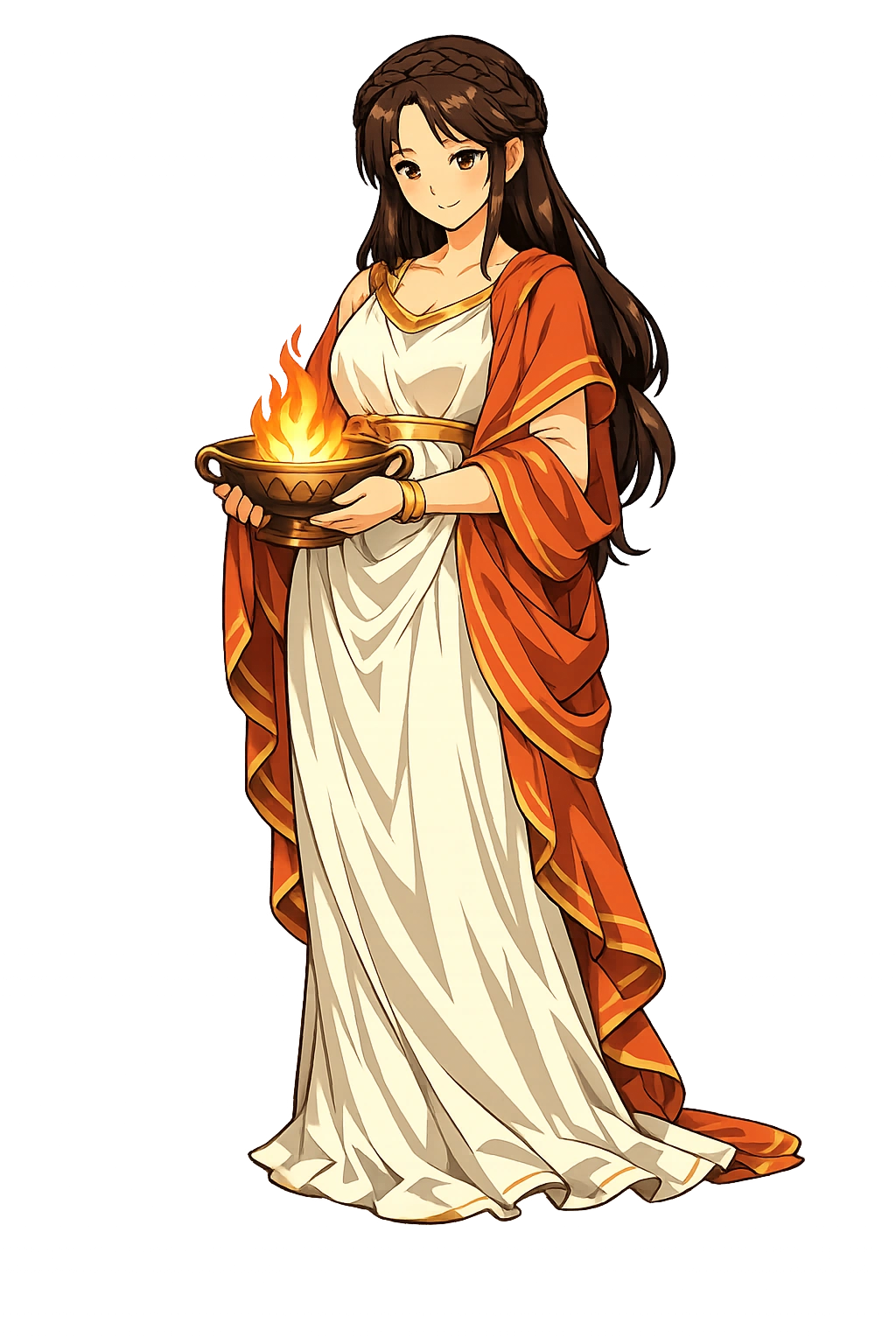
The figure type we possess is late and modest: the so-called Hestia Giustiniani (Torlonia Collection, Rome), a heavily veiled, simply draped standing matron, a Roman copy of what appears to be a severe-style original of the fifth century, modesty given a body. Votive reliefs show her truer, a woman veiled to the brow, standing quietly at a small flaming altar, hands drawn into her himation, letting the fire speak. Her one grand image is architectural: the circular temples, the Tholos at Athens and the round temple at Magnesia on the Maeander, whose floor-plan imitates the hearth's geometry.

06

Reception & Transformation

The name after its own age — transmission, translation, survival

Afterlives

Hestía's afterlife ran through philosophy before art. The Neoplatonists made her a metaphysical pivot: in Proclus she is the goddess of remaining (monē), the still point in the great triad of remaining, procession, and return, set against Hermes, who governs movement.

Her Roman form outlived the empire: when Theodosius' edicts closed the last temples, the Vestal fire in the Forum went out in 394 CE, and the last Vestalis Maxima, Coelia Concordia, embraced Christianity, an emblematic handover of the hearth. The Middle Ages remembered her mostly through the grammarians: Servius explained Vesta and her penates to centuries of readers of Virgil.

Modern scholarship gave her a second career. Jean-Pierre Vernant's celebrated pairing of Hestia and Hermes as the fixed and the mobile made her a key to Greek space and society, and historians of religion read her cult as the ancient world's deepest grammar of home. In revived Hellenic practice today, household polytheists kindle a flame to her each evening, a modern movement, honestly so called, tending what is probably the oldest rite in this catalogue.

Identifications Across Traditions

The Roman identification with Vesta was exact: same goddess, same function, same eternal flame, and the Vestal Virgins gave the cult an institutional form unmatched in Greece. In Christianity, the hearth's sanctity migrated into the home itself and, in the Byzantine East, into the sanctuary lamp that still burns before Orthodox icons. Hestia's archaic importance is visible in syntax as much as cult: Greek prayers and sacrifices opened with her name, and Pindar opens a victory ode at the prytaneion she presides over (Nemean 11.1–8). She is the most conservative deity in the pantheon — the one whose worship changed least from the Bronze Age hearth to the Roman Forum.

Modern Legacy

Hestia's legacy is the sanctity of home. The English word 'hearth' still carries emotional weight far beyond its practical function, and the concepts of hospitality, asylum, and household gods all descend from her cult: to harm a guest seated by the hearth was to profane her. The Roman Vestals were among the most powerful women in the ancient world, and 'vestal' still means chaste and guardianship. Modern phrases — 'home and hearth,' 'keep the home fires burning' — are secular liturgies of her flame. Restoring Hestía restores the name of the goddess who made the home a temple.

07

The Meditation

What Hestía means — beyond the dictionary

Hestia is the god of staying put. While other gods roam, fight, and love, she remains at the center, tending the fire. Her power is not dramatic; it is structural. Without her, there is no place from which to depart and to which to return.

In a mobile, dispersed world, Hestia asks what we have lost by making everywhere equally available and nowhere truly central. The hearth is not merely a source of heat; it is the symbol of continuity — the same fire, the same family, the same city across generations. The restoration of her name is a reminder that some powers are preserved not by movement but by steadfastness.

08

Frequently Asked Questions

Common questions about Hestía, Hearth, Home, Family, and Unicode restoration

01How do you pronounce Hestía?

In reconstructed pronunciation, Hestía is /hɛs.tí.a/ — approximately 'hess-TEE-ah' — the middle syllable carries the pitch, and the final 'ah' is short and open.

02What does Hestía mean?

Hestía means Hearth, fireplace in the greek tradition.

03What are the symbols of Hestía?

Hestía is associated with Hearth fire (The center of home, city, and cosmos — the flame that must never be allowed to die), Kettle or cauldron (The tripod vessel standing over the fire; in art she is a veiled woman beside it, tending the coals), Pig (The animal offered at hearth-centered rites, especially the women's Thesmophoria shared with Demeter), Circle (The shape of the hearth and of the gathering around it — the Greeks seated by rank around the fire's round), Modest veil (Her chaste, domestic nature; no mythology of scandal attaches to her anywhere).

04Why restore Hestía in Unicode?

Plain ASCII hestia strips the stress, length, and script that make the name specific. Unicode restoration returns the name to its original written dignity.

05What is the most important myth about Hestía?

“Virginity and Precedence” — the The Suitors story that anchors the mythology of Hestía, told in full on the lore page.

09

Scholarly Sources

The philological foundations of this restoration

Every claim on this page is grounded in established scholarship. The orthographic restorations follow disciplinary convention. The etymological chain follows the best available reference works. This is not invention — it is resurrection through scholarship.

◈

Lexicography & Philology

  • Liddell, H. G., Scott, R., & Jones, H. S. A Greek-English Lexicon. Oxford: Clarendon Press, 9th ed. 1996.
  • Pape, W., & Benseler, G. E. Wörterbuch der griechischen Eigennamen. Braunschweig: Vieweg, 1884.
  • Beekes, R. S. P. Etymological Dictionary of Greek. Leiden: Brill, 2010.
◎

Primary Texts

◉

Archaeology & Art History

  • Material evidence — iconography, inscriptions, and temple archaeology — for Hestía and related cults.
✦

Religious Studies

  • Dionysius of Halicarnassus, Roman Antiquities 2.64–67
Return

The Surface Awaits

You have traced the name from its earliest attestation to its Unicode restoration. Now return to the myth. The story is where the name lives.

Back to Lore
Hestía mascot