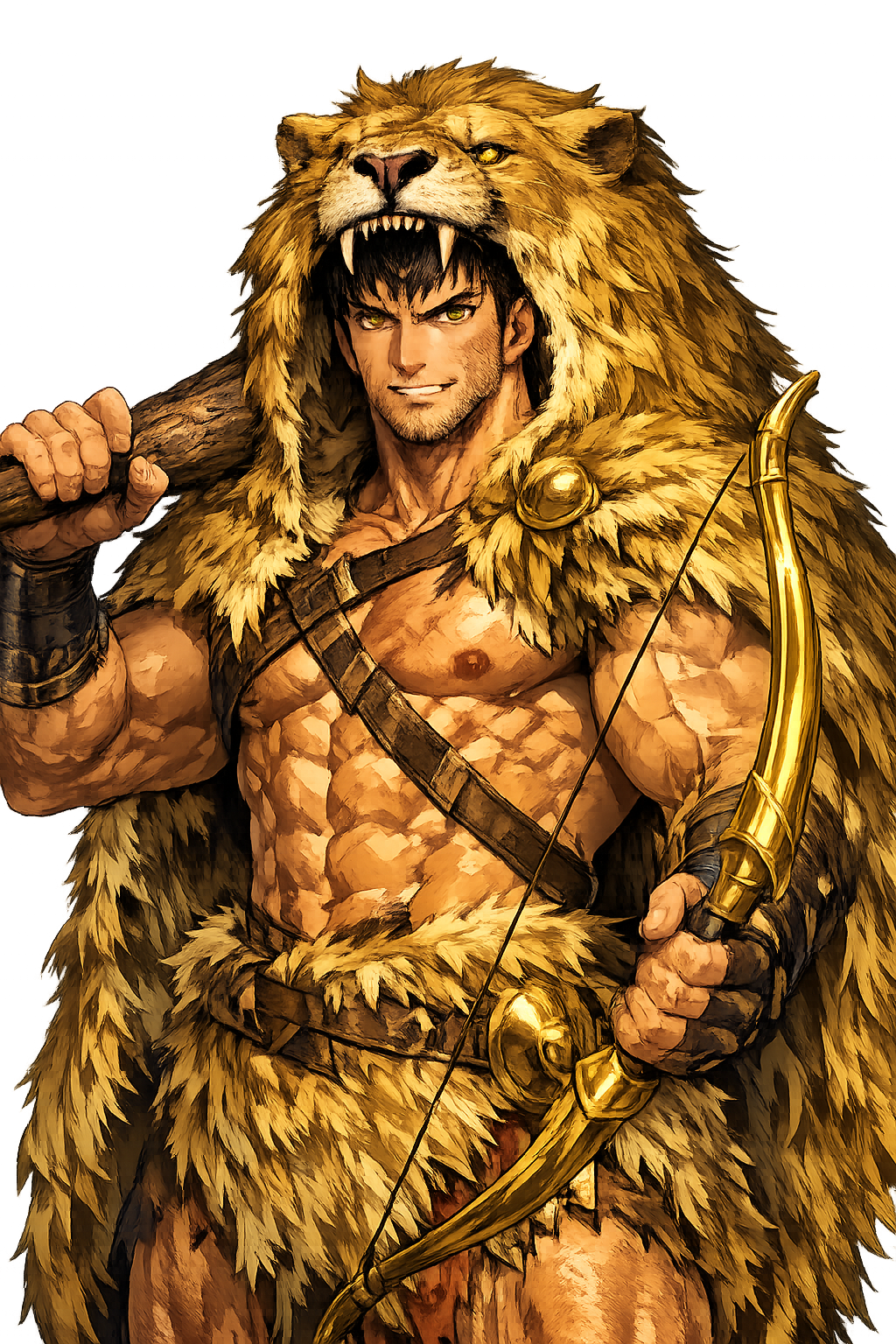
Stories of Hēraklēs
Hēraklēs's mythology is enormous and contradictory, preserved in epic, lyric, tragedy, and handbook. What holds it together is the figure of a mortal strong enough to challenge gods and monsters, yet vulnerable enough to weep, rage, and die. Here are four of its load-bearing walls.
Hesiod already knows Hēraklēs as the hero fated to settle the gods' war with the Giants: in the Theogony (950–955) he appears among the mortal unions of Zeús — by Alkmēnē, who bore him 'bold in might' in Thebes — and the poet makes his birth a debt of cosmic order, for Zeús's plan needed a mortal strong enough to finish what the gods began. His name, 'Glory of Hera,' is the tradition's own irony: the queen of the gods persecutes him from the cradle, sending two serpents against his crib, which the infant strangled one in each fist — the scene Pindar (Nemean 1) and Theocritus (Idyll 24) immortalized. Homer already sings of him as one who walked the earth yet now feasts among the immortals (Odyssey 11.602–604). The hero's whole career is compressed in that double fact: born to be attacked, destined to be deified.
The first labour sent Hēraklēs against the Nemean lion, whose hide no weapon could pierce; he strangled it in its cave and wore the pelt thereafter, its gaping maw as his helmet (Apollodorus 2.5.1). The second pitted him against the Lernaean hydra, whose severed heads multiplied — Iolaos cauterized each neck with fire while Hēraklēs struck, and Hera, aiding the monster, sent a giant crab that became the constellation Cancer (Apollodorus 2.5.2; Eratosthenes, Catasterismi). The fourth labour brought the Erymanthian boar alive to Mycenae — the comic masterpiece of the cycle, Eurystheus so terrified he hid in a bronze storage jar while the hero hoisted the squealing beast overhead. Behind the folktale comedy lies the theology of the series: each labour drags a creature of chaos into the human world and converts it to order — a hide that becomes armor, a swamp made safe, a mountain terror that becomes a king's lesson.
The twelfth labour sent Hēraklēs down to fetch Kerberos 'with no weapon, neither iron nor bronze' (Apollodorus 2.5.12) — through a dark crack at Tainaron, past the gates where Hades stood with drawn sword until Athena intervened. In the dark he found Theseus and Peirithoos frozen in chairs of forgetfulness for their attempt to steal Persephonē; he freed Theseus, but the earth held Peirithoos. He met the shade of Meleager, whose tale of dying for love moved him to seek the sister's hand — the fatal marriage to Deianeira. Then he asked Hades for the hound, and when Hades consented, he wrestled the three-headed beast into daylight, choking it with his bare arms until it submitted. The labour is the cycle's thesis in one image: the strongest hero enters death unarmed and returns with death's own guardian leashed. Every descent rehearsed his apotheosis.
Sophocles' Women of Trachis gives the hero his end. The centaur Nessus, dying from Hēraklēs' arrow, told Deianeira to keep his blood as a love-charm; years later, fearing her husband's love for Iole, she anointed a robe with it and sent it to him. The blood — poisoned by the Hydra's venom on the arrow — ate into his flesh like acid. Brought home in agony from Euboea, he ordered his own pyre on Mount Oeta, gave his bow to Poeas, and mounted the flames. Athena's chariot received him: from the fire he ascended to Olympus, reconciled at last with Hera, married to Hebe, Youth — and Homer already knew the ending (Odyssey 11.602–604), while Euripides stages the apotheosis on the machine in his Heracles. The last labour is the only one performed on himself — and its reward is the one Eurystheus never assigned: immortality as the price of a fully burned life.
Strength, Labours, and Apotheosis
Hēraklēs is the greatest of Greek heroes and the only one to become a full Olympian god. His very name means 'Glory of Hera,' yet Hera persecuted him from the cradle, driving him to madness and murder. His life is a sequence of impossible tasks performed under duress: the Twelve Labours, the conquest of monsters, the rescue of captives, and finally a death by fire that turned into immortality.
Imposed by Eurystheus at Hera's prompting: the Nemean lion, Lernaean hydra, Ceryneian hind, Erymanthian boar, Augean stables, Stymphalian birds, Cretan bull, mares of Diomedes, girdle of Hippolyta, cattle of Geryon, apples of the Hesperides, and Kerberos from Hades.
Son of Zeús by Alkmēnē, he possesses strength beyond mortality from infancy; as a baby he strangled the serpents Hera sent against him.
Hera's frenzy made him kill his wife Megara and their children; the Delphic oracle sentenced him to serve Eurystheus, transforming violence into labour.
Poisoned by the blood of the centaur Nessus, he mounted a funeral pyre on Mount Oeta; from the flames he ascended to Olympus and married Hebe.
From the original script to the living URL
Ἡρακλῆς
The name in its original Greek form. Hēraklēs (Ἡρακλῆς) is attested in the source tradition — “Glory of Hera (from Ἥρα + κλέος)”. Its long vowels and acute accents carry the full phonetic and orthographic weight of the source tradition.
herakles
Reduced to plain herakles, the name loses everything that made it specific: long vowels and acute accents. What remains is an ASCII string that machines can parse but that no longer speaks with its original voice.
Hēraklēs
The Unicode restoration recovers what ASCII flattened. Hēraklēs restores long vowels and acute accents, returning the name to its original written dignity. The domain encodes to Punycode, but the browser displays the truth.
Hēraklēs.com → xn--hrakls-p3ae.com
The non-ASCII characters in Hēraklēs are encoded while the ASCII remains visible. To the DNS, it is Punycode. To humanity, it is Hēraklēs.
Owned, ideal, and ASCII forms of Hēraklēs
Hēraklēs
Restores Ἡρακλῆς. The live temple domain — hēraklēs.com.
herakles
Flattens Ἡρακλῆς. The plain ASCII fallback — what DNS and legacy systems see.
How Hēraklēs was spoken
How Hēraklēs travels from ancient script to the modern URL
Greek Ἡρακλῆς; from Ἥρα + κλέος “glory", hence “glory of Hera".
Strength, Labours, Heroism
The Unicode restoration Hēraklēs preserves Greek stress and length; the ASCII form herakles loses these features.
The lore you have read is the living myth. Extended Lore opens the scholarly vault beneath it: the cult and its material remains, a history of the image, the name after antiquity, a meditation on what the name still means, and the full scholarly apparatus — etymology, orthography, sources.
Enter Extended Lore