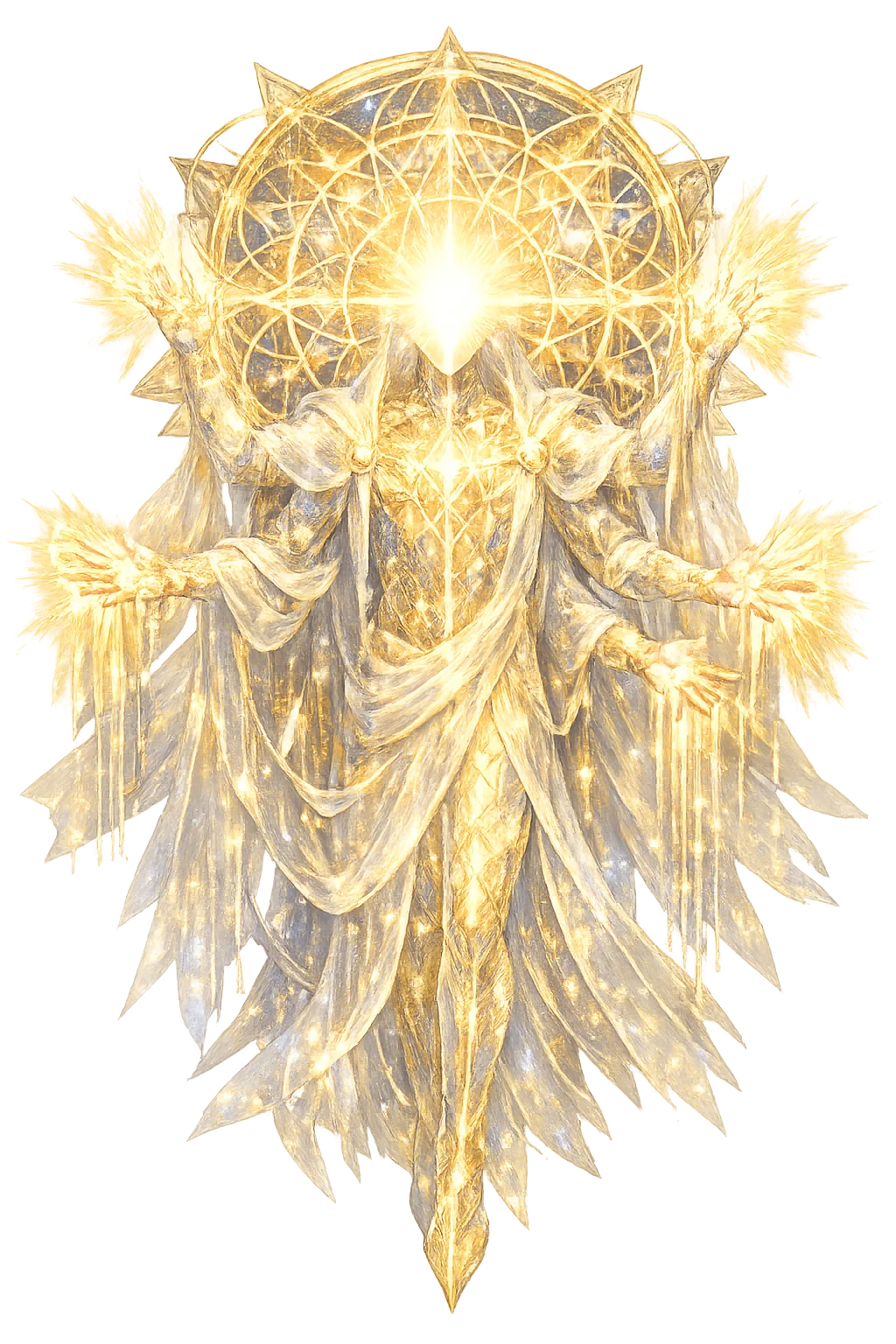
Stories of Hén
Hén has no myths in the usual sense, because it is not a person but a principle — yet its philosophical biography is one of the great narratives of ancient thought. From Pythagorean counting to Eleatic logic, from Plato's sun to Plotinus's mystical return, the tiny word gathers the whole destiny of Greek metaphysics.
Around 475 BCE a citizen of Elea carried his poem On Nature through the Greek world, reporting a revelation: brought by mares and the daughters of the Sun past the gates of Night and Day, he was received by a goddess who taught him 'the unshaken heart of well-rounded truth' (frag. 1). Her doctrine is the austerity itself of thought: 'is, and it is impossible for it not to be' (frag. 2). What genuinely is must be one — whole, unique, motionless, without beginning or end (frag. 8). Change, plurality, and coming-to-be belong to the 'way of mortal opinion', the second half of the poem, recited only so it may be named and dismissed. Nothing in earlier Greek literature argues this hard. The One enters philosophy not as a mystic blur but as a logical cage: deny it, and your own words betray you, for to speak of what-is-not is to speak of nothing.
Plato gave the One its most influential passage without quite naming it. In the Republic (509b), Socrates calls the Form of the Good 'beyond being in dignity and power' — the source that makes all other forms knowable, as the sun makes things visible. Later Platonists fused sun and syllable: the Good simply is to hen. The dialogue Parmenides then ran the experiment in reverse, asking what follows if the One is, and again if the One is not (137c–166c): in the first hypothesis the One cannot even partake of being, since partaking would divide it. Some ancients dismissed the exercise as logical gymnastic; the Neoplatonists read it as the via negativa written in Plato's own hand. Either way, the identification of unity with goodness became the hinge of Western metaphysics: whatever is most real is most simple, and whatever is most simple is most good.
Plotinus (204/5–270 CE), teaching in Rome, made to hen the first of three hypostases: the One, Intellect (Nous), and Soul (Enneads V.1). The One is beyond being, beyond thought, beyond even self-awareness — for awareness implies duality, and duality is the first fall. From it Intellect proceeds eternally, thinking the forms it contains; from Intellect proceeds Soul, which orders the material cosmos and, in us, turns back toward its source (V.4). The return is the point: every hypostasis flows out of the One and aspires back, like light indifferent to distance. Plotinus claimed firsthand acquaintance with it — 'four times in the years of my life' (Porphyry, Vita Plotini 23). Philosophy here completes the trajectory the goddess of Elea began: the One that Parmenides proved and Plato glimpsed becomes an addressable presence, the terminus of the soul's one true eros.
Earlier than both, and stranger, stood the Pythagoreans, who did not argue for the One but counted with it. Aristotle reports their founding thesis: the elements of number are the elements of all things, and the whole heaven is harmony and number (Metaphysics 986a). Their first principle was the monad — the unit, to hen by another name — from which the dyad, the number series, and finally the cosmos unfolded; their oath swore by the tetraktys, the holy triangle of ten that holds 'the fount and root of ever-flowing nature'. Number was not description but substance: justice was four, marriage five, opportunity seven. Later tradition credits Pythagoras with calling the one both even and odd (Aristotle, Physics 203a). Where Elea reached unity by stripping away, Pythagoras reached it by building up — one dot, then two, then the world. Greek mathematics, and with it Greek science, begins in this religious arithmetic of the ἕν.
Unity, First Principle, and Indivisibility
Hén is the Greek neuter of εἷς, 'one'. In everyday speech it is simply the number; in philosophy it became one of the most powerful words in the Western tradition. For Parmenides, Plato, and the Neoplatonists, τὸ ἕν names the ultimate source from which all multiplicity flows.
The indivisible whole that precedes every plurality and every distinction.
In Plato, the first principle beyond being is identified with the Form of the Good, source of all knowability (Republic 509b).
For Plotinus, τὸ ἕν is the first hypostasis, absolutely simple and unknowable, from which Mind and Soul proceed (Enneads V.1).
What is truly one cannot be divided without ceasing to be itself; it is the root of identity.
From the original script to the living URL
ἕν
The name in its original Greek form. Hén (ἕν) is attested in the source tradition — “Greek neuter of εἷς, "one"; philosophically "The One" in Neoplatonism.”. Its acute accents carry the full phonetic and orthographic weight of the source tradition.
hen
Reduced to plain hen, the name loses everything that made it specific: acute accents. What remains is an ASCII string that machines can parse but that no longer speaks with its original voice.
Hén
The Unicode restoration recovers what ASCII flattened. Hén restores acute accents, returning the name to its original written dignity. The domain encodes to Punycode, but the browser displays the truth.
Hén.com → xn--hn-bja.com
The non-ASCII characters in Hén are encoded while the ASCII remains visible. To the DNS, it is Punycode. To humanity, it is Hén.
Owned, ideal, and ASCII forms of Hén
Hén
Restores ἕν. The live temple domain — hén.com.
hen
Flattens ἕν. The plain ASCII fallback — what DNS and legacy systems see.
How Hén was spoken
How Hén travels from ancient script to the modern URL
Greek neuter of εἷς, "one"; philosophically "The One" in Neoplatonism.
Unity, The One, Oneness
The Unicode restoration Hén preserves Greek stress and length; the ASCII form hen loses these features.
The lore you have read is the living myth. Extended Lore opens the scholarly vault beneath it: the cult and its material remains, a history of the image, the name after antiquity, a meditation on what the name still means, and the full scholarly apparatus — etymology, orthography, sources.
Enter Extended Lore