PuniCodex

Extended Lore

ἕν Hén

Etymology · Orthography · Cult · Iconography · Reception · Sources

Tier 2 Hén.com
Hén — Unity, The One, Oneness
01

Quick Facts

Essential information about Hén, Unity, The One, Oneness

Original Scriptἕν
Unicode RestorationHén
Reconstructed Pronunciation/hɛ́n/
PantheonGreek
DomainUnity, The One, Oneness
MeaningGreek neuter of εἷς, "one"; philosophically "The One" in Neoplatonism.
ClassificationTier 2
Primary DomainHén.com
Sacred SymbolsCircle, Point, Monad, Radiant centre
02

Etymology & Word Family

From original script to Unicode restoration

Proto-indo-european *sem- one
Original Script ἕν Hén — "Greek neuter of εἷς, "one"; philosophically "The One" in Neoplatonism."
Unicode Restoration Hén Restored stress, length, and script
Modern ASCII hen Plain-ASCII fallback

From Greek ἕν, neuter of εἷς "one", continuing Proto-Indo-European *sem- "one", reflected in Latin semel "once" and English same.

03

Unicode Character Breakdown

Character-by-character philological analysis

CharacterUnicodeNameBlockPhonetic Role
HU+0048Latin Capital Letter HBasic LatinSame, capitalized
éU+00E9Latin Small Letter E with AcuteLatin-1 SupplementAcute marks stress on e
nU+006ELatin Small Letter NBasic LatinSame

The Tier 2 classification reflects how much of the original phonology this restoration preserves — stress and vowel length for Greek names, distinctive letters and diacritics for every other tradition.

04

Cult & Worship

How the sacred was kept — rites, sanctuaries, remains

The Cult

No temple ever housed the One, and that is the point: cult attaches to gods of place, and Hén is prior to place. What antiquity offers instead is one devout community and one devotional practice. The early Pythagoreans, who held number to be the substance of things, treated the monad with religious seriousness: initiates swore the oath of the tetraktys — by the one ‘who handed down to our generation the tetraktys, which contains the fount and root of ever-flowing nature’. Neoplatonism then made the principle an object of addressable longing: Plotinus taught the soul's return to the One as its only true eros, and claimed to have arrived there four times. Later mystics and modern devotees who venerate unity are building on that Neoplatonic piety — not on any ancient temple, priesthood, or festival, none of which ever attached to the name.

In the Earth

No cult or temple attaches to Hén, but the word is among the best-traveled survivors of ancient thought. Parmenides' poem reaches us through quotations in Simplicius's sixth-century commentaries; Plato's dialogues and Plotinus's Enneads descend through the medieval manuscript tradition — the Plato of Constantinople and the Plotinus of the Arabic translators of Baghdad. In papyri and school exercises the word appears endlessly, glossed for generations of students as the first of the numbers and the root of henology. Its material biography is therefore the biography of Greek literacy itself: a one-syllable word that had to be copied, century after century, because everything else depended on it.

05

Iconography

How Hén was imaged across the ages

The Image

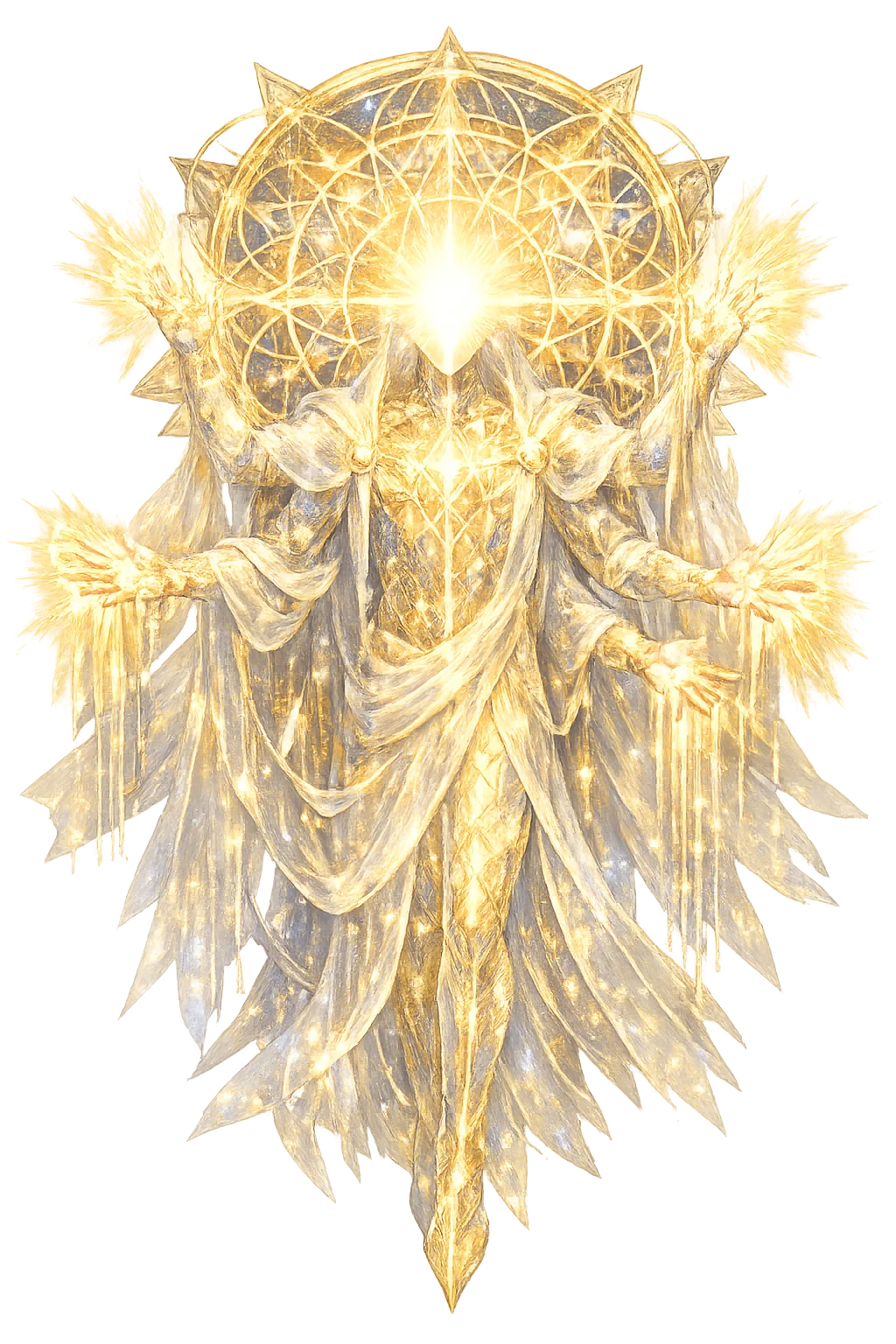
The One was never imaged, because an image divides what it depicts. The tradition's solution was mathematical. Proclus taught that the point — partless, indivisible, generator of line and world — is the One's true likeness, a diagram being able to carry theology where a statue cannot. The Pythagoreans had already given the One its only antique emblem, the tetraktys: ten dots in the holy triangle, one at the apex, four at the base, an object of oath rather than of art. Renaissance Neoplatonists revived the practice: Francesco Giorgi's De harmonia mundi (1525) built a whole cosmology out of Pythagorean number, and John Dee's Monas Hieroglyphica (1564) compressed the universe into a single invented ‘monad’ glyph — the nearest thing the One has ever had to a portrait. No ancient statue, vase, or fresco depicts Hén. Its self-portrait remains a dot.

06

Reception & Transformation

The name after its own age — transmission, translation, survival

Afterlives

Hén's afterlife is the biography of a syllabus. Parmenides' poem survives embedded in Simplicius's sixth-century commentaries; Plotinus reached the Latin Middle Ages twice — through Augustine, who never names him but breathes him, and through the Liber de causis, the twelfth-century Latin adaptation of Proclus that stood as a set text in the universities until Aquinas exposed its authorship. Eriugena made the One speak Christian in the Periphyseon, calling the superessential God a ‘nothing’ beyond all things; Boethius had already devoted a tractate, the De hebdomadibus, to the puzzle of how things, being many, are good when goodness is one. Pseudo-Dionysius supplied the liturgy. The fifteenth century found the One a new spokesman in Nicholas of Cusa, whose learned ignorance locates the coincidentia oppositorum where all division fails. Modern scholarship finally named the science — Jean Trouillard's ‘henology’ (1955) — and the word ἕν still carries its own lemma in Greek lexica: the smallest dictionary entry bearing the largest claim in Western thought.

Identifications Across Traditions

The Greek ἕν shaped Jewish and Christian monotheism through Philo and the Church Fathers, who read the biblical God through Platonist categories — Augustine's Trinity leans directly on Plotinus, and Aquinas argues that God, as ipsum esse, is supremely one. In Indian philosophy, the Upaniṣadic Brahman offers an analogous reflection on unity beyond plurality, though the two traditions reached it by different roads. The modern mathematical unit and the philosophical problem of the one and the many both descend from this small Greek word: set theory's generator, Spinoza's substance, and the recurring mystical claim that all things are one are footnotes to the dialectic begun at Elea.

Modern Legacy

From the Pythagorean monad to Neoplatonic mysticism, from Spinoza's substance to the unit element of modern algebra, the One has never ceased to shape Western thought. In mathematics the number 1 became the generator of the whole series; in set theory, the empty set's successor. The mystics made it devotional — the 'One' of Eckhart and of the Sufi waḥdat al-wujūd is the same word translated across three faiths. Restoring Hén in Unicode preserves the acute accent that marks the word's classical pitch: a single diacritic carrying an entire metaphysical lineage, the smallest possible monument to the largest possible claim.

07

The Meditation

What Hén means — beyond the dictionary

The smallest entry in this lexicon carries the largest claim. Hén is one syllable, one breath, one phoneme-cluster of Greek — and it names what all syllables, breaths, and Greeks were thought to come from. The name teaches a lesson in scale: in the Greek imagination, ultimate reality is not a bigger thing but a simpler one; not a universe packed with content but a unity from which content can proceed without diminishing it. That is why the tradition never outgrew the word. Philosophers could complicate the architecture — hypostases, emanations, triads — but the roof stayed the same. To restore the accent on Hén is to keep the pitch of that roof: a word whose entire office is to be indivisible, marked by the only stress it can bear.

08

Frequently Asked Questions

Common questions about Hén, Unity, The One, Oneness, and Unicode restoration

01How do you pronounce Hén?

In reconstructed pronunciation, Hén is /hɛ́n/ — approximately 'HEN' — with a slight initial h and a rising pitch on the first, only syllable.

02What does Hén mean?

Hén means Greek neuter of εἷς, "one"; philosophically "The One" in Neoplatonism. in the greek tradition.

03What are the symbols of Hén?

Hén is associated with Circle (The perfect shape without parts or beginning, symbol of unity.), Point (A geometric entity with no magnitude, the mathematical image of the One.), Monad (The Pythagorean unit from which the number series and cosmos arise.), Radiant centre (The source from which all lines and all beings emanate.).

04Why are there different spellings of Hén?

Each form is a historically attested restoration rather than a mistake: hén is the owned form (Lowercase owned domain form). PUNICODEX registers the full set so the tradition is preserved under every defensible spelling.

05Why restore Hén in Unicode?

Plain ASCII hen strips the stress, length, and script that make the name specific. Unicode restoration returns the name to its original written dignity.

06What is the most important myth about Hén?

“What Is Is One” — the Parmenides story that anchors the mythology of Hén, told in full on the lore page.

09

Scholarly Sources

The philological foundations of this restoration

Every claim on this page is grounded in established scholarship. The orthographic restorations follow disciplinary convention. The etymological chain follows the best available reference works. This is not invention — it is resurrection through scholarship.

◈

Lexicography & Philology

  • Liddell, H. G., Scott, R., & Jones, H. S. A Greek-English Lexicon. Oxford: Clarendon Press, 9th ed. 1996.
  • Beekes, R. S. P. Etymological Dictionary of Greek. Leiden: Brill, 2010.
◎

Primary Texts

  • Plato
  • Plato, Republic 6.509b; Parmenides 137c–166c
◉

Archaeology & Art History

  • Material evidence — iconography, inscriptions, and temple archaeology — for Hén and related cults.
✦

Religious Studies

  • Parmenides, On Nature (fragments preserved by Simplicius)
  • Plotinus, Enneads V.1, V.4, VI.9; Porphyry, Vita Plotini 23
  • Aristotle, Metaphysics 986a; Physics 203a
  • Beekes, Etymological Dictionary of Greek, s.v. εἷς
  • LSJ, s.v. εἷς
Return

The Surface Awaits

You have traced the name from its earliest attestation to its Unicode restoration. Now return to the myth. The story is where the name lives.

Back to Lore
Hén mascot