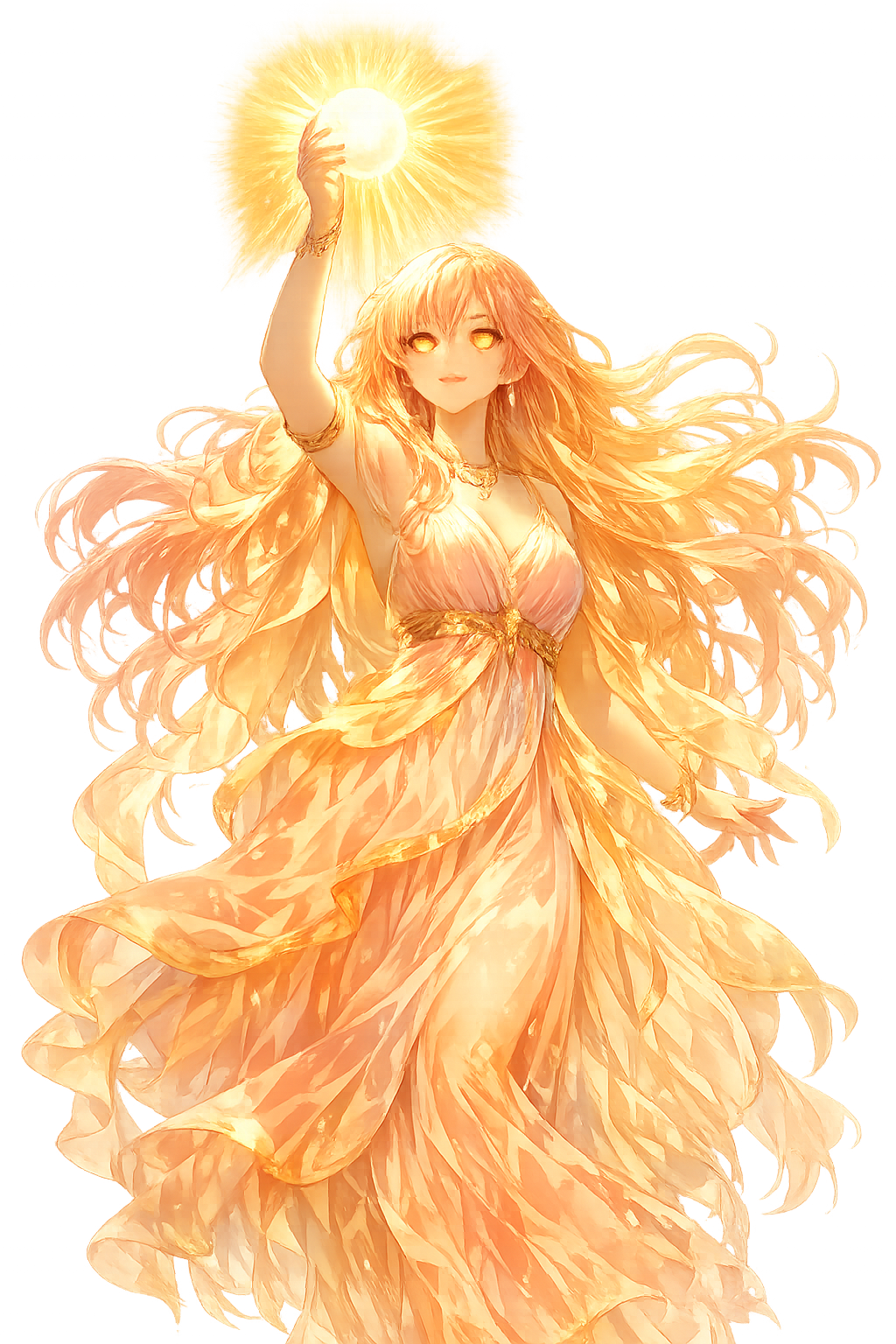
Stories of Hēméra
Hēméra is a cosmogonic figure more than a narrative one. Her myths are genealogies and spatial arrangements: where she comes from, where she lives, and how she greets her mother at the door. Yet these arrangements are themselves a story — the story of how light separates from darkness without ever conquering it.
Hesiod's Theogony gives her the purest possible pedigree: from Cháos came Érebos and black Nyx; from Nyx, paired with Érebos, came Aithḗr and Hēméra (Theogony 123–125). The genealogy is a small machine of logic — out of the gap comes darkness, and out of darkness, by pairing, the bright upper air and the day itself. She is therefore only two generations from the beginning of things, a luminous granddaughter of the void, born not from a mother alone but from darkness embracing darkness. The older poems remembered a shorter form of her name — Homeric ἦμαρ, 'day' — and Attic lengthened it to ἡμέρᾱ; Beekes leaves the deeper prehistory open, and the name may be as old as the light it names. The myth's point is the genealogy's point: day is not the world's default state but a child — born late, born of Night, and owed back to her at evening. The bright hours are a loan, and the household of the cosmos keeps careful books.
The Theogony's other Hēméra-passage is its most atmospheric (744–757). Beyond Atlas, where the rim of heaven meets the earth, stand the house and threshold of bronze that belong to Night and to Hēméra. The two draw near and greet one another as they pass it — the one going out as the other comes in — and the house never holds them both: one is always outside, crossing the earth, while the other waits within for her own going-forth, 'and one holds for the other in turn the house they share'. It is the only dwelling in the poem the gods do not visit, and it needs none: the alternation itself is the household. And no quarrel is ever recorded between mother and daughter — an extraordinary restraint in a theogony built on succession-crises, swallowed children, and castrated fathers. The Greeks imagined cosmic time not as a war of opposites but as a change of watch: day and night as two sentries who salute on the bronze doorsill, and whose courtesy is the world's clock.
Rome adopted the personification and re-drew the pedigree. Hyginus, in the preface to his Fabulae, derives from Caligo — Mist — a first family of Chaos, Nox, Dies, Erebus, and Aether: Day (Dies) now the sibling of Night and the dark powers, not Night's daughter. Roman religious thought generally preferred the abstraction to the goddess — dies fastus, dies nefastus, the lawful and the forbidden day — and the calendar's dies religiosi were marked with more care than any cult statue of the Day. The Latin tradition never gave Dies a threshold-house or a mythology of her own. The reception is instructive: Rome could borrow a goddess of the day and lose the myth that made her interesting, keeping only the accounting. Hēméra's richer story stayed Greek, which is why her temple is Greek — and why the Roman evidence belongs in her dossier as a genealogy-lemma rather than a life.
Aristophanes opens the birds' winning argument with a cosmogony the birds themselves recite to prove their seniority over the gods (Birds 693–703): first were Cháos and Night and black Érebos and broad-bosomed Tartaros; in the bosom of Érebos, black-winged Night laid a wind-egg, from which, in the turning seasons, sprang Eros — golden-winged, 'back-whirling' Desire — source of the race of birds. The comic version keeps Hesiod's primordial quartet but substitutes an egg and a laughing, troublesome eros for the solemn unions of the Theogony, and it never mentions Hēméra at all. That absence is precisely the evidence: by 414 BCE the genealogy of night and day had become common property, a framework an Athenian audience could recognize inside a parody, with the furniture rearranged. A myth has reached full citizenship when comedy can send up its cosmogony — swap the daughter of Night for a cosmic egg — and everyone still recognizes the house. The birds, claiming to be older than the gods, had to borrow the gods' own first family to make the joke land.
Daylight, Cycle, and the Threshold
Hēméra is the personification of daylight itself — not the sun, but the bright interval the sun creates. Born from the union of Érebos and Nyx, she is the sister and counterpart of Aithḗr, the upper air. While Hēlios drives the chariot, Hēméra is the day. She is the goddess of beginnings, of visibility, and of the measured hours between two nights.
Hesiod makes her the child of Érebos and Nyx — darkness giving birth to the luminous day.
She shares a dwelling with Nyx beyond the bronze threshold; they pass each other at the door, never meeting.
Her return marks the month, the ritual calendar, and the agricultural rhythm of ancient life.
In poetry and art she appears as a woman clothed in pale radiance, the visible form of the daylight hour.
From the original script to the living URL
Ἡμέρα
The name in its original Greek form. Hēméra (Ἡμέρα) is attested in the source tradition — “Day”. Its acute accents carry the full phonetic and orthographic weight of the source tradition.
hemera
Reduced to plain hemera, the name loses everything that made it specific: acute accents. What remains is an ASCII string that machines can parse but that no longer speaks with its original voice.
Hēméra
The Unicode restoration recovers what ASCII flattened. Hēméra restores acute accents, returning the name to its original written dignity. The domain encodes to Punycode, but the browser displays the truth.
Hēméra.com → xn--hmra-cpa4w.com
The non-ASCII characters in Hēméra are encoded while the ASCII remains visible. To the DNS, it is Punycode. To humanity, it is Hēméra.
Owned, ideal, and ASCII forms of Hēméra
Hēmera
Restores Ἡμέρα. The live temple domain — hēmera.com.
hemera
Flattens Ἡμέρα. The plain ASCII fallback — what DNS and legacy systems see.
How Hēméra was spoken
How Hēméra travels from ancient script to the modern URL
Greek Ἡμέρα; from ἡμέρα "day". Hemera is the personification of day, born of Nyx (Night) and Erebus (Darkness) and paired with Aether (Upper Air) in Hesiod's cosmogony.
Day
The Unicode restoration Hēméra preserves Greek stress and length; the ASCII form hemera loses these features.
The lore you have read is the living myth. Extended Lore opens the scholarly vault beneath it: the cult and its material remains, a history of the image, the name after antiquity, a meditation on what the name still means, and the full scholarly apparatus — etymology, orthography, sources.
Enter Extended Lore