PuniCodex

Extended Lore

Ἡμέρα Hēméra

Etymology · Orthography · Cult · Iconography · Reception · Sources

Tier 1 Hēmera.com
Hēméra — Day
01

Quick Facts

Essential information about Hēméra, Day

Original ScriptἩμέρα
Unicode RestorationHēméra
Reconstructed Pronunciation/hɛː.mé.raː/
PantheonGreek
DomainDay
MeaningDay
ClassificationTier 1
Primary DomainHēmera.com
Sacred SymbolsRooster, Torch, White robe or veil, Chariot, The threshold
02

Etymology & Word Family

From original script to Unicode restoration

Original Script Ἡμέρα Hēméra — "Day"
Unicode Restoration Hēméra Restored stress, length, and script
Modern ASCII hemera Plain-ASCII fallback

The name Hēméra carries the orthographic signature of the greek tradition: Ἡμέρα. Unicode restoration recovers what ASCII flattens.

03

Unicode Character Breakdown

Character-by-character philological analysis

CharacterUnicodeNameBlockPhonetic Role
HU+0048Latin Capital Letter HBasic LatinH uppercase
ēU+0113Latin Small Letter E with MacronLatin Extended-AMacron: long vowel
mU+006DLatin Small Letter MBasic Latinm same
éU+00E9Latin Small Letter E with AcuteLatin-1 SupplementAcute on e
rU+0072Latin Small Letter RBasic Latinr same
aU+0061Latin Small Letter ABasic Latina same

The Tier 1 classification reflects how much of the original phonology this restoration preserves — stress and vowel length for Greek names, distinctive letters and diacritics for every other tradition.

04

Cult & Worship

How the sacred was kept — rites, sanctuaries, remains

The Cult

No sanctuary, no festival, no inscribed dedication names Hēméra, and the absence is the datum: the Day was worshipped by being used. Her cult was the daily round itself — courts opening at dawn, markets and ships moving while the light lasted, Rome's priests marking dies fastus and nefastus on the legal calendar. Rome personified the day as Dies and even gave her a pedigree in mythography, yet built her no temple: a calendar is a goddess's temple that needs no statue. The closest thing to her sanctuary in Greek literature is Hesiod's bronze threshold beyond Atlas, where Night and Day keep house and salute each other on the doorsill — a dwelling with no worshippers because its two residents are always passing through. Modern Hellenic devotion, which greets her at sunrise, is honestly a revival; antiquity simply lived inside her rite.

In the Earth

No sanctuary of Hēméra is known and no inscription names her — the evidence is visual and literary. The LIMC (s.v. Hemera) catalogs her personification in Classical and South Italian vase-painting, where she appears as a woman in pale drapery alongside Night and Dawn. Roman and late-antique floor mosaics from North Africa and the eastern provinces pair a torch-bearing Day with a veiled Night as guardians of thresholds and seasons, and sarcophagus reliefs repeat the couple as an emblem of mortal time. The Orphic gold tablets from Thurii and elsewhere speak of the soul passing from night toward light — the same cosmography that Hesiod built into her bronze threshold. The most vivid 'excavation' of her house remains textual: the Theogony's doorsill, where two goddesses still salute each other on every page, and where the one within waits for the one without, as she has waited since the poem was young.

05

Iconography

How Hēméra was imaged across the ages

The Image

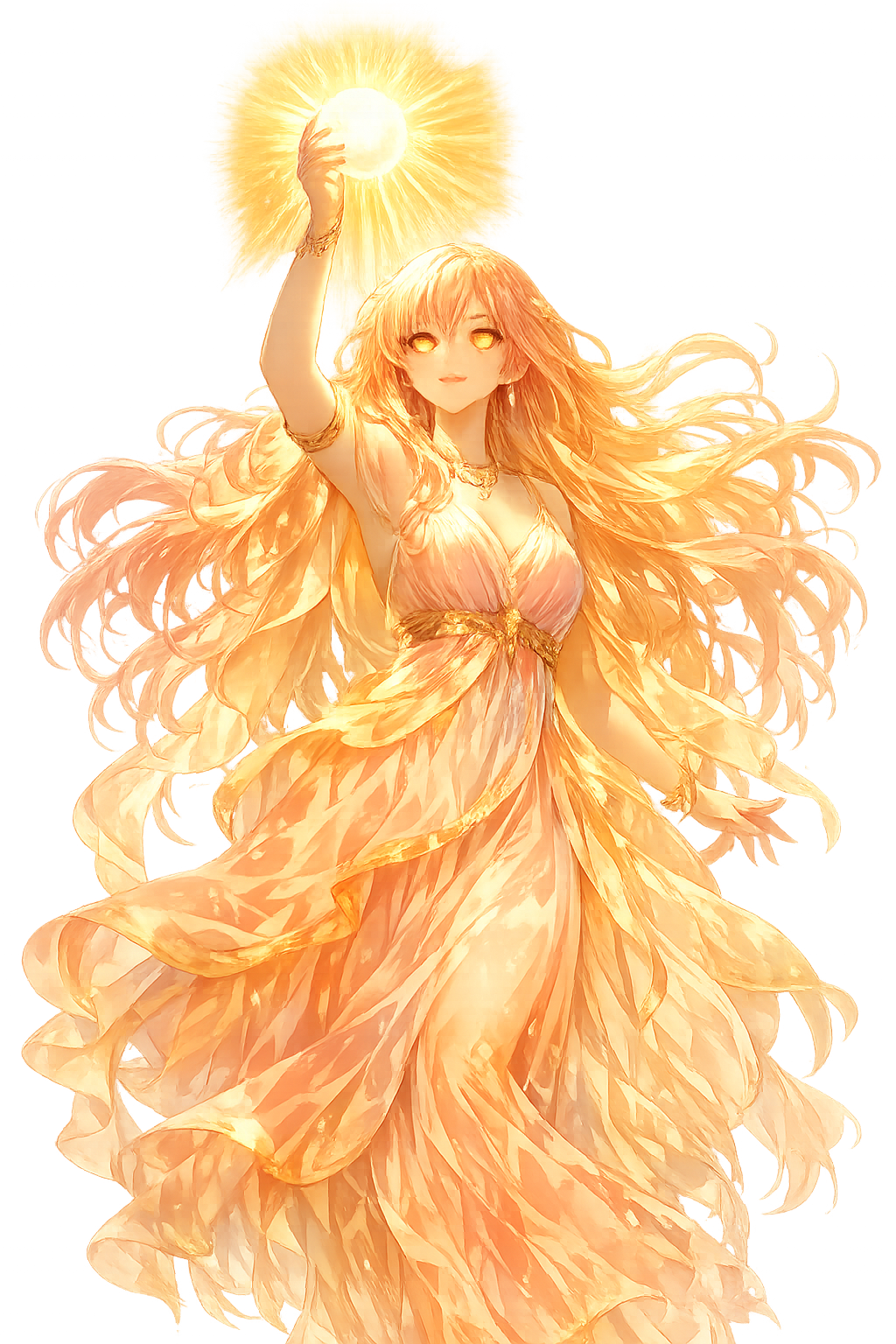
Hēméra's image is modest and constant: a standing woman in pale drapery, torch in hand, hair bound — one figure in the vase-painters' chorus of personifications, distinguished from winged Eos by her diffused, sourceless light. The LIMC catalogs her appearances in Attic and South Italian painting beside Nyx and the daughters of Time. Her most durable medium was the floor: Roman and late-antique mosaics from North Africa and the eastern provinces set a torch-bearing Day against a veiled Night across thresholds, bath pavements, and tombs, and sarcophagus workshops repeated the couple as an emblem of mortal time — the image doing quietly what Hesiod's poem says aloud. Renaissance and Baroque allegory inherited the pair whole: Michelangelo's Day and Night for the Medici Chapel at San Lorenzo still guards a tomb with the ancient couple, exactly where antiquity had placed them.

06

Reception & Transformation

The name after its own age — transmission, translation, survival

Afterlives

In Byzantium the Theogony was a school text, copied and scholiated through the medieval centuries — the vehicle that carried Hēméra's bronze threshold safely to the Renaissance, which printed it at Milan in the 1490s and read her doorkeeping literally again. Learned commentary has never stopped testing her passage: the house beyond Atlas, whose two residents never meet, has been suspected as interpolation, read as cosmology, and — since M. L. West's edition (1966) — compared with far older Near Eastern gates of day and night. Her personification had a quieter afterlife than her word: medieval and Modern Greek kept iméra as the plain everyday word for day, and scholars built ‘hemerology’ as the name for calendar science. Of all the daughters of Night, she is the one who never needed revival — her name is still the ordinary word for the thing she is.

Identifications Across Traditions

The Romans personified the day as Dies, though she never achieved a developed mythic personality like the Greek Hēméra; Roman religion preferred the abstraction — dies fastus, nefastus — to the goddess. Hēméra was increasingly conflated in later thought with Eos/Aurora, the dawn, and with Hēlios/Sol, the sun, because all three bring light; but Hesiod's grammar keeps them distinct — Eos is the morning's edge, Hēlios the sun's body, Hēméra the whole bright interval. Orphic cosmogonies elevated her and her brother, setting Aithḗr and Hēméra among the first principles gathered about the world-egg, and the Neoplatonists read the Day-Night threshold-house as an image of cosmic alternation and the return of opposites. Modern Greek still says iméra for 'day,' and English keeps her in ephemeral — that which lasts but one of her hours — and in hemerology, the study of calendars.

Modern Legacy

Hēméra lives on in language rather than cult — she never had a major sanctuary or festival, her worship dissolving into the day's own round of business and omen. The Greek word for day, ἡμέρα, underlies English ephemeral (lasting a single day) and hemerology (the science of calendars), and botany's Hemerocallis, the day-lily that opens and closes within her hours — 'beauty for a day'. In allegorical art from late antiquity through the Renaissance she appears as a pale woman with a torch or a rooster, usually paired with a veiled Nyx — the bronze threshold translated into marble, mosaic, and paint. Modern Hellenic and Neopagan devotion has reclaimed her as a goddess of morning intention, of clarity, and of the sacred ordinary. Her name reminds us that the day itself was once a presence with a genealogy — a daughter of Night, not a number on a dial, and a guest who always leaves on time.

07

The Meditation

What Hēméra means — beyond the dictionary

Hēméra is the goddess of the obvious made strange. We say "day" hundreds of times without thinking, but for the Greeks it was a being that rose from darkness, walked across the sky, and returned home at evening. To name Hēméra is to recover the sense that daylight is a gift, an interval, a borrowed radiance that must be given back each night.

Modern life has blurred her threshold. Electric light keeps us awake after she has gone; screens replace her with a lesser glow. Restoring Hēméra in Unicode is a small act of remembering that there is a difference between the sun and the day, between brightness and the time brightness makes. She is the measured day, the day that can be spent well or wasted — the original meaning of ephemeral.

08

Frequently Asked Questions

Common questions about Hēméra, Day, and Unicode restoration

01How do you pronounce Hēméra?

In reconstructed pronunciation, Hēméra is /hɛː.mé.raː/ — approximately "hay-MEH-RAH" — first syllable long and deep like 'hay'; middle syllable pitched high like 'MEH'; final 'rah' is held slightly longer than English usually allows.

02What does Hēméra mean?

Hēméra means Day in the greek tradition.

03What are the symbols of Hēméra?

Hēméra is associated with Rooster (The bird that announces her arrival and drives away Nyx), Torch (The pale flame that she carries as she leaves the house of Night), White robe or veil (The garment of diffused daylight), Chariot (The vehicle that bears her across the sky, paired with but distinct from Hēlios's solar car), The threshold (The bronze doors where Day and Night exchange places).

04Why are there different spellings of Hēméra?

Each form is a historically attested restoration rather than a mistake: Hēmera is the macron-only form (Owned domain form: length only, no acute). PUNICODEX registers the full set so the tradition is preserved under every defensible spelling.

05Why restore Hēméra in Unicode?

Plain ASCII hemera strips the stress, length, and script that make the name specific. Unicode restoration returns the name to its original written dignity.

06What is the most important myth about Hēméra?

“Born from Darkness” — the Theogony story that anchors the mythology of Hēméra, told in full on the lore page.

09

Scholarly Sources

The philological foundations of this restoration

Every claim on this page is grounded in established scholarship. The orthographic restorations follow disciplinary convention. The etymological chain follows the best available reference works. This is not invention — it is resurrection through scholarship.

◈

Lexicography & Philology

  • Liddell, H. G., Scott, R., & Jones, H. S. A Greek-English Lexicon. Oxford: Clarendon Press, 9th ed. 1996.
◎

Primary Texts

  • Hesiod
  • Hesiod, Theogony 123–125 (birth of Aithḗr and Hēméra) and 744–757 (the bronze threshold of Night and Day)
◉

Archaeology & Art History

  • Material evidence — iconography, inscriptions, and temple archaeology — for Hēméra and related cults.
✦

Religious Studies

  • Aristophanes, Birds 693–703 (the birds' cosmogony)
  • Hyginus, Fabulae, preface (Caligo, Chaos, Nox, Dies, Erebus, Aether)
  • Allen, W. Sidney, Vox Graeca, 3rd ed., Cambridge, 1987; and Beekes, Robert, Etymological Dictionary of Greek, Brill, 2010, s.v. ἡμέρᾱ
  • Lexicon Iconographicum Mythologiae Classicae (LIMC), s.v. Hemera
  • West, M. L., The Orphic Poems, Oxford, 1983
Return

The Surface Awaits

You have traced the name from its earliest attestation to its Unicode restoration. Now return to the myth. The story is where the name lives.

Back to Lore
Hēméra mascot