
Pronouncing Hel: a guide for the curious
Saying Hel aloud is harder than reading it on a screen, and more rewarding. The restored spelling is a compressed pronunciation guide: every accent and macron is an instruction. This post unpacks those instructions — the reconstructed sound, the phoneme-by-phoneme record, the kindred forms in neighboring languages — and then zooms out to the full record around the name: its Younger Futhark writing, its mythology, its cult, and its modern life as a Unicode domain. Whether you arrive as a linguist, a reader of myth, or a domainer, you will leave able to say the name the way the evidence suggests it was said — and able to type it the way it was written.
At a Glance
- Restored name: Hel
- ASCII form: hel
- Meaning: "Hidden one (from *heljan)"
- Domain of influence: Death, Underworld, Souls
- Pantheon: Norse
- Classification: Tier 2
- Original script: ᚼᛁᛚ (Younger Futhark)
Overview
Hel (hel) — Death, Underworld, Souls · Hidden One — is the daughter of Loki and the giantess Angrboða, sister to the wolf Fenrir and the serpent Jǫrmungandr, whom Óðinn cast down into Niflheimr and set over the dead: those who die of sickness and of old age are sent to her, and she apportions their dwellings in nine worlds.
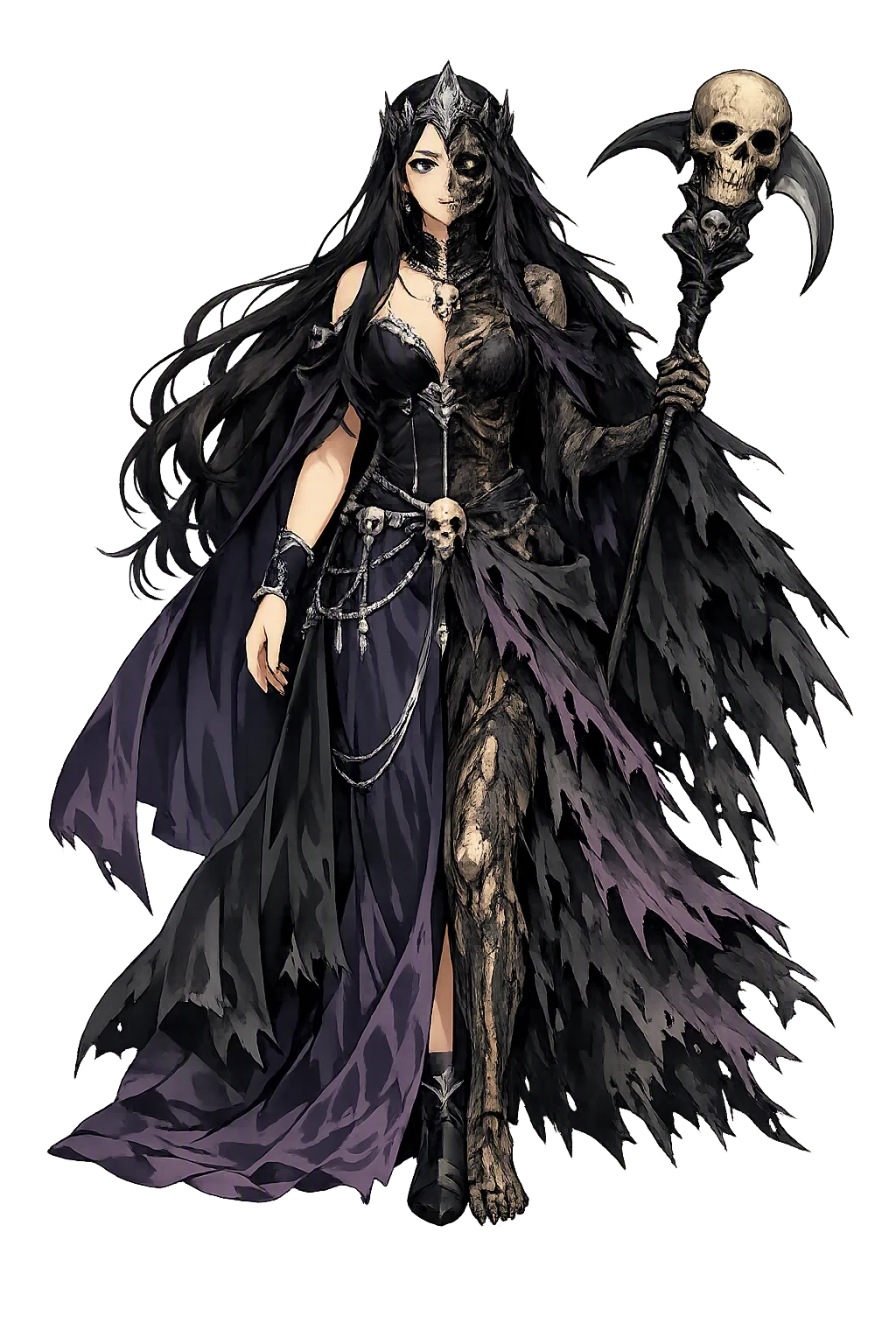
Her hall is Éljúðnir, her dish Hunger and her knife Famine, her threshold Plunging to Destruction and her bed the Sick-bed hung with Gleaming Bale; she herself is half blue-black and half the colour of living flesh — 'easily recognized', Snorri says, downcast and fierce. Her one great scene is the hinge of the Baldr tragedy: when Hermóðr rides nine nights to ransom the dead god, it is Hel who sets the condition on which everything turns — if all things in the world weep for Baldr, he may return.
PuniCodex restores the name as Hel. The normalized Old Norse form is already plain ASCII — three letters and a capital, with no diacritic or distinctive letter for the restoration to recover — and so the name is Tier 2 by the project's mechanical rule: the ASCII form loses nothing. This temple is domain-less: hel.com is a plain-ASCII address registered decades ago and is held by a third party outside the PuniCodex collection, watched for release; the project owns no form of this name and claims none.
The Name
The name is attested in Old Norse as Hel — at once the goddess's name and the common noun hel 'death, the grave, the realm of the dead'. It descends from Proto-Germanic haljō, formed on the verb helan / heljan 'to conceal, to cover': the hidden thing, and so 'the hidden one'. The lexicon glosses the meaning accordingly as 'Hidden one (from heljan)'. The word is pan-Germanic: Gothic halja appears already in Ulfilas's fourth-century Bible translation, and Old English helle and Old High German hella* continue it as the place of the dead.
A genuine scholarly debate attaches to the name, and this edition registers it honestly. The continental languages attest the realm everywhere and the goddess nowhere; Jacob Grimm reconstructed a continental goddess Halja, but modern handbooks (Simek, Lindow) leave open whether Hel the person is an old deity or a Scandinavian personification of the older grave-word — the hidden place given a face. The lexicon's etymology itself is not in dispute: the derivation from heljan* 'to conceal' is secure.
Because the normalized form is pure ASCII, the letter-by-letter transformation is the shortest in the Norse catalogue:
- h → H — Same, capitalized
- e → e — Same
- l → l — Same
Only the capitalization changes. The name is classified Tier 2 by the mechanical rule — the restoration preserves nothing the ASCII form loses — which says something about the orthography and nothing about the goddess. The plain-ASCII address hel.com is held by a third party outside the collection and watched for release; this temple claims no domain.
Etymology & Roots
The recorded derivation reads: Hidden one (from *heljan)
The reconstructed proto-form is *heljan (proto-indo-european), glossed as "Hidden one".
The reconstruction is classed as attested.
The Original Script
The name is preserved in medieval Icelandic manuscripts in the Latin alphabet as Hel — Old Norse (North Germanic), attested 13th c. CE in the Codex Regius of the Poetic Edda and the early codices of Snorri's Edda, recording material centuries older. The word's deeper attestation is Germanic-wide: Gothic halja stands already in Ulfilas's fourth-century Bible translation.
The scholarly rendering proceeds step by step:
- The form is Hel, a feminine noun from Proto-Germanic haljō, built on the verb helan / heljan 'to conceal, to cover' — hence 'hidden one / concealment'.
- Old Norse writes three plain Latin letters; there is no vowel length, diacritic, or distinctive letter for a Unicode restoration to recover, which is why the name is Tier 2 by the project's mechanical rule.
- In the Younger Futhark the name would have been carved ᚼᛁᛚ (h-i-l, the ᛁ-rune covering e), though no runic attestation of the theonym survives.
- The plain-ASCII domain hel.com is held by a third party outside the PuniCodex collection and is watched for release; no form of the name is owned, and this temple claims none.
Pronunciation
The reconstructed pronunciation of the name is /ˈhel/ — Old Norse Reconstruction.
Phoneme by phoneme:
- H- — Voiceless glottal fricative [h], fully sounded as in English hall
- -e- — Short close-mid front vowel [e], held brief; the short e of the verb heljan, not a long é
- -l — Single clear alveolar lateral [l]; the manuscripts write one l and the name keeps it light
For the modern speaker, the closest approximation is: 'HEL' — one crisp syllable, a short bright 'e' as in get, a single clean l. The English word hell is the name's own descendant and nearly its own pronunciation.
Kindred and historical forms of the name:
- Old Norse — Hel, the goddess and the realm; the common noun hel 'death, the grave'
- Gothic — halja, the underworld-word of Ulfilas's fourth-century Bible
- Old English / Old High German — helle / hella, the realm kept without the goddess
- Proto-Germanic — haljō, from helan / heljan 'to conceal, to cover'
Hel is Tier 2 because the restoration preserves nothing ASCII loses: no diacritic, no distinctive letter, no vowel length. Three plain letters carry the whole underworld.
Mythology
Hel's mythology is an origin, a judgment, and a standing geography: she acts rarely and presides always.
The Casting Down (Gylfaginning 34)
Loki got three children on the giantess Angrboða: the wolf Fenrir, the serpent Jǫrmungandr, and Hel. When the gods learned the brood was being raised and read in prophecy that great harm would come of it, Óðinn disposed of each: the serpent into the encircling sea, the wolf kept among the Æsir to be bound, and Hel cast down into Niflheimr with authority over nine worlds — to apportion dwellings among those sent to her, the sickness-dead and the age-dead. Snorri then gives the inventory: the hall Éljúðnir, the dish Hunger and knife Famine, the slow-walking servants, the threshold Plunging to Destruction, the bed Sick-bed hung with Gleaming Bale — and the goddess herself, half blue-black and half flesh-coloured, downcast and fierce.
The Weeping Condition (Gylfaginning 49)
When Baldr lay dead and Hermóðr had ridden the nine nights, leapt Helgrindr on Sleipnir, and found his brother in the hall's high seat, he asked Hel for Baldr's release. Her answer is her only speech in the corpus, and the end of the world turns on it: if all things, living and lifeless, weep for Baldr, he shall return; if anything refuses, he stays with Hel. All things wept — men and beasts, earth and stones, trees and metals — until one giantess in a cave, calling herself Þökk, wept dry tears: 'let Hel hold what she has.' The gods suspected Þökk was Loki in disguise. Baldr stayed.
The Strewn Benches (Baldrs draumar)
Before the fall, Óðinn himself rode down to a grave-mound east of Hel's gate and woke a dead völva, who told him for whom the realm was dressed: the benches strewn with arm-rings, the mead brewed, the shields overspread — for Baldr. The poem's glimpse inside the hall is the other side of Snorri's famine inventory: Hel's house is also a hall of honour, prepared in advance and shining, for the guest it expects.
The Geography (Vafþrúðnismál 43; Grímnismál 31)
The Poetic Edda keeps her realm on the map: Óðinn's proof of far travel is that he passed through nine worlds below Niflhel, 'thither men die out of Hel'; and Grímnismál plants Hel's dwelling beneath one of the three roots of Yggdrasill. The dead are not elsewhere — they are under the same tree, at another root.
Symbols & Iconography
Hel's iconography is an inventory: Gylfaginning 34 furnishes her hall with named fittings that do the work a cult statue never did — the attributes are household objects, and each is named for what it takes away.
- The half-blue, half-flesh face — half blue-black, half the colour of living flesh: the two states of being divided by a single line, making her 'easily recognized'
- Éljúðnir — her hall, 'Sprayed with Snowstorms', behind high walls and great gates: architecture for the ordinary ending
- Hungr and Sultr — her dish Hunger, her knife Famine: the table-service of the wasting deaths she rules
- Fallanda Forað — 'Plunging to Destruction', the threshold of her bedchamber
- Kǫr and Blíkjanda Bǫl — her bed, the Sick-bed, and its hangings, Gleaming Bale: the dead received as the sick are received to bed
- Ganglati and Ganglǫt — her serving-man and serving-maid, both named for the slow walk: time in Hel moves at a dying pace
Archaeology & Evidence
Hel is a textual figure: no runestone invokes her, no votive deposit names her, and no Scandinavian place-name can be securely tied to her cult — a silence she shares with the corpus's whole chthonic stratum. Her attestation is manuscript evidence: the Codex Regius of the Poetic Edda (Vafþrúðnismál, Grímnismál), the fourteenth-century AM 748 I 4to that alone preserves Baldrs draumar, and the early codices of Snorri's Edda, composed about 1220.
The word beneath her is far better attested than the goddess: Gothic halja appears in Ulfilas's fourth-century Bible translation, and Old English helle and Old High German hella fill the continental record as the name of the dead's place — but nowhere outside Scandinavia does the place carry a person. That distribution is itself the central datum in the debate over whether Hel is an old goddess or a late personification of the grave-word, a question Simek and Lindow keep open. Saxo's Proserpina in Gesta Danorum Book 1 is the nearest thing to an independent witness: a Danish historian already translating her for Latin readers before Snorri's Edda took its final shape.
Realm & Domain
Hel is catalogued under the domain Death, Underworld, Souls — the keeper of the dead who do not fall in battle, and the ruler of the place that shares her name.
The Unheroic Dead
Óðinn's grant to her is explicit: she apportions dwellings to all who are sent to her — 'and those are the sickness-dead and the age-dead'. Where Óðinn's Valhǫll selects the spectacular few, Hel receives the ordinary majority of humankind.
The Underworld
Her realm lies beneath one root of Yggdrasill (Grímnismál 31), and the corpus layers it downward: Óðinn boasts of travelling the nine worlds below Niflhel, 'thither men die out of Hel' (Vafþrúðnismál 43). The hidden one is hidden under the world's own structure.
The Boundary
The road to her is measured in the Hermóðr myth — nine nights through dark valleys, the river Gjǫll, the gold-thatched bridge, the barred gate Helgrindr. What crosses in does not cross out: 'let Hel hold what she has' is her realm's whole charter.
Loki's House
She is the daughter of Loki and Angrboða, sister of Fenrir and Jǫrmungandr — the three children the gods could not kill and could only dispose of: the sea, the fetter, and the grave.
Across Cultures
The oldest syncretism is the one the sources perform on themselves: Saxo Grammaticus, writing Latin for a Danish court a generation before Snorri's Edda reached its final form, cannot say 'Hel' and so writes Proserpina — in Gesta Danorum Book 1 the goddess appears to Balderus in a dream as Proserpina, promising the dead man her embraces, the interpretatio latina folded directly into the plot. The same book sends the hero Hading under the earth, past a river crossed by a bridge, in a journey whose geography matches the Norse Hel-road.
The Greek comparison runs deeper than the name-swap: like Hades, Hel is both a person and a place — one goes til Heljar, to Hel, as one goes to Hades — and scholars since Grimm have asked whether the person is as old as the place. Grimm projected a continental goddess Halja backward from the Gothic and Old High German words; current scholarship (Simek, Lindow) is cooler, noting that the continent attests the realm but never the ruler, and leaving open whether the goddess is a Scandinavian personification of the grave-word.
The largest syncretism is the one history performed unasked: Christianity took the word itself and made it 'hell', the punitive fire of the damned — recolouring the goddess's quiet hall of the sick-dead into the most feared address in the language. Her name survived by being emptied of her.
Cultural Legacy
Hel's afterlife is the English language's own: every speaker of English, German, or the Scandinavian tongues pronounces her name each time they say hell — the commonest relic any Norse deity has left behind, carried out of the temple and into the swear-word. The word's journey is her biography in reverse: the goddess faded, the place-name endured, and the place darkened from a hall of the age-dead into a prison of fire.
Modern reception has restored the person, if not the theology. She returns in Victorian and twentieth-century mythography, in Neil Gaiman's Norse Mythology (2017), and most visibly in Marvel's Hela, whose shadowed iconography reaches back past the comics to Snorri's two-coloured face. In modern Heathen and Ásatrú practice she is kept as the keeper of the ordinary ancestors — the goddess for everyone who will not die in battle, which is to say for nearly everyone — and the Baldr rites of the revival keep her single line of dialogue at the centre of the year's grief-cycle.
The Scholarly Record
The account of Hel given in this edition rests on the witnesses and reference works listed below. The Eddas supply the origin, the judgment, and the geography; Saxo supplies the interpretatio latina; the lexica secure the etymology; the modern handbooks frame the personification debate.
- Snorri Sturluson, Edda, Gylfaginning 34 (Loki's children; Hel cast into Niflheimr; Éljúðnir and its fittings) and 49 (Hermóðr's errand; the weeping condition), ed. and trans. Anthony Faulkes (London: Everyman, 1987).
- The Poetic Edda, trans. Carolyne Larrington, 2nd ed. (Oxford: Oxford University Press, 2014): Vafþrúðnismál 43; Grímnismál 31; Baldrs draumar.
- Saxo Grammaticus, Gesta Danorum, Book 1 (Proserpina's promise to Balderus; Hading's journey under the earth), trans. Peter Fisher, ed. Hilda Ellis Davidson (Cambridge: D. S. Brewer, 1979).
- Cleasby, Richard, and Guðbrandur Vigfússon, An Icelandic-English Dictionary, 2nd ed. (Oxford: Clarendon Press, 1957), s.v. hel, Hel, helja.
- Zoëga, Geir T., A Concise Dictionary of Old Icelandic (Oxford: Clarendon Press, 1910), s.v. Hel.
- de Vries, Jan, Altnordisches etymologisches Wörterbuch, 2nd ed. (Leiden: Brill, 1962), s.v. Hel, hel.
- Simek, Rudolf, Dictionary of Northern Mythology, trans. Angela Hall (Cambridge: D. S. Brewer, 1993), s.v. Hel.
- Lindow, John, Norse Mythology: A Guide to the Gods, Heroes, Rituals, and Beliefs (Oxford: Oxford University Press, 2001), s.v. Hel.
- Orchard, Andy, Dictionary of Norse Myth and Legend (London: Cassell, 1997), s.v. Hel.
- Grimm, Jacob, Teutonic Mythology, trans. James Steven Stallybrass, 4 vols. (London: George Bell, 1882–88).
A Meditation
Hel is what the gods do with what they cannot destroy. Óðinn cannot kill Loki's daughter — the prophecies forbid the thought — so he hides her, and the hiding is so thorough that it becomes an office: the concealed one becomes the keeper of everyone else the world conceals. Her name says it plainly: the hidden one, from the verb for covering over.
And her charter is more honest than Valhǫll's. Óðinn's hall takes the spectacular few, the spear-marked and the chosen; Hel takes the rest — the sick, the old, the farmers in their beds — which is to say she receives, in the end, almost the whole of humankind, and keeps it behind a gate no god has ever forced. 'Let Hel hold what she has' was meant as a curse. It is also simply the truth of things, and the Edda knew it: everything that dies quietly is already hers, and she has never once given it back.
The Unicode Restoration
Hel is classified as Tier 2: the restoration needs no distinctive letters or diacritics its ASCII form would lose. The ASCII fallback hel still resolves everywhere, but it is the restored form that carries the name's full information. That is the whole thesis of this temple: the marks are the message.
Why This Restoration Matters
Pronunciation turns out to be the heart of the matter. The marks in Hel are instructions for the voice, and a web that strips them is a web that mispronounces the past at scale. The restoration hands the instructions back: say it as the evidence suggests, type it as the tradition wrote it, and let the punycode machinery do the quiet translation in between. That is all the PuniCodex project asks of the infrastructure — and everything it asks of you, the reader, is to use the whole name.
Explore Further
This post is one doorway into the temple. The home page carries the full character breakdown and the ambient canvas; the lore page tells the myths in long form; the Scholarly Edition preserves the sources, pronunciation data, and revision history; and the patron wall supports the restoration directly. For the wider map, browse the Lexicon, explore the Pantheon, or return to the PuniCodex blog.
Related Names
Sources
The full scholarly apparatus — every citation, revision, and review — lives in the Scholarly Edition. Key references for this post:
- Snorri Sturluson, Edda, Gylfaginning 34 (Loki's children; Hel cast into Niflheimr; the hall and its fittings; her appearance), ed. and trans. Anthony Faulkes (London: Everyman, 1987).
- Snorri Sturluson, Edda, Gylfaginning 49 (Hermóðr's errand and Hel's condition), trans. Faulkes (1987).
- Simek, Rudolf, Dictionary of Northern Mythology, trans. Angela Hall (Cambridge: D. S. Brewer, 1993), s.v. Hel.
- Cleasby, Richard, and Guðbrandur Vigfússon, An Icelandic-English Dictionary, 2nd ed. (Oxford: Clarendon Press, 1957), s.v. hel, Hel, helja.
- Lexicon authorities for this entry: Cleasby-Vigfusson, Zoëga.