PuniCodex

Extended Lore

Hel — The Deeper Record

Etymology · Orthography · Cult · Iconography · Reception · Sources

ASCII-equivalent form Hel
Hel — Death, Underworld, Souls
01

At a Glance

Hel — every fact links to its home

PantheonNorse
DomainDeath, Underworld, Souls
Original Scriptᚼᛁᛚ →
Primary Sources3 cited →
02

Etymology & Word Family

From original script to canonical restoration — the full etymology page →

Proto-indo-european *heljan Hidden one
Original Script ᚼᛁᛚ Hel — "Hidden one (from *heljan)"
Canonical Restoration Hel Canonical scholarly spelling — ASCII-identical
Modern ASCII hel Plain-ASCII fallback

Hidden one (from *heljan)

03

Character breakdown

Character-by-character philological analysis

CharacterUnicodeNameBlockPhonetic Role
HU+0048Latin Capital Letter HBasic LatinSame
eU+0065Latin Small Letter EBasic LatinSame
lU+006CLatin Small Letter LBasic LatinSame

This restoration reflects fidelity to the attested tradition, not recovered diacritics: every character of Hel already survives in ASCII. What the restoration preserves is the canonical spelling itself — the form scholarship standardised.

04

Cult & Worship

How the sacred was kept — rites, sanctuaries, remains

The Cult

Hel received no known cult, and the silence is itself the evidence. No runestone invokes her, no Scandinavian place-name securely contains her name, no votive deposit addresses her: for the Viking North the sick- and age-dead simply went to her, and the living dealt with their own dead in the grave rather than with her in any sanctuary. Her domain needed no priesthood, because every funeral was her liturgy and every grave her temple. The one ritual drama the corpus stages is an embassy, not a sacrifice — Hermóðr riding to her barred gate, and her conditional verdict on Baldr. Modern Heathenry has since built her a devotional life, honoring her as keeper of the ordinary ancestors; but that is a revival movement, centuries and honestly labeled away from anything the Viking Age attests.

In the Earth

Hel is a textual figure: no runestone invokes her, no votive deposit names her, and no Scandinavian place-name can be securely tied to her cult — a silence she shares with the whole chthonic stratum of the pantheon. Her attestation is manuscript evidence: the Codex Regius of the Poetic Edda (Vafþrúðnismál, Grímnismál), the fourteenth-century AM 748 I 4to that alone preserves Baldrs draumar, and the early codices of Snorri's Edda, composed about 1220. The word beneath her is far better attested than the goddess: Gothic halja appears in Ulfilas's fourth-century Bible translation, and Old English helle and Old High German hella fill the continental record as the name of the dead's place — but nowhere outside Scandinavia does the place carry a person. That distribution is itself the central datum for the scholarly debate over whether Hel the goddess is an old figure or a late personification of the grave-word, a question Simek and Lindow keep open. Saxo's Proserpina in Gesta Danorum Book 1 is the nearest thing to an independent witness: a Danish historian, a generation before Snorri's Edda reached its final form, already translating her for Latin readers.

05

Iconography

How Hel was imaged across the ages

The Image

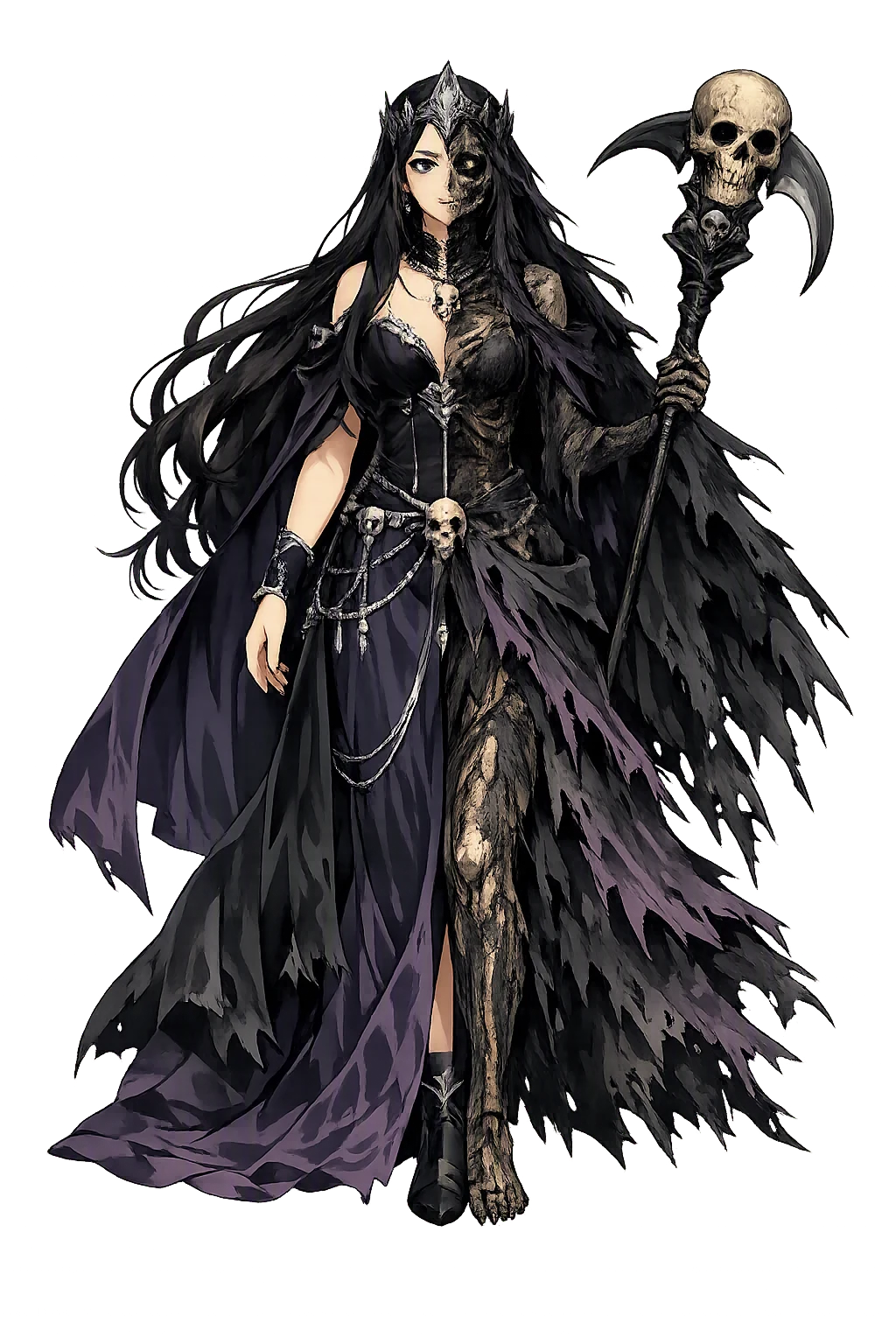
No Viking Age image of Hel survives that scholars will swear to, and her portrait was always textual: half blue-black, half living flesh, downcast and fierce — Snorri's two-toned face, ‘easily recognized’, the seam between the quick and the dead worn on a single head. The corpus gives attributes without an artist: Éljúðnir behind its high gates, a household furnished out of hunger, the half-corpse countenance. The first pictures we actually possess are paper: early-modern Icelandic illuminators of Snorri's Edda — the manuscript artists of the seventeenth and eighteenth centuries — drew her exactly as Gylfaginning describes, divided down the middle, and it is those book illustrations that fixed her face for every later century. Antiquarian and Romantic mythography adopted the divided mask wholesale; a portrait invented in a scriptorium became the one part of Hel no generation has ever given back.

06

Reception & Transformation

The name after its own age — transmission, translation, survival

Afterlives

Hel's journey ran backward: the person died first, the word last. Her poems survived in three medieval codices — the Codex Regius, the fourteenth-century AM 748 that alone preserves Baldrs draumar, and the early manuscripts of Snorri's Edda — and when antiquarian editors lifted the Edda from parchment to print in the seventeenth and eighteenth centuries, her dossier was among the strangest cargo: a goddess no church father had mentioned, ruling a realm the church had already redecorated. The Northern Renaissance received her as a puzzle. Mallet and Percy introduced her to European readers; the nineteenth century, raising runestones and grave-goods from the soil, made her the standing test case of a hard question — when does a word for the grave grow into its keeper? That question remains her monument: Simek and Lindow still leave it open. Her only continuous portrait is younger still — the two-coloured face invented by an Icelandic illuminator and adopted by Victorian mythography, an image younger than her philology.

Identifications Across Traditions

The oldest syncretism is the one the sources perform on themselves: Saxo Grammaticus, writing Latin for a Danish court, cannot say 'Hel' and so writes Proserpina — in Gesta Danorum Book 1 the goddess appears to Balderus in a dream as Proserpina, promising the dead man her embraces, the interpretatio latina folded directly into the plot. The Greek comparison runs deeper than the name-swap suggests: like Hades, Hel is both a person and a place, and the Old Norse word does the same double duty — one goes til Heljar, to Hel, as one goes to Hades. Jacob Grimm projected the goddess backward onto the continent as *Halja, citing the Gothic and Old High German words; current scholarship (Simek, Lindow) is cooler, noting that the continental languages attest the realm but never the ruler, and that the goddess may be a Scandinavian personification of an older common noun — the hidden place given a face. The largest syncretism is the one history performed without asking: Christianity took the word itself and made it 'hell', the punitive fire of the damned, recoloring the goddess's quiet hall of the sick-dead into the most feared address in the language. Her name survived by being emptied of her.

Modern Legacy

Hel's afterlife is the English language's own: every speaker of English, German, or the Scandinavian tongues still pronounces her name every time they say hell — the commonest relic any Norse deity has left behind, carried out of the temple and into the swear-word. The word's journey is her biography in reverse: the goddess faded, the place-name endured, and the place darkened from a hall of the age-dead into a prison of fire. Modern reception has restored the person, if not the theology: she returns in Wagnerian and Victorian mythography, in Neil Gaiman's retellings, and most visibly in Marvel's Hela, whose half-shadowed iconography reaches back past the comics to Snorri's two-coloured face. Modern Heathenry keeps her as the keeper of the ordinary ancestors — the goddess for everyone who will not die in battle, which is to say, for nearly everyone.

08

The Original Script Note

What the written record preserves — and what it does not

Original Script

The normalized Old Norse form is Hel — already plain ASCII, with no diacritic or distinctive letter for the restoration to recover; in the Younger Futhark the name would have been carved ᚼᛁᛚ (h-i-l, the ᛁ-rune covering e, as the Viking-Age row does not distinguish the front vowels). Because the name is pure ASCII, its domain was registered decades ago in the ordinary way: hel.com is held by a third party outside the PuniCodex collection and is watched for release — no form of the name is currently owned, and this temple claims none.

09

The Meditation

What Hel means — beyond the dictionary

Hel is what the gods do with what they cannot destroy. Óðinn cannot kill Loki's daughter — the prophecies forbid the thought — so he hides her, and the hiding is so thorough that it becomes an office: the concealed one becomes the keeper of everyone else the world conceals. Her name says it plainly: the hidden one, from the verb for covering over. Every grave is a small act of heljan. And her charter is more honest than Valhǫll's: Óðinn's hall takes the spectacular few, the spear-marked and the chosen; Hel takes the rest — the sick, the old, the children, the farmers in their beds — which is to say she receives, in the end, almost the whole of humankind, and keeps it behind a gate no god has ever forced. 'Let Hel hold what she has' was meant as a curse. It is also simply the truth of things, and the Edda knew it: everything that dies quietly is already hers, and she has never once given it back.

10

Screen & Culture

Where Hel echoes through film, television, and games — and how

11

Frequently Asked Questions

Deep-dives into the cult, attestation, reception, and sources of Hel

01How do we know how Hel was worshipped?

Hel is a textual figure: no runestone invokes her, no votive deposit names her, and no Scandinavian place-name can be securely tied to her cult — a silence she shares with the whole chthonic stratum of the pantheon. The full cult record →

02Where do the earliest attestations of Hel come from?

The record rests on Poetic Edda: Vafþrúðnismál 43 (the nine worlds below Niflhel; men dying out of Hel), Grímnismál 31 (Hel beneath one root of Yggdrasill), Baldrs draumar (the benches strewn and the mead brewed for Baldr), Snorri Sturluson, Prose Edda: Gylfaginning 34 (Loki's children; Hel cast into Niflheimr; the hall Éljúðnir and its named fittings; her half-blue appearance) and 49 (Hermóðr's errand and the weeping condition), Saxo Grammaticus, Gesta Danorum, Book 1 (Proserpina's promise to Balderus), trans. Peter Fisher, ed. Hilda Ellis Davidson, among 5 cited works. The full source apparatus →

03How did later traditions reinterpret Hel?

Hel's journey ran backward: the person died first, the word last. Reception & transformation →

04What do the surviving images of Hel actually show?

No Viking Age image of Hel survives that scholars will swear to, and her portrait was always textual: half blue-black, half living flesh, downcast and fierce — Snorri's two-toned face, ‘easily recognized’, the seam between the quick and the dead worn on a single head. The iconography →

05What does the written record of Hel actually preserve?

The normalized Old Norse form is Hel — already plain ASCII, with no diacritic or distinctive letter for the restoration to recover; in the Younger Futhark the name would have been carved ᚼᛁᛚ (h-i-l, the ᛁ-rune covering e, as the Viking-Age row does not distinguish the front vowels). The Original Script note →

12

Scholarly Sources

The philological foundations of the record

Every claim on this page is grounded in established scholarship. The orthographic restorations follow disciplinary convention. The etymological chain follows the best available reference works. This is not invention — it is resurrection through scholarship.

◈

Lexicography & Philology

  • Cleasby-Vigfusson
  • Zoëga
◎

Primary Texts

  • Poetic Edda: Vafþrúðnismál 43 (the nine worlds below Niflhel; men dying out of Hel), Grímnismál 31 (Hel beneath one root of Yggdrasill), Baldrs draumar (the benches strewn and the mead brewed for Baldr)
  • Snorri Sturluson, Prose Edda: Gylfaginning 34 (Loki's children; Hel cast into Niflheimr; the hall Éljúðnir and its named fittings; her half-blue appearance) and 49 (Hermóðr's errand and the weeping condition)
  • Saxo Grammaticus, Gesta Danorum, Book 1 (Proserpina's promise to Balderus), trans. Peter Fisher, ed. Hilda Ellis Davidson
◉

Archaeology & Art History

  • Foote, P., & Wilson, D. M. The Viking Achievement; Graham-Campbell, J. Viking Art.
✦

Religious Studies

  • Cleasby–Vigfusson, An Icelandic-English Dictionary, s.v. hel (death, the grave, the goddess) and heljan
  • Simek, Dictionary of Northern Mythology; Orchard, Dictionary of Norse Myth and Legend; Lindow, Norse Mythology: A Guide — s.v. Hel (the etymology, the personification debate, the realm-versus-ruler problem)
Return

The Surface Awaits

You have traced the name from its earliest attestation to its canonical restoration. Now return to the myth. The story is where the name lives.

Back to Lore
Hel mascot