
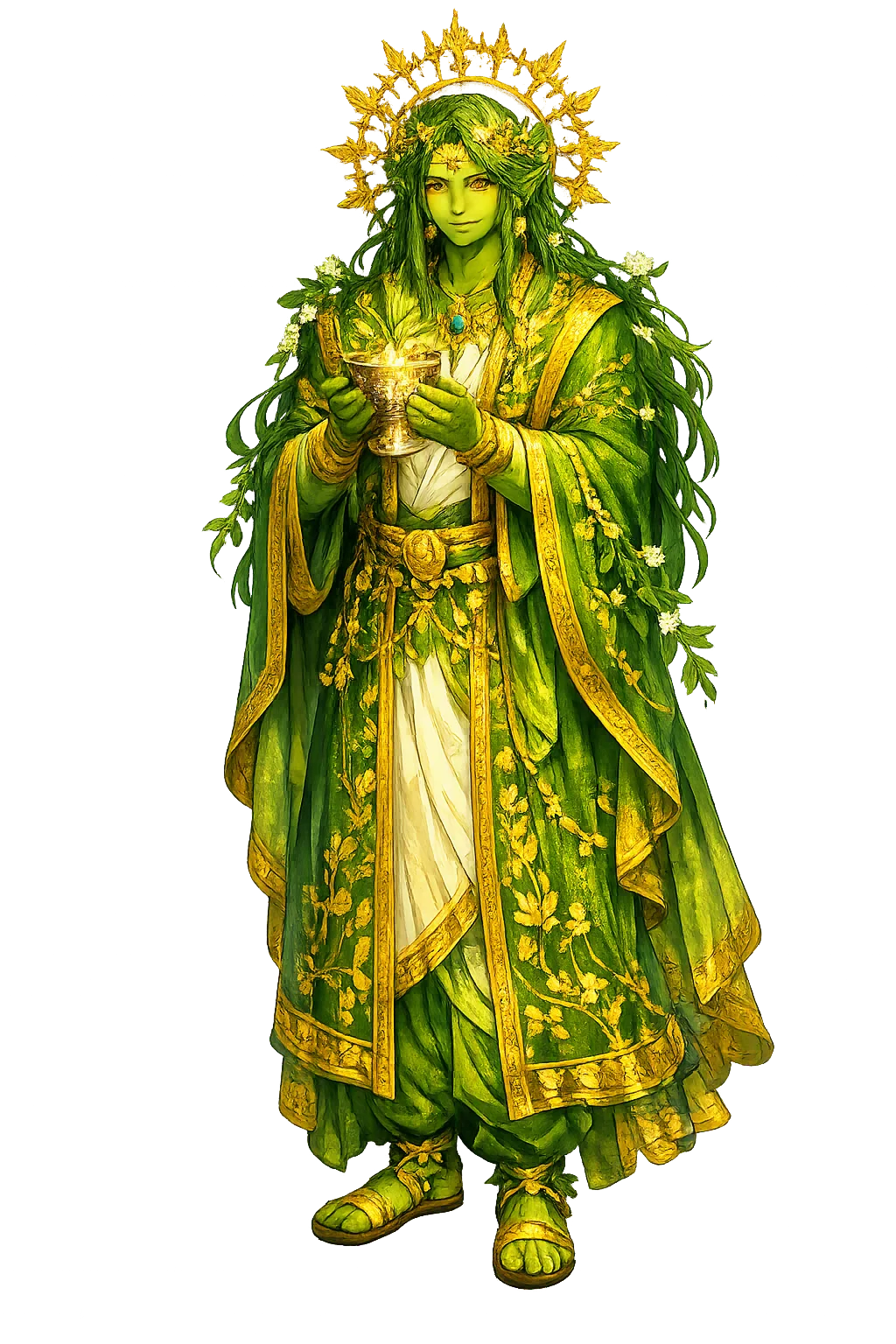
Haoma: The Pressed One, the Immortal Plant, and the Living Elixir of Zoroastrian Worship
Some names are doors, and Haoma opens onto one of the most fragrant and contested rooms in the history of religion. It is the name of a plant, a ritual, and a deity all at once. It is also the name of an experience: the pressing of a sacred stem, the mingling of its juices with water and milk, and the conviction that whoever drinks it rightly will receive health, strength, wisdom, and even a share in immortality. Haoma sits at the center of Zoroastrian worship, and the name itself tells you what happens there. It means "the pressed one," the one who is crushed so that life can flow. In 2026, when digital text often reduces sacred names to lowercase ASCII tokens, restoring the name as Haoma is more than a typographical preference. It is a way of keeping visible the ritual, botanical, and theological density that the plain form haoma silently strips away.
At a Glance
- Restored name: Haoma
- ASCII form: haoma
- Meaning: "The pressed one"
- Domain of influence: Sacred Plant, Immortality
- Pantheon: Zoroastrian
- Classification: Tier 2
- Original script: 𐬵𐬀𐬊𐬨𐬀 (Avestan)
Overview
Haoma is one of the most important figures in the Zoroastrian pantheon, yet the category into which he falls is not easy to define by modern standards. He is simultaneously a god, a plant, and the sacramental drink prepared from that plant. This threefold identity is not a confusion but a deliberate feature of Zoroastrian ritual thought. In the sacred texts, the plant is addressed as a living being who has consciousness, power, and a mission to help human beings. When the priest presses the plant and offers the resulting liquid, he is not merely performing a magical operation; he is entering into a relationship with a divine person who mediates between the human and celestial worlds.
The domain assigned to Haoma in the lexicon is "Sacred Plant, Immortality," and that pairing is exact. The plant is sacred because it is the material basis of the highest ritual act in Zoroastrian worship. It is associated with immortality because the texts promise that those who worship Haoma properly will live long, prosper, and ultimately share in the final victory of truth over death. Haoma is therefore not an escape from the body but a sanctification of it. The plant grows in the mountains, is harvested with care, is prepared with precise ritual gestures, and becomes the means by which mortal human beings participate in divine life.
Etymology and the Name
The Avestan word haoma- is generally explained as meaning "pressed" or "what is pressed." It is derived from the same Indo-Iranian root that gives the Vedic Sanskrit word soma. The two names are not identical, because sound laws transformed the initial s of Sanskrit soma into the h of Avestan haoma, but the underlying concept is the same: a sacred plant whose juice is pressed out and consumed in ritual. This correspondence is one of the classic pieces of evidence for the shared inheritance of Indo-Iranian religion, and it has fascinated scholars since the early days of comparative mythology.
The name's meaning, "the pressed one," is not merely descriptive. It identifies the central action of the Haoma ritual. In the Yasna, the chief Zoroastrian liturgy, the priest repeatedly presses the plant between stones while reciting sacred verses. The act of pressing is an act of worship. It transforms the raw plant into the divine presence of Haoma himself. To name the deity is therefore to name the ritual, and to name the ritual is to name the plant. The three are inseparable.
Linguists have long debated the precise botanical identity of the Haoma plant. Candidates have included ephedra, a genus of desert shrubs; various rhubarb species; and even, in some speculative theories, a psychoactive plant such as cannabis or a mushroom. The question is difficult because the ancient texts emphasize the plant's effects rather than its modern taxonomy. It gives alertness, strength, healing, and a sense of closeness to the divine. Whatever the historical plant may have been, the name Haoma continues to function as a placeholder for the sacred power that flows from the properly performed rite.
Mythology and Domain
The mythology of Haoma is concentrated in the ninth and tenth chapters of the Yasna, known as the Hom Yasht. There the deity appears as a beautiful youth who comes down from the mountains at the summons of Zarathustra. He carries the sacred plant with him and instructs the prophet in the proper way to press and offer it. The text is full of praise for Haoma's powers. He heals the sick, gives strength to the weak, makes the poor wealthy, and guides the wise. Warriors pray to him for victory, and priests pray to him for inspiration.
The ritual of Haoma has three pressings, corresponding to different times of day and different fractions of the plant. Each pressing is accompanied by specific prayers and offerings. The liquid is mixed with water and, in some traditions, with milk. The preparation must be performed by a ritually qualified priest, and the entire procedure is governed by purity laws that ensure the sanctity of the act. Drinking the parahaoma, as the prepared draught is called, is not a casual refreshment. It is a sacramental participation in the divine life of the plant.
Haoma's domain extends beyond the ritual itself. As a deity, he is associated with truth, healing, and the moral order. He is not a god of intoxication in the crude sense; the texts explicitly condemn drunkenness and the misuse of sacred substances. The legitimate Haoma experience is one of clarity and heightened responsibility. It binds the worshipper more tightly to asha, the truth that governs both cosmos and conscience. In this respect, Haoma functions as a bridge between the natural world and the ethical world. The plant is sacred because it is used rightly, and the worshipper becomes holy by approaching it with the proper intention.
The association with cattle is also significant. In Zoroastrian tradition, cattle represent the good creation that Ahura Mazda intends for human beings to protect. Haoma, as a deity of life-giving vegetation, stands in a complementary relationship to the animal world. The offerings that accompany the Haoma rite often include milk and other products derived from cattle, symbolizing the harmonious cooperation of plant and animal life under the rule of truth. The destruction of cattle by predators and enemies is one of the great evils that Zoroastrian ethics opposes, and Haoma's ritual is one of the means by which that opposition is enacted.
The Botanical Question
No account of Haoma would be complete without acknowledging the long and often heated debate over the plant's botanical identity. The ancient descriptions are evocative but not botanically precise. Haoma grows on mountains, is green, has stems, and is pressed to yield a juice that is then consumed. From these sparse clues, scholars have proposed a wide range of candidates. The most widely accepted identification today is with a species of ephedra, a shrub that grows in the arid regions of Central Asia and contains stimulant alkaloids. Ephedra fits many of the ancient descriptions: it grows in mountains, can be pressed or pounded, and produces effects of alertness and heightened energy.
Other candidates have included rhubarb, which also grows in the relevant regions and has medicinal properties, and various psychoactive plants. Some scholars have argued for a mushroom, drawing on comparative evidence from other cultures, while others have speculated about cannabis or other mind-altering substances. The difficulty is that the texts are interested in the plant's religious effects, not in its scientific classification. The same plant might be described differently depending on the ritual context and the theological point being made.
Modern Zoroastrian communities have made their own decisions about which plant to use. Many Parsi priests use ephedra in the parahaoma preparation, while others follow different local traditions. The important point is that the ritual continuity matters more than the botanical identification. Haoma is not reducible to a single species. He is the sacred power that becomes present when the plant is pressed, prayed over, and offered with the proper intention. The name therefore retains its meaning even when the exact botanical referent remains uncertain.
Haoma and Vedic Soma
The relationship between Haoma and the Vedic Soma is one of the great puzzles and pleasures of Indo-Iranian studies. The two names are clearly cognate, and the two figures share many features. Both are associated with a sacred plant whose juice is pressed and consumed. Both are praised as divine beings who grant strength, inspiration, and a kind of immortality. Both stand at the center of an elaborate priestly ritual. The similarities are so extensive that scholars have reconstructed a common Indo-Iranian ritual and theology behind them.
Yet there are also important differences. In the Vedas, Soma is often associated with poetic inspiration and ecstatic experience. The Rigvedic hymns to Soma are among the most rapturous in the collection, full of images of flight, light, and divine intoxication. In the Avesta, Haoma retains some of these associations, but the emphasis shifts toward truth, healing, and moral responsibility. The Zoroastrian reform associated with Zarathustra appears to have reinterpreted the older Haoma cult in light of an ethical monotheism that condemned intoxication and false worship.
This tension is visible within the Avesta itself. Some passages seem to preserve an older, more enthusiastic Haoma tradition, while others reflect the reformer's concern for truth and proper ritual. The result is a rich but complex document that allows scholars to trace the history of religious change across centuries. Haoma thus serves as a case study in how a sacred figure can be reinterpreted without being abandoned, and how continuity and innovation can coexist in a living tradition.
Cultural Legacy
The cultural legacy of Haoma is inseparable from the larger Indo-Iranian heritage. In the Vedas of ancient India, the corresponding figure is Soma, a deity and plant whose juice is pressed and consumed by priests and gods alike. The Rigveda contains hundreds of hymns to Soma, praising him as king of plants, giver of immortality, and source of poetic inspiration. The parallels with the Avestan Haoma are so close that scholars have long treated them as reflexes of a single prehistoric cult. The Vedic Soma and the Zoroastrian Haoma are like two branches of the same ancient tree, each shaped by the distinct religious developments of India and Iran.
This shared background has made Haoma a focal point for debates about the prehistory of Indo-Iranian religion. Did the proto-Indo-Iranians already worship a sacred plant deity? What was the original plant? How did the cult split into the Vedic and Zoroastrian forms? These questions have occupied philologists, archaeologists, and historians of religion for generations. They are unlikely to receive a single definitive answer, but the persistence of the debate itself testifies to the importance of Haoma in reconstructing the religious past.
In living Zoroastrian practice, Haoma remains central. Parsi communities in India and Zoroastrian communities in Iran continue to perform the Yasna and to prepare the parahaoma according to traditional rules. The identity of the plant used today varies by community, but the ritual structure and the theological meaning remain constant. Haoma is still the pressed one, still the giver of strength and purity, still the companion of the priest who stands before the sacred fire.
Haoma has also entered modern popular and scholarly imagination as a symbol of humanity's ancient relationship with sacred plants. Writers and artists interested in shamanism, ethnobotany, and comparative religion often invoke Soma and Haoma as examples of how premodern cultures used plants to approach the divine. While some of these treatments are romanticized, they keep alive the recognition that Haoma is not merely a name in an old book but a window onto one of humanity's deepest religious experiments.
Haoma in the Living Zoroastrian Tradition
For all the scholarly debates about the original plant and the prehistoric cult, Haoma remains a living reality in Zoroastrian practice today. The Yasna ceremony, at the center of which the parahaoma is prepared, continues to be performed by priests in Iran, India, and the global diaspora. The ritual requires extensive training, physical purity, and meticulous attention to detail. The priest must wear the proper vestments, recite the sacred verses in the ancient Avestan language, and perform the pressing at the correct moments. The entire ceremony can last several hours and is considered one of the most powerful acts of worship available to the community.
The Haoma ritual also plays a role in life-cycle ceremonies. Initiations, weddings, and memorial services may all include Yasna performances or simpler Haoma offerings. In each case, the purpose is to invoke divine blessing, strengthen the moral order, and connect the participants with the ancient tradition. For many Zoroastrians, the presence of Haoma in these ceremonies is a tangible link to the faith of their ancestors and a reminder that their religion is not merely a heritage but a living path.
Modern Parsi communities have had to adapt the Haoma tradition to changed circumstances. In some places, it is difficult to obtain the traditional plant or to find priests with the requisite training. Communities have developed practical solutions while trying to preserve the core meaning of the rite. These adaptations are themselves a form of tradition, showing that Haoma can survive translation across time and space without losing his identity as the pressed one who gives immortality.
The Unicode Restoration
The PuniCodex entry for Haoma is classified as Tier 2. The restored form Haoma differs from the ASCII form haoma only in capitalization, but that difference carries cultural weight. The early domain-name system required lowercase ASCII, so haoma became the only registrable string. The result was that a name associated with immortality, sacred ritual, and one of the world's oldest continuing religions was visually downgraded to the level of a password or a product code.
Unicode IDNs make it possible to reverse that downgrade. When a visitor types or sees Haoma in an address bar, the name appears as a proper name, with the dignity of capitalization and the recognition of its cultural status. The punycode transformation happens invisibly beneath the surface, translating the Unicode string into the ASCII form that the DNS can route. What the human eye sees, however, is the restored form. This is the technical achievement that makes the PuniCodex temple at its temple possible.
The restoration also has a symbolic dimension. Just as the Haoma ritual transforms a raw plant into a sacred presence, the Unicode restoration transforms a raw ASCII string into a culturally meaningful address. Both processes depend on precise technique and respectful attention. The priest must know how to press the plant; the domain administrator must know how to encode the name. In both cases, the goal is to make something hidden visible and something ordinary holy.
Conclusion
Haoma is a name that refuses to stay in one category. It is plant and deity, ritual and person, nature and culture, mortality and immortality. That multiplicity is precisely what makes it valuable. In a digital age that tends to reduce complex realities to single strings, the restored form Haoma reminds us that names can carry whole worlds within them. The PuniCodex temple dedicated to Haoma is therefore more than a page about a Zoroastrian figure. It is a demonstration that the internet can be a place where ancient rituals, scholarly precision, and technological capability meet. The pressed one still has juice in him, and the Unicode web is one more vessel through which it can flow.
Related Names
- AhuraMazdā — Supreme Creator, Wisdom, Light
- Amərətāt — Immortality, Plants
- Anāhitā — Fertility, Water, Wisdom
- Aša — Truth, Righteousness, Cosmic Order
- Ašavahišta — Truth, Righteousness, Fire
Sources
- Mary Boyce, Zoroastrians: Their Religious Beliefs and Practices (1979).
- J. Darmesteter (trans.), The Zend-Avesta, Sacred Books of the East vols. 4 & 23 (1880–1883).
- Prods Oktor Skjærvø, The Zoroastrian Oral Tradition as Reflected in the Texts (2003).