PuniCodex

Extended Lore

हनुमान् Hanumān

Etymology · Orthography · Cult · Iconography · Reception · Sources

Tier 1 Hanumān.com
Hanumān — Devotion, Strength, Messenger
01

Quick Facts

Essential information about Hanumān, Devotion, Strength, Messenger

Original Scriptहनुमान्
Unicode RestorationHanumān
Reconstructed Pronunciation/ɦɐ.nʊ.maːn/
PantheonSanskrit
DomainDevotion, Strength, Messenger
MeaningThe Large-Jawed One — the monkey-god of devotion and strength, Rāma's peerless servant
ClassificationTier 1
Primary DomainHanumān.com
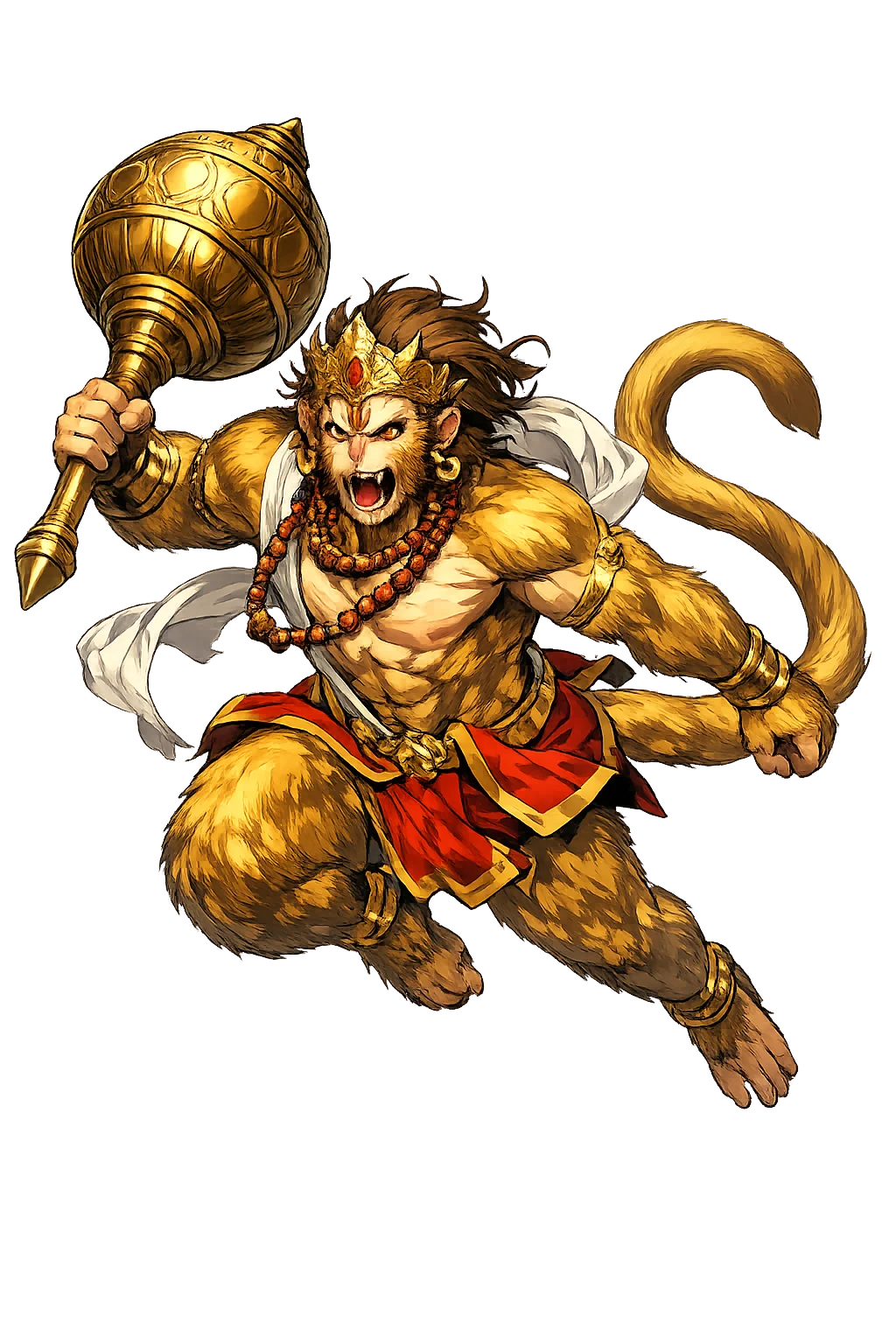
Sacred SymbolsThe mace (gada), The flying mountain-bearer, The torn-open chest, The sindoor-covered body, The upraised tail
02

Etymology & Word Family

From original script to Unicode restoration

Original Script हनुमान् Hanumān — "The Large-Jawed One — the monkey-god of devotion and strength, Rāma's peerless servant"
Unicode Restoration Hanumān Restored stress, length, and script
Modern ASCII hanuman Plain-ASCII fallback

The name Hanumān carries the orthographic signature of the sanskrit tradition: हनुमान्. Unicode restoration recovers what ASCII flattens.

03

Unicode Character Breakdown

Character-by-character philological analysis

CharacterUnicodeNameBlockPhonetic Role
HU+0048Latin Capital Letter HBasic LatinSame
aU+0061Latin Small Letter ABasic LatinShort /a/
nU+006ELatin Small Letter NBasic LatinSame
uU+0075Latin Small Letter UBasic LatinShort /u/
mU+006DLatin Small Letter MBasic LatinSame
āU+0101Latin Small Letter A with MacronLatin Extended-ALong ā on final syllable
nU+006ELatin Small Letter NBasic LatinLong ā on final syllable

The Tier 1 classification reflects how much of the original phonology this restoration preserves — stress and vowel length for Greek names, distinctive letters and diacritics for every other tradition.

04

Cult & Worship

How the sacred was kept — rites, sanctuaries, remains

The Cult

Hanumān's cult exploded during the Vijayanagara period and has never receded. Tuesday and Saturday are his days; devotees recite the Hanumān Chālīsā, offer sindoor mixed in oil, and bring bananas and bundis to images whose faces are smeared vermilion. The Sankat Mochan temple at Vārāṇasī, founded in the sixteenth century within Tulsīdās's own lifetime, anchors the North Indian tradition, while South Indian Navaveera shrines and wrestling akhāṛās claim him as patron of bodily strength. Modern colossi at Paritala Anjaneya, Nandura, and Karol Bagh turn the monkey-god into landscape-scale spectacle. Pilgrims touch his feet for protection from Saturn and from every affliction.

In the Earth

His oldest images are Gupta-period (5th c. CE) reliefs; the cult's medieval explosion runs through the Vijayanagara empire, whose emblem he was. The great modern colossi — Karol Bagh (Delhi, 108 ft), Nandura (105 ft), Paritala Anjaneya (135 ft, among the world's tallest statues) — continue the tradition of the Vijayanagara monoliths. The Sankat Mochan temple at Vārāṇasī (16th c., founded within Tulsīdās's tradition) and Hampi's Anjaneya hill anchor his pilgrimage map.

05

Iconography

How Hanumān was imaged across the ages

The Image

Hanumān is imaged as a monkey-man of controlled power: muscled torso, long tail, usually kneeling or flying, mace in one hand and mountain of healing herbs in the other. Gupta reliefs from the fifth century give his earliest shape, while Vijayanagara monoliths developed the massive standing form copied by modern statues. Pahari and Rajasthani miniatures show him tearing open his chest to reveal Rāma and Sītā enthroned within his heart. In calendar art and temple banners he is a radiant orange figure, tail aflame or coiled, eyes fixed on Rāma. The iconography insists that devotion, not species, is the measure of divinity.

06

Reception & Transformation

The name after its own age — transmission, translation, survival

Afterlives

Hanumān's afterlife is inseparable from the transmission of the Rāmāyaṇa. Vālmīki's Sanskrit epic made him Rāma's servant; Tulsīdās's Rāmcaritmānas made him the beloved of the Hindi-speaking North, accessible through the Chālīsā recited in every village, temple, and household from dawn onward. The story travelled southeastward as the Ramakien in Thailand, the Reamker in Cambodia, and the Javanese Kakawin Rāmāyaṇa, in each of which the monkey general kept his loyal shape while absorbing local monkey-king traditions. Colonial scholars catalogued his cult under "animism," but independence and diaspora communities restored him as a symbol of strength, service, and Hindu identity. Today he appears in Bollywood, television serials, yoga culture, and Hindu nationalist iconography, his image among the most widely circulated in the Hindu world.

Identifications Across Traditions

He crosses every boundary: in Cambodia's Reamker and Thailand's Ramakien he is the monkey-general unchanged; China's classical tradition links him to the monkey-king Sūn Wùkōng of Journey to the West (the kinship debated for a century); and Indonesia keeps Hanoman as the Ramayana's most-beloved wayang character. The wrestler-god is also the celibate scholar — patron of gyms (akhāṛās) and grammar students alike. In the Khmer, Thai, Lao, and Balinese retellings, he is so beloved that the epics are, in places, his story: the Reamker spends whole books inside his adventures. No other Hindu god is so completely at home in the languages of five nations.

Modern Legacy

The Hanumān Chālīsā — Tulsīdās's forty verses — is the most-recited hymn in the Hindi world; his Tuesday fasts, his sindoor-red idols, and his roar in a hundred TV serials make him the most-worshipped deity of North India. 'Bajrang Bali' is the name shouted at heavy lifts and hard exams alike. The Indian Army's mountain troops invoke him; his flying figure brands logistics firms, gyms, and the Delhi Metro's most-photographed statue (108 ft at Karol Bagh). Wrestlers anoint him before matches; students before examinations; the frightened at crossroads at dusk. Of all the gods of the Rāmāyaṇa, it is the servant — not the king — whom the streets claim as their own.

07

The Meditation

What Hanumān means — beyond the dictionary

Hanumān is the god of the impossible errand. He never asks whether the ocean can be crossed — he asks for Rāma's name and jumps. He is the proof the Rāmāyaṇa makes everywhere it goes: that the measure of strength is not what it can lift but whom it serves, and that the biggest tasks are always done by the ones who say 'I am only the messenger.'

The wrestlers know him as the patron of strength; the students as the patron of grammar; the frightened as the name that ends fear. He is all three, because his real gift is neither muscle nor memory but this: the certainty that the ocean can be crossed, spoken in the ear of anyone who is sure it cannot.

The Jāmbavān moment is the one India loves most: before the leap, the old bear reminds him of his strength — because the curse had made him forget. Everyone keeps a Hanumān inside, a strength mislaid until someone says its name aloud. The whole Chālīsā is, in a way, that reminder set to verse.

08

Screen & Culture

Where Hanumān echoes through film, television, and games — and how

09

Frequently Asked Questions

Common questions about Hanumān, Devotion, Strength, Messenger, and Unicode restoration

01How do you pronounce Hanumān?

In reconstructed pronunciation, Hanumān is /ɦɐ.nʊ.maːn/ — approximately 'huh-noo-MAHN' — the final syllable long, the 'h' a soft breath rather than an English hiss.

02What does Hanumān mean?

Hanumān means The Large-Jawed One — the monkey-god of devotion and strength, Rāma's peerless servant in the sanskrit tradition.

03What are the symbols of Hanumān?

Hanumān is associated with The mace (gada) (Strength subordinated to service; he carries it as Rāma's general, never as a warlord of his own), The flying mountain-bearer (The night flight with the healing mountain in one hand — the most reproduced scene in Indian devotional art), The torn-open chest (In later devotional tradition (the Ānand Rāmāyaṇa and its heirs), he splits his own breast to show Rāma and Sītā enthroned where his heart was), The sindoor-covered body (Devotees smear him with vermilion as Sītā once did; he wore it as armor, and his idols wear it still), The upraised tail (His tail — bound in oil-soaked rags and set alight by Rāvaṇa's court, then used to burn Laṅkā itself).

04Why restore Hanumān in Unicode?

Plain ASCII hanuman strips the stress, length, and script that make the name specific. Unicode restoration returns the name to its original written dignity.

05What is the most important myth about Hanumān?

“The Wind's Son” — the The Birth story that anchors the mythology of Hanumān, told in full on the lore page.

10

Scholarly Sources

The philological foundations of this restoration

Every claim on this page is grounded in established scholarship. The orthographic restorations follow disciplinary convention. The etymological chain follows the best available reference works. This is not invention — it is resurrection through scholarship.

◈

Lexicography & Philology

  • MW
  • KEWA
◎

Primary Texts

  • The Ṛgveda; the Śatapatha Brāhmaṇa; the early Upaniṣads; the Śiva Purāṇa and Liṅga Purāṇa.
◉

Archaeology & Art History

  • Material evidence — iconography, inscriptions, and temple archaeology — for Hanumān and related cults.
✦

Religious Studies

  • Vālmīki, Rāmāyaṇa: Kiṣkindhākāṇḍa 65–67 (birth); Sundarakāṇḍa 1, 20–21, 52–54 (leap, court, burning); Yuddhakāṇḍa 74–76 (mountain), and the war's close (the boon)
  • Ānand Rāmāyaṇa, Sārakāṇḍa (the chest; later tradition)
  • Tulsīdās, Rāmcaritmānas (esp. Sundarkāṇḍ) and Hanumān Chālīsā
  • Monier-Williams, Sanskrit-English Dictionary (hanu, hanumat)
  • Goldman, The Rāmāyaṇa of Vālmīki (translation and annotation)
  • Lutgendorf, Hanuman's Tale: The Messages of a Divine Monkey
Return

The Surface Awaits

You have traced the name from its earliest attestation to its Unicode restoration. Now return to the myth. The story is where the name lives.

Back to Lore
Hanumān mascot