
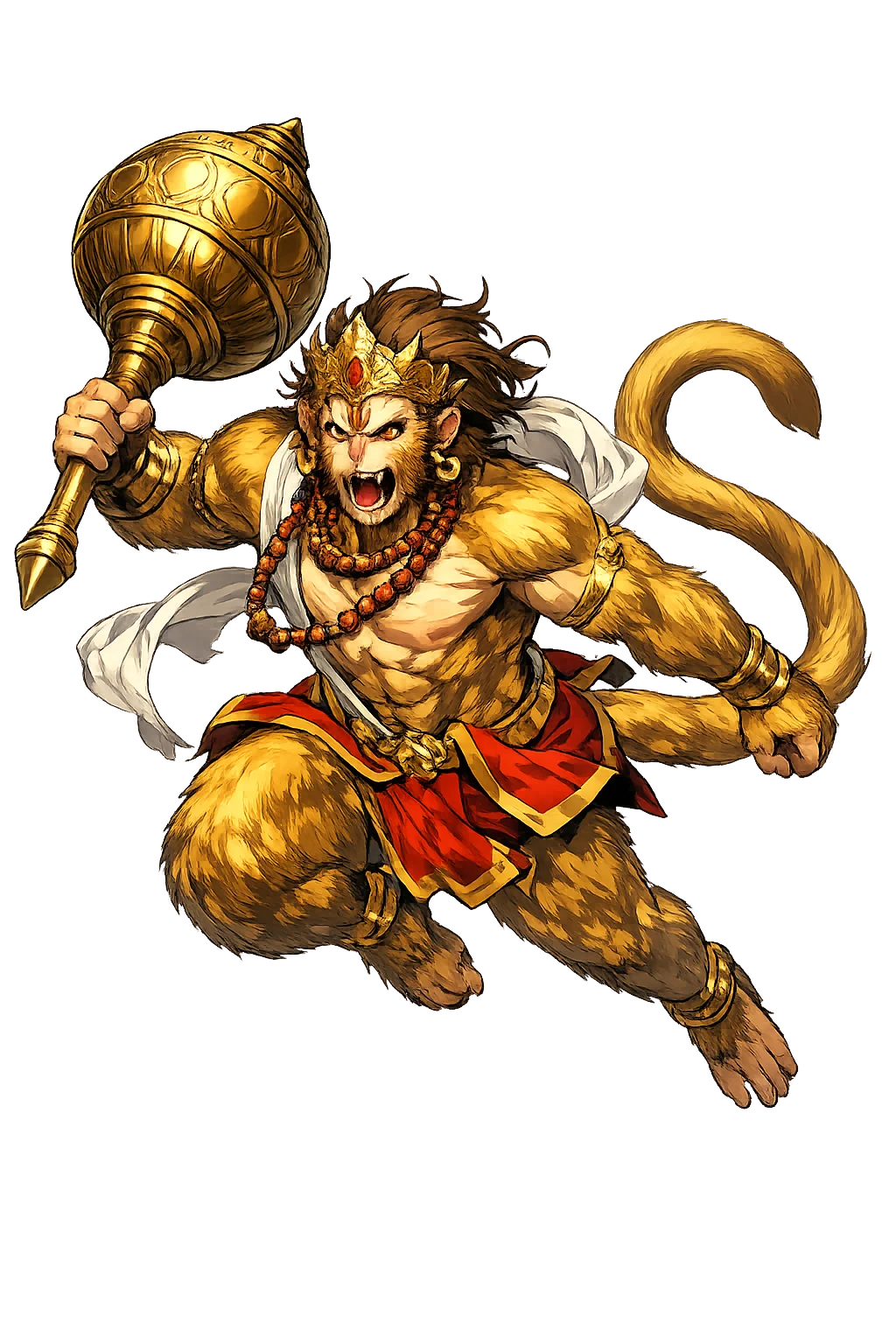
Hanumān: the stories first, then the spelling
You cannot weigh an accent without knowing what it carries. Here is what Hanumān has been carrying.
The Stories That Carry the Name
The Wind's Son. Hanumān's origin story is told by the old bear Jāmbavān, on the seashore before the great leap, when the vanaras doubted that anyone could cross the ocean (Rāmāyaṇa, Kiṣkindhākāṇḍa 65–67, vulgate). As an infant, the child of the wind-god Vāyu and the vanara woman Añjanā saw the rising sun, mistook it for a ripe fruit, and leapt to eat it. Indra hurled his thunderbolt; it broke the child's jaw — hanu, the bone that named him — and the wounded wind, in grief, withdrew his breath from the worlds until the gods repaired the harm with boons: from Indra, the bolt could not kill him; from Agni, fire could not burn; from Varuṇa, water could not drown; from Brahmā, immunity from every weapon.
One Bound to Laṅkā. When Sītā was carried across the ocean, the vanara army reached the shore and stopped: a hundred yojanas of water and no way across. The elder Jāmbavān reminded Hanumān of his strength; Hanumān grew until he filled the sky, pressed down on the mountain Mahendra with his foot, and leapt — clearing the ocean in a single bound (Rāmāyaṇa, Sundarakāṇḍa 1). He landed on Laṅkā's Trikūṭa hill, shrank himself to the size of a cat, and searched the golden city street by street, palace by palace, until he found Sītā beneath an Aśoka tree, guarded but unbowed.
The Tail that Burned a City. In Laṅkā, Hanumān let himself be taken — to measure the enemy, he said — and was dragged in his bonds before Rāvaṇa. Their exchange is one of the epic's great set-pieces: the captured monkey lecturing the ten-headed king on statecraft, diplomacy, and the certainty of his own destruction (Rāmāyaṇa, Sundarakāṇḍa 20–21). Rāvaṇa's courtiers had his tail wrapped in oil-soaked cloth and set it alight.
And Here Is What the Spelling Preserves
The restoration keeps one feature the ASCII form hanuman cannot show:
- a → ā — Long ā on final syllable: how long the vowel is held.
A storyteller pronouncing the name would restore every one of them by instinct. The file only writes down what the voice already knows.
At a Glance
- Restored name: Hanumān
- ASCII form: hanuman
- Meaning: "The Large-Jawed One — the monkey-god of devotion and strength, Rāma's peerless servant"
- Domain of influence: Devotion, Strength, Messenger
- Pantheon: Sanskrit
- Classification: Tier 1
- Original script: हनुमान्
- Series: The Restoration Files, No. 189 of 546
The Name Travels
He crosses every boundary: in Cambodia's Reamker and Thailand's Ramakien he is the monkey-general unchanged; China's classical tradition links him to the monkey-king Sūn Wùkōng of Journey to the West (the kinship debated for a century); and Indonesia keeps Hanoman as the Ramayana's most-beloved wayang character. The wrestler-god is also the celibate scholar — patron of gyms (akhāṛās) and grammar students alike.
The Address It Earned
The temple of Hanumān stands at /hanuman/ — lore, scholars, patterns — because a name carrying this much story deserves more than a parking page. What survives here cannot be shown in ASCII: a feature of the original that the fallback alphabet flattens. That is the Tier-1 test, and this name passes it without argument.
The Sources Are Open
The myths above are retold from the temple's record; the primary voices are in the Sacred Texts: Rig Veda and Ramayana. Nothing in this file outranks them.
The File Continues
Read the founding dispatch for the name's full story, the Resonance File for the archetype at work — or the whole archive in one sitting.
Continue the series — previous file: Hwanin (read it here) · next file: Haoma (read it here).
The Restoration Files are written from the same canonical record as the temples themselves: the lexicon, the lore catalog, the pattern atlas, and the cited scholarly sources. If a file ever disagrees with its temple, the temple is right — tell us, and the file will be corrected.