The Living Myth
Grandmother Spirit, Earth · The grandmother who holds the earth
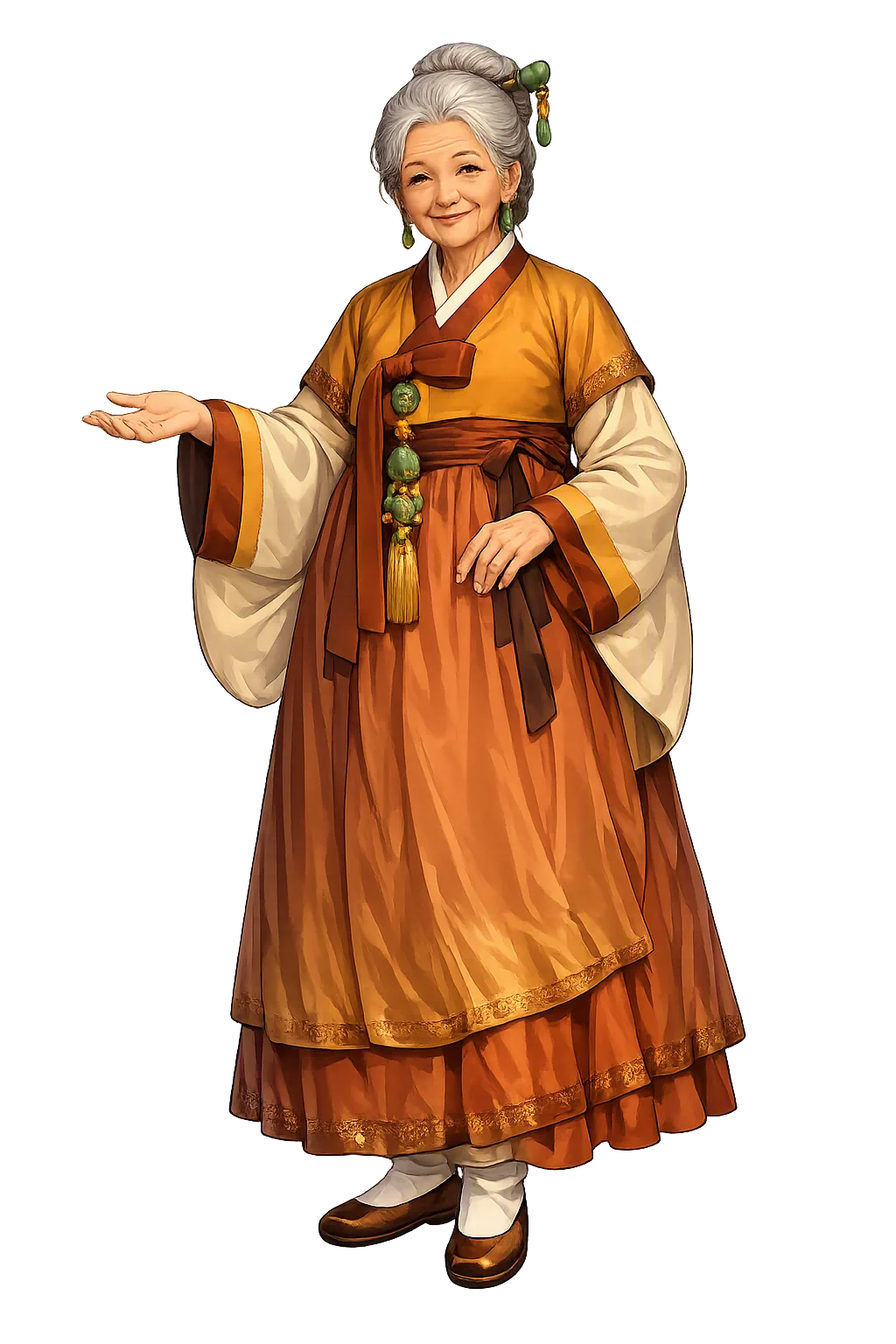
Stories of Halmoni
Halmoni — 'Grandmother' — is less a single goddess than the Korean imagination's highest honorific for female sacred power: the earth that feeds, the ancestor who guards the lineage, the birth-spirit who inscribes a child's fate, the wind that fills a fisherman's sails. Her mythology lives in Jeju's landscape tales, kitchen cults, and shamanic rites rather than in any fixed canon.
Jeju tradition remembers Seolmundae Halmang, the Grandmother Seolmundae, as a giantess who made the island with her hands. She piled earth and stone in its center until Hallasan, the great shield-volcano, rose to hold the land in place; she pressed fields flat with her palms for the villages, dug channels with her fingers for the streams, and set the oreum — the parasitic cones that stud Jeju — like bowls across her handiwork. When at last she lay down to die, her body became the mountain itself, her hair the forests, and the people she had fed became the island's first villages. The story is preserved in Jeju oral tradition and retold at the island's shrines; the Jeju folklorist Im Seok-jae (1904–1985) recorded related narratives from island storytellers. The myth does not describe creation from nothing: the grandmother builds the land the way a grandmother feeds a house — by hand, piece by piece, until it is enough.
The same tradition gives the grandmother a terrible second ending. Seolmundae Halmang had five hundred sons — the Obaekjanggun, the Five Hundred Generals — and one day she set a great cauldron to cook their meal. Leaning over the boiling pot to taste the broth, she slipped and fell in; when her sons came home hungry, they ate the soup, and only afterward discovered at the bottom of the pot the ring she wore. Stricken with grief and shame, the five hundred brothers wandered the island and were turned to stone — the clustered rock pillars that Jeju people still point out — and a village shrine, the Obaekjanggun-dang, keeps their memory. The tale was recorded in twentieth-century Jeju folklore collections. Its meaning is double-edged, exactly like a grandmother's love: the one who feeds you can vanish into the meal, and the guilt of having eaten becomes a permanent landscape.
In mainland tradition the title Halmoni attaches to Samshin, the Birth Grandmother — one goddess with three faces, or three sister spirits — who arrives at every childbirth to inscribe the child's fate: its span of life, its fortune, its character. Korean households hung a charcoal pouch high in the kitchen as her dwelling and set out clean water and rice on the third, seventh, and fourteenth days after a birth, asking her to lodge the newborn's soul firmly in its body. Moving the pouch or letting it grow dirty risked the child's health; an easy delivery meant she had come gladly. Laurel Kendall's fieldwork among Korean shamans and housewives shows Samshin Halmoni still receiving petitions for conception, safe birth, and a sick child's recovery. The myth places the most dangerous threshold of ordinary life — birth — under the charge of a grandmother, not a warrior or a king: sacred power at its most intimate is imagined as maternal vigilance.
Jeju's Chilmeori-dang shrine, in Geonip-dong by the old port of Jeju City, honors Grandmother Yeongdeung, the wind goddess of the sea. Each year on the first day of the second lunar month she rises from her homeland beneath the waves and walks the island's villages for a fortnight; while she is present, the fishermen receive their luck and the spring winds blow true for planting. On the day she departs, the village holds the Yeongdeung-gut at the shrine, sending her home with shamanic song, food, and money for the journey. The rite of the Chilmeoridang Yeongdeung-gut was inscribed by UNESCO in 2009. The myth is a calendar made flesh: an old woman's annual visit, welcomed and seen off with full ceremony, orders the whole maritime year. It shows Halmoni at her most public — not the grandmother of one house but of an island's entire livelihood, arriving from the sea like the weather she brings.
venerated grandmother of earth, ancestry, and the household
Halmoni is the grandmother spirit, a title of veneration given to ancestral female deities who watch over earth, lineage, and the household in Korean tradition. The name means "Grandmother" and belongs to the domain "Grandmother Spirit, Earth." Halmoni means "grandmother" in Korean, but in religious usage it becomes an honorific title for powerful female spirits who protect lineage, land, and the domestic sphere. The most famous Halmoni figure is Seolmundae Halmang of Jeju Island, a giant grandmother whose body became the landscape and whose grief created the island's geography.
A title of sacred grandmotherhood applied to ancestral, domestic, and landscape goddesses.
Halmoni watches over the household and the land that feeds it.
The giant creator grandmother whose body formed the island of Jeju.
She receives lineage rites and petitions for family harmony and health.
From the original script to the living URL
할머니
The name in its original Korean form. Halmoni (할머니) is attested in the source tradition — “Grandmother”. Its original diacritics and script distinctions carry the full phonetic and orthographic weight of the source tradition.
halmoni
The plain halmoni form is identical to the Unicode restoration. Because this name is already written in Latin letters, no diacritics, stress, or script information were lost — only capitalization differs.
Halmoni
The Unicode restoration does not need to recover lost marks for Halmoni. Its value is canonical spelling and consistent cataloguing, not the reconstruction of erased orthography. The domain is readable as-is to both DNS and humanity.
Halmoni.com
This restoration is written entirely in ASCII letters — no Punycode encoding stands between Halmoni and the DNS. The domain reads identically to machines and to human eyes.
Owned, ideal, and ASCII forms of Halmoni
Halmoni
Restores 할머니. The full Unicode restoration. halmoni.com is not in the PuniCodex collection — it is watched for release; if it drops, this temple upgrades to an owned flagship.
How Halmoni was spoken
How Halmoni travels from ancient script to the modern URL
The lore you have read is the living myth. Extended Lore opens the scholarly vault beneath it: the cult and its material remains, a history of the image, the name after antiquity, a meditation on what the name still means, and the full scholarly apparatus — etymology, orthography, sources.
Enter Extended Lore