PuniCodex

Extended Lore

할머니 Halmoni

Etymology · Orthography · Cult · Iconography · Reception · Sources

Tier 2 Halmoni
Halmoni — Grandmother Spirit, Earth
01

Quick Facts

Essential information about Halmoni, Grandmother Spirit, Earth

Original Script할머니
Unicode RestorationHalmoni
Reconstructed Pronunciation/hal.mo.ni/
PantheonKorean
DomainGrandmother Spirit, Earth
MeaningGrandmother
ClassificationTier 2
Primary DomainHalmoni
Sacred SymbolsEarth and soil, Hearth and kitchen, Mountain landscape, White cloth
02

Etymology & Word Family

From original script to Unicode restoration

Original Script 할머니 Halmoni — "Grandmother"
Unicode Restoration Halmoni Canonical scholarly spelling — ASCII-identical
Modern ASCII halmoni Plain-ASCII fallback

The name Halmoni reaches the modern world through scholarly transliteration of the korean tradition. Because the conventional spelling uses only Latin letters, its Unicode and ASCII forms coincide — the tradition it carries is in the name itself, not in diacritics.

03

Unicode Character Breakdown

Character-by-character philological analysis

CharacterUnicodeNameBlockPhonetic Role
HU+0048Latin Capital Letter HBasic LatinSame, capitalized
aU+0061Latin Small Letter ABasic LatinSame
lU+006CLatin Small Letter LBasic LatinSame
mU+006DLatin Small Letter MBasic LatinSame
oU+006FLatin Small Letter OBasic LatinSame
nU+006ELatin Small Letter NBasic LatinSame
iU+0069Latin Small Letter IBasic LatinSame

The Tier 2 classification here reflects fidelity to the attested tradition, not recovered diacritics: every character of Halmoni already survives in ASCII. What the restoration preserves is the canonical spelling itself — the form scholarship standardised.

04

Cult & Worship

How the sacred was kept — rites, sanctuaries, remains

The Cult

Halmoni is worshipped in the shamanic gut rituals of Korea, above all in Jeju, where the Chilmeori-dang shrine in Jeju City has housed the Yeongdeung rites for centuries. The rites honor the grandmother spirits of wind, childbirth, and the earth, with offerings of food, wine, and petition rather than temple sacrifice. Seoul-area rituals such as the Samshin-gut address Samshin Halmoni as the triple spirit of childbirth. The cult is vernacular and performed: its temples are modest shrine enclosures, and its priesthood is the manshin, female shamans who mediate between the grandmother spirits and the living.

In the Earth

Halmoni leaves few stones because her cult leaves few stones: the evidence is wooden, cloth, and performed. The Chilmeori-dang shrine in Jeju City — a modest enclosure of three thatched-roof shrines by the old port — has housed the Yeongdeung rites for centuries and is a protected Jeju cultural property; the Obaekjanggun-dang shrine preserves the stone memory of Seolmundae's sons. Ethnographic collections (National Folk Museum of Korea, Seoul) hold the kitchen charcoal pouches, offering tables, and white ritual cloth of the household cult. The textual stratum beneath it all is manuscript: the Samguk Yusa of the thirteenth-century monk Il-yeon, whose Goryeo-era codices preserve the foundation-myth world in which grandmother figures guard lineages and lands.

05

Iconography

How Halmoni was imaged across the ages

The Image

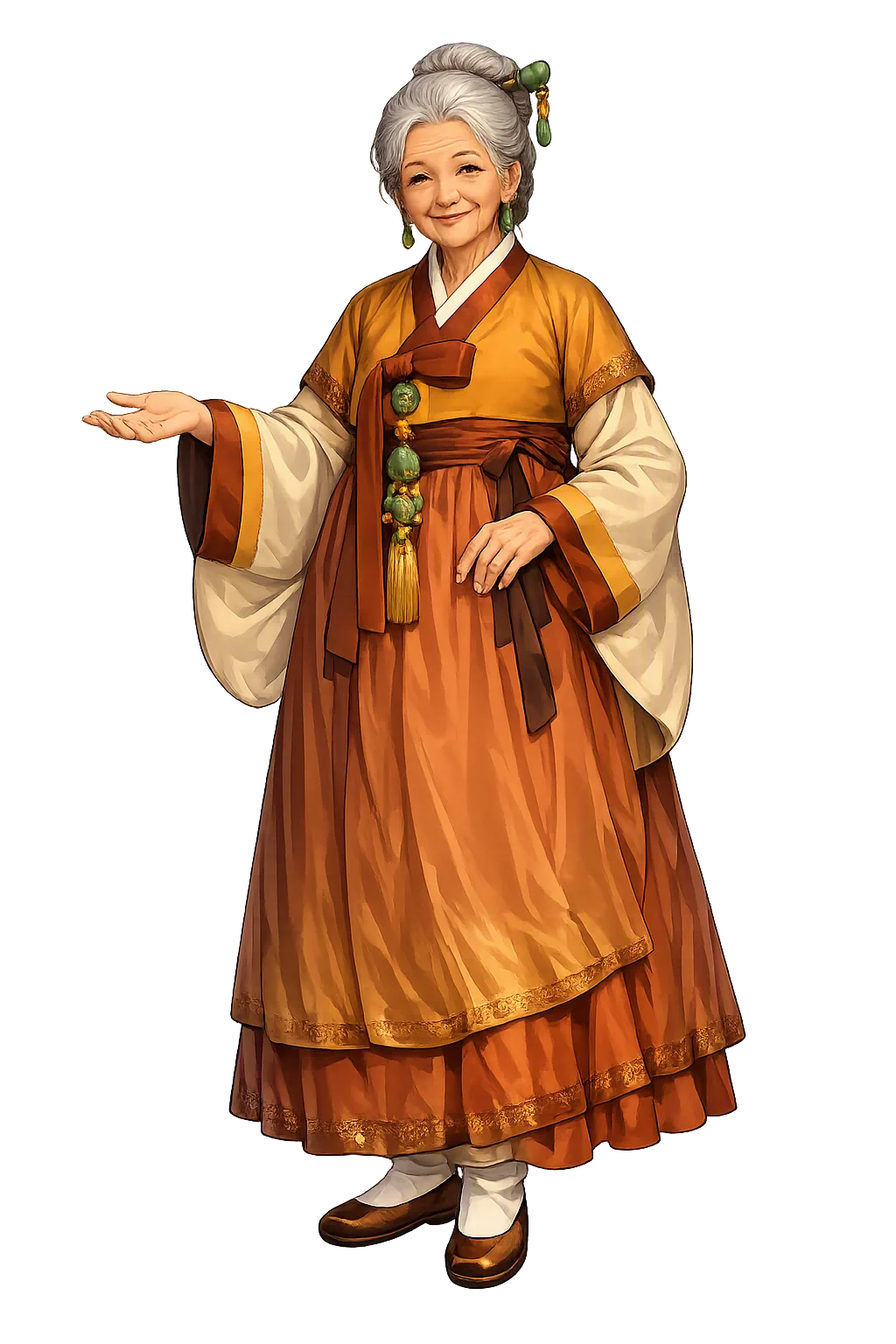
The iconography of Halmoni is domestic rather than monumental. She appears in shamanic paintings, taenghwa, as an elderly woman, often seated, surrounded by offerings of food, fruit, and cloth; in Jeju she may be represented by the stones and three thatched shrines of Chilmeori-dang rather than by a human image. Wooden effigies and embroidered spirit figures accompany village rituals. Unlike pan-Asian mother goddesses given royal iconography, Halmoni is imaged as the Korean grandmother next door, a visual logic that matches her role as family ancestor and local protector.

06

Reception & Transformation

The name after its own age — transmission, translation, survival

Afterlives

Halmoni belongs to a layer of Korean folk religion that survived Buddhist, Confucian, and Christian pressures by remaining domestic and local. Colonial Japanese ethnographers recorded the rituals in the early twentieth century; post-war scholars such as Laurel Kendall preserved the shamanic voice in academic prose and ethnographic film. In contemporary South Korea, grandmother-spirit devotion persists in both rural gut and urban shamanic consultations, while Jeju's Chilmeori-dang Yeongdeung-gut has been inscribed on UNESCO's Representative List of the Intangible Cultural Heritage of Humanity. The term halmoni itself has become an everyday honorific for elderly women and, in public discourse, a symbolic figure of national suffering, resilience, and the comfort-women cause. Her reception thus moves between altar, academic monograph, public memorial, and the ongoing life of Korean shamanism.

Identifications Across Traditions

Halmoni is less a single deity than a title that gathers female sacred power across Korean religion. It overlaps with Samshin Halmoni in birth cults, with Seolmundae Halmang in Jeju landscape myth, and with household ancestor spirits in Confucian-influenced ancestral rites — where the dead grandmother becomes a protective presence only so long as the lineage continues to feed her at the rites. Buddhist temples accommodate her under a thin doctrinal veil, and the shaman (mudang) tradition gives her voice and horse whenever a household needs to ask her something directly. The Confucian ancestral tablet, the Buddhist statue, and the shaman's trance are three doors into the same kitchen. The figure challenges scholarly models that separate gods from ancestors, because Halmoni moves fluidly between both categories — and often the deciding question is not theology but who still sets out her rice.

Modern Legacy

Halmoni remains vivid in Korean family life through ancestral rites, folk painting, Jeju mythology, and popular media. The story of Seolmundae Halmang is retold in Jeju tourism, children's books, and regional festivals; the Yeongdeung-gut at Chilmeori-dang is a UNESCO-listed rite performed to this day. The title also carries emotional weight in Korean diaspora communities, where grandmother figures often symbolise cultural continuity — a resonance deepened for many families by the historical 'comfort women' commemorations, in which the surviving grandmothers are honored under exactly this word. Feminist scholars have turned to Halmoni as evidence of persistent female sacred authority in Korean religion, while environmentalists cite Seolmundae as a mythic model of embodied relationship with land.

07

The Meditation

What Halmoni means — beyond the dictionary

Halmoni asks why the sacred so often needs a throne when it already has a kitchen. The figure carries no weapon, commands no army, and appears in no national pantheon's first rank — yet she is the one Koreans actually petition when a child is born, when the rice is planted, when the winds fail. Her temple is a charcoal pouch hung out of reach; her hymn is the lullaby; her theologians are grandmothers. There is a quiet subversion in this: the highest female sacred authority in a deeply patriarchal society belongs to the woman the family already called by the humblest name in the language. To restore the name Halmoni to capital-letter dignity is to acknowledge what the tradition always knew — that the one who fed you is the first god you ever had, and the last one you can afford to forget.

08

Frequently Asked Questions

Common questions about Halmoni, Grandmother Spirit, Earth, and Unicode restoration

01How do you pronounce Halmoni?

In reconstructed pronunciation, Halmoni is /hal.mo.ni/ — approximately 'hahl-MOH-nee' — A three-syllable Korean word with light aspiration on the first consonant. It is a common kinship term elevated to divine status in folk religion.

02What does Halmoni mean?

Halmoni means Grandmother in the korean tradition.

03What are the symbols of Halmoni?

Halmoni is associated with Earth and soil (The grandmother is identified with the land that sustains the family and the nation.), Hearth and kitchen (The domestic centre where Halmoni receives offerings and watches over the household.), Mountain landscape (In Jeju tradition, the grandmother's body becomes the island's mountains and fields.), White cloth (A pure offering associated with female spirits and with transitions such as birth and death.).

04Why restore Halmoni in Unicode?

Halmoni is written entirely in ASCII letters, so its restoration is about canonical fidelity rather than recovered diacritics: the temple fixes the name in its scholarly standard spelling, attested in the source tradition, instead of leaving it to drift.

05What is the most important myth about Halmoni?

“Seolmundae Halmang Makes the Island” — the Jeju myth story that anchors the mythology of Halmoni, told in full on the lore page.

09

Scholarly Sources

The philological foundations of this restoration

Every claim on this page is grounded in established scholarship. The orthographic restorations follow disciplinary convention. The etymological chain follows the best available reference works. This is not invention — it is resurrection through scholarship.

◈

Lexicography & Philology

  • Korean folklore
  • Shamanic texts
◎

Primary Texts

  • Primary sources in the korean tradition for Halmoni.
◉

Archaeology & Art History

  • Material evidence — iconography, inscriptions, and temple archaeology — for Halmoni and related cults.
✦

Religious Studies

  • Kendall, Laurel, Shamans, Housewives, and Other Restless Spirits (University of Hawaii Press, 1985).
  • Lee, Jung Young, Korean Shamanistic Rituals (Mouton, 1981).
  • National Folk Museum of Korea, Encyclopedia of Korean Folk Beliefs (2015).
  • Im Seok-jae, collections of Jeju oral tradition and mythology (20th c.).
  • UNESCO Intangible Cultural Heritage, 'Jeju Chilmeoridang Yeongdeunggut' (2009).
Return

The Surface Awaits

You have traced the name from its earliest attestation to its Unicode restoration. Now return to the myth. The story is where the name lives.

Back to Lore
Halmoni mascot