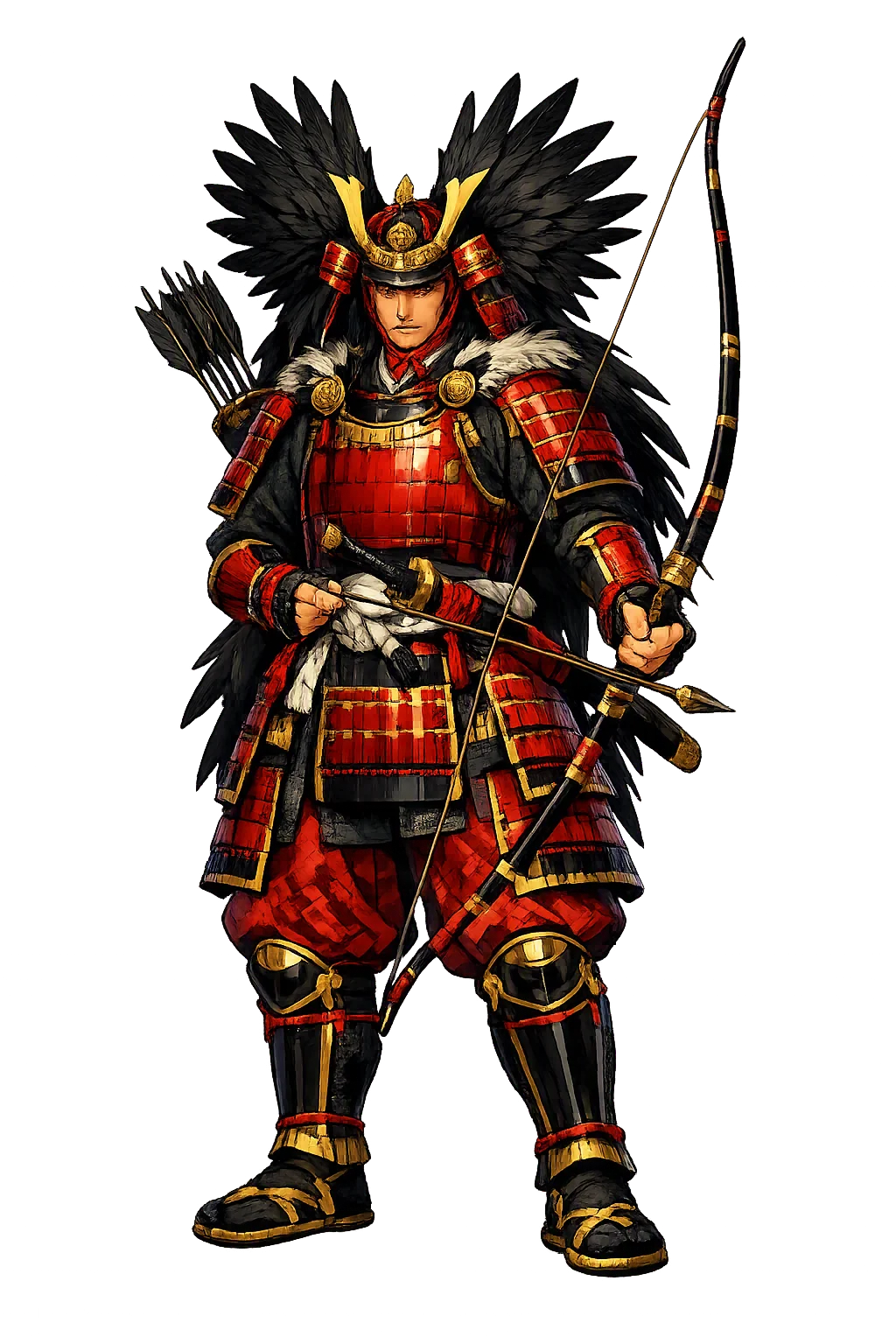
Stories of Hachiman
Hachiman's mythology is entangled with imperial history: he is most commonly identified as the deified Emperor Ōjin, making him a kami who was once a man — the only great war god of Japan who had served as a soldier. The chronicles give us the emperor; the shrine oracles, the god; and the medieval centuries fused the two into the nation's shield.
Emperor Ōjin, the fifteenth emperor, was born, the Nihon Shoki says, while his mother the empress Jingū carried him through the Korean campaign, the child holding back his own birth until the war was won — the chronicle's way of making the unborn prince a participant in victory. He grew into a ruler remembered for welcoming scholars, artisans and new technologies from the Korean kingdoms, and when he died, tradition holds, he was enshrined at Usa in Kyūshū and became Hachiman, the kami of the eight banners. The identification between the deified emperor and the war god formed gradually across the eighth century; the chronicles give us the man, and the shrine tradition gives us the god (Kojiki, Nihon Shoki, Ōjin and Jingū narratives).
A man-made kami was a new kind of divinity for Japan: not a nature power but an ancestor — which meant that the warrior's death could have a shrine, and the state's wars could have a patron who had once been a soldier himself.
The great shrine at Usa in northern Kyūshū became Hachiman's head shrine, and in the eighth century its oracle began to speak into the politics of the capital. In 749 the Shoku Nihongi records, the god was invited from Usa to Nara to lend divine authority to the casting of the Great Buddha at Tōdai-ji; in 764 his oracle denounced the rebel Fujiwara no Nakamaro and threw the prestige of heaven behind the embattled court; by the later eighth century the chronicles were styling him Hachiman Daibosatsu, the Great Bodhisattva Hachiman. A regional war god of Kyūshū had become a constitutional power — consulted, invoked and quoted in the state's own records.
The oracle's career is the quiet history of Japanese religion: kami authority deployed at the exact moments the court needed legitimacy, until protection of the throne became the god's defining office.
When the Great Buddha of Tōdai-ji was cast in 749 and opened its eyes in 752, Hachiman came from Usa as its appointed guardian, and a shrine to him was raised within the temple precincts. The temple tradition preserves the god volunteering for the office — declaring in a dream that he would protect the Buddha's hall: a kami stepping forward as a bodhisattva's gatekeeper, and a Buddhist monastery accepting a warrior god as its own. For centuries the great temples and the great Hachiman shrines traded processions, oracles and honors, and the figure of the armored archer came to stand inside Buddhist temple grounds as naturally as buddhas stood in the shrine's mandalas.
This was the deepest layer of the medieval synthesis — not a treaty between two religions but a single ritual world, in which the war god could be a bodhisattva and a bodhisattva could wear a sword.
In 1274 and again in 1281 the Mongol fleets of Kublai Khan came against Japan, and the court and the bakufu prayed to Iwashimizu Hachimangū — the shrine south of Kyōto founded in 860 to guard the capital — as to the nation's shield. The second fleet was destroyed by the typhoon of 1281, recorded in the Azuma Kagami, and the wind that sank it was named kamikaze, the divine wind: read then as the answer of the gods, and read ever after as Hachiman's own breath guarding the islands. Whether or not the storm was ever attributed to him alone, the association stuck — the god of the eight banners became the god of the storm that saved the country.
Here the mythology turns from cult history to national myth: Hachiman now protects not a shrine or a clan but the archipelago itself, and his banners fly at the scale of the sea.
Guardian of the Nation and the Samurai
Hachiman is the kami of war, archery, and protection, worshipped by samurai, peasants, and emperors alike. His symbol — eight banners (hachi-man) — recalls the standards under which the divine child grew to become a warrior patron. He is one of the most widely enshrined kami in Japan, and his cult blurred the boundary between Shinto and Buddhism for over a millennium.
Patron of warriors and archers — but of defense, not conquest: the god who protects the realm and those who fight in its name.
His name refers to the eight ritual banners that accompanied the divine birth of the child who became Emperor Ōjin.
Guardian of the nation — invoked from Usa and Iwashimizu as the shield of the throne, and credited with the storm that sank the Mongol fleets.
Worshipped both as a kami and as the Buddhist bodhisattva Hachiman Daibosatsu — the first kami the national chronicles style a bosatsu.
From the original script to the living URL
八幡
The name in its original Japanese form. Hachiman (八幡) is attested in the source tradition — “Eight banners”. Its original diacritics and script distinctions carry the full phonetic and orthographic weight of the source tradition.
hachiman
The plain hachiman form is identical to the Unicode restoration. Because this name is already written in Latin letters, no diacritics, stress, or script information were lost — only capitalization differs.
Hachiman
The Unicode restoration does not need to recover lost marks for Hachiman. Its value is canonical spelling and consistent cataloguing, not the reconstruction of erased orthography. The domain is readable as-is to both DNS and humanity.
Hachiman.com
This restoration is written entirely in ASCII letters — no Punycode encoding stands between Hachiman and the DNS. The domain reads identically to machines and to human eyes.
Owned, ideal, and ASCII forms of Hachiman
Hachiman
Restores 八幡. The full Unicode restoration. hachiman.com is not in the PuniCodex collection — it is watched for release; if it drops, this temple upgrades to an owned flagship.
How Hachiman was spoken
How Hachiman is preserved in writing
A bespoke provenance study for Hachiman is being prepared by the PUNICODEX scholarly team.
Contribute scholarly provenance →The lore you have read is the living myth. Extended Lore opens the scholarly vault beneath it: the cult and its material remains, a history of the image, the name after antiquity, a meditation on what the name still means, and the full scholarly apparatus — etymology, orthography, sources.
Enter Extended Lore