
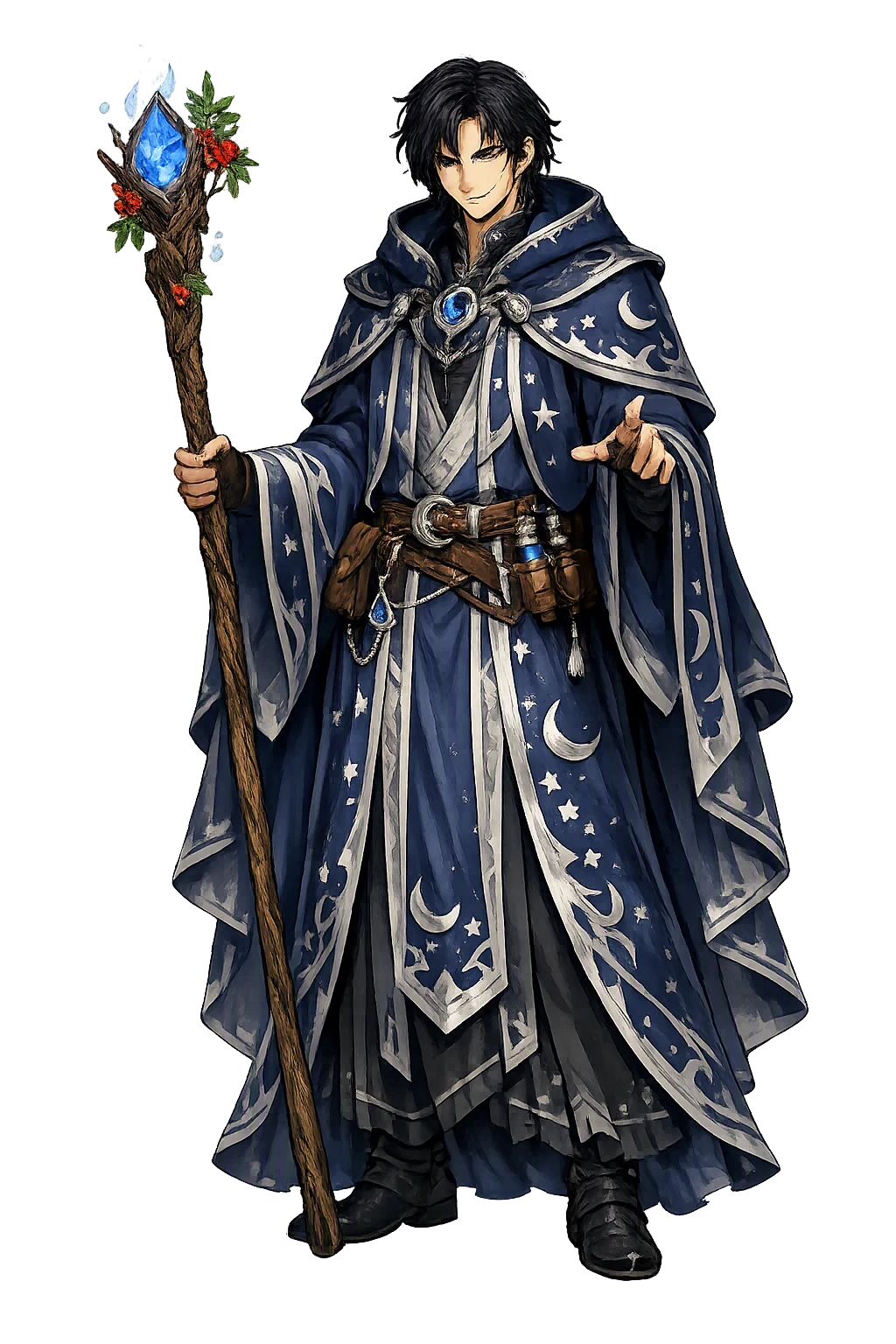
Why Gwydion belongs in your address bar
Every address bar is a choice. When you type Gwydion, you are not typing a novelty; you are restoring a name that the early DNS, built for English typewriters, could not carry. The plain ASCII form gwydion is a leftover of that constraint, not the name itself. This post is the long version of the restoration: where the name comes from, how the Celtic transcription tradition wrote it, how it is pronounced, what the myths and the material record preserve, and why its Unicode form now lives as a working domain. The claim throughout is simple — the original spelling is not decoration. It is the name.
At a Glance
- Restored name: Gwydion
- ASCII form: gwydion
- Meaning: "Born of trees"
- Domain of influence: Magic, Poetry, Trickery
- Pantheon: Celtic
- Classification: Tier 2
Overview
Gwydion (gwydion) — Magic, Poetry, Trickery · Enchanter of the Fourth Branch — is the great magician of medieval Welsh literature: son of Dôn, brother of Gilfaethwy, nephew of King Math fab Mathonwy of Gwynedd, and the animating intelligence of 'Math uab Mathonwy', the Fourth Branch of the Mabinogi. Poet, trickster, shape-shifter, foster-father, and avenger, he engineers the war that costs him three years in animal skins, and he ends the tale as the careful craftsman who sings his foster-son Lleu Llaw Gyffes down out of an oak and nurses him back into human shape.
The name's etymology is honestly debated. A derivation from the Celtic root widu- 'wood, forest' has often been proposed — compare Welsh gwydd 'trees', Old Irish fid — but the connection is not proven, and the standard scholarship treats it as uncertain. Because Welsh is written in the Latin alphabet and the Middle Welsh manuscripts already spell the name Gwydion, the ASCII form loses nothing: the name is Tier 2 by the mechanical rule, preserving no diacritic or distinctive letter that ASCII drops.
PuniCodex records the name as Gwydion — the attested manuscript spelling, identical in ASCII and Unicode. The plain-ASCII domain gwydion.com is registered to a third party and held outside the collection; it is watched for release, and this temple meanwhile stands without a domain of its own.
The Name
The name is attested in Middle Welsh as Gwydion — Gwydion uab Dôn, 'Gwydion son of Dôn' — in the White Book of Rhydderch and the Red Book of Hergest. Its etymology is debated. The most-discussed proposal derives it from the Celtic root widu- 'wood, forest' (Welsh gwydd 'trees', Old Irish fid, Gaulish vidu-), which would make the enchanter's name a tree-name — fitting for the magician of Kat Godeu, the Battle of the Trees — but the phonological and semantic steps are not secure, and the handbooks mark the etymology uncertain. The older popular gloss 'born of trees' reflects this same gwydd association rather than a settled derivation.
Because the manuscript spelling is plain Latin letters, the ASCII form gwydion is not a flattening but the attested form itself: there is no diacritic to restore and no distinctive letter ASCII loses, which places the name in Tier 2. The Unicode form Gwydion differs from the ASCII only by capitalisation.
The letter-by-letter transformation runs:
- g → G — Same, capitalized
- w → w — Same
- y → y — Same
- d → d — Same
- i → i — Same
- o → o — Same
- n → n — Same
The plain-ASCII domain gwydion.com is registered to a third party and held outside the collection; it is watched for release.
The Original Script
Welsh is written in the Latin alphabet, and the name is preserved in Middle Welsh manuscripts as Gwydion — attested 14th–15th c. CE in the White Book of Rhydderch (Aberystwyth, National Library of Wales, Peniarth 4–5, c. 1350) and the Red Book of Hergest (Oxford, Jesus College MS 111, c. 1400), the two great codices of the Mabinogion, recording material whose oral and written prehistory reaches centuries earlier.
The scholarly rendering proceeds step by step:
- The manuscript spelling Gwydion is already the normalized editorial form; Ifor Williams's standard edition of the Four Branches regularises nothing in this name.
- No runic, ogham, or other non-Latin attestation exists; Welsh names of this stratum were not carved in ogham, and the ogham stones of Wales belong to an earlier, Irish-settler epigraphic horizon.
- The ASCII form gwydion differs only in capitalisation; nothing is lost or restored between the two.
- The plain-ASCII domain gwydion.com is registered to a third party, held outside the collection, and watched for release.
Pronunciation
The modern Welsh pronunciation of the name is /ˈɡwɪdjɔn/ — Modern Welsh standard.
Phoneme by phoneme:
- Gwy- — Voiced velar stop [ɡ] immediately rounded into [w] as a single onset; the vowel is Welsh y in a stressed monosyllabic element, the close central vowel conventionally written [ɪ], like a tighter version of the i in English 'kin'
- -dion — Voiced dental stop [d], palatal glide [j] written i before the vowel, short open [ɔ], final dental nasal [n]
For the modern speaker, the closest approximation is: 'GWID-yon' — two syllables, stress on the first, the gw sounded together as in 'Gwen', never 'guh-WID-ee-on'.
Kindred and historical forms of the name:
- Middle Welsh — Gwydion (uab Dôn), the manuscript form
- Modern Welsh — Gwydion, unchanged in spelling and near-unchanged in sound
- Proposed cognates — Welsh gwydd 'trees, wood', Old Irish fid 'wood', Gaulish vidu-, behind the debated widu- etymology
- Attested form — Gwydion
Gwydion is Tier 2 because the restoration preserves nothing ASCII loses: the name arrives in the Latin alphabet, without diacritics, in the manuscripts themselves. The name's interest lies not in rescued marks but in the honesty of its uncertainty — a famous magician whose own name has never been fully explained.
Mythology
Gwydion's mythology is the Fourth Branch of the Mabinogi, 'Math uab Mathonwy' — the masterpiece of medieval Welsh prose, and a single continuous narrative in which he moves from trickster to penitent to restorer.
The War for the Swine
King Math of Gwynedd could live only with his feet in a virgin's lap, save in wartime, and the maiden Goewin held that office. When Gwydion's brother Gilfaethwy desired her, Gwydion engineered the remedy: he went to Pryderi of Dyfed in the guise of a poet and asked for the swine — the hobeu, the first pigs brought to Wales, a gift from Arawn of Annwfn. Refused, he conjured twelve stallions, twelve greyhounds, and twelve shields, all of them seeming-gold, and traded the apparitions for the herd. The glamour faded, Pryderi pursued, and Gwynedd and Dyfed went to war. While Math was with the army, Gwydion and Gilfaethwy forced Goewin. At the settlement Pryderi demanded single combat, and at Maenor Penard Gwydion killed him — the tale's own formula is 'by strength and valour and by magic and enchantment'.
The Punishment of the Brothers
Math's answer was the most distinctive judgement in the Mabinogi. He struck the brothers with his wand into a stag and a hind for one year, a boar and a sow for the second, a wolf and a she-wolf for the third; each year's offspring — Hyddwn, Hychddwn Hir, Bleiddwn — was sent to court, baptised, and raised. After the third year Math restored them: they had had punishment enough, and had been greatly shamed, and he took them back into honour.
The Naming and Arming of Lleu
Proposing his sister Arianrhod as the new footholder, Gwydion watched her step over Math's wand for the virginity test and drop a yellow-haired boy — Dylan, who made at once for the sea — and 'something small' that Gwydion swept up and hid in a chest at the foot of his bed. From the chest came the boy he fostered. Arianrhod, shamed, laid three tynghedau on him: no name unless she named him, no arms unless she armed him, no wife of any race then on earth. Gwydion undid the first two by craft: disguised as a shoemaker beneath Caer Arianrhod, he let the boy knock a wren's leg askew with a stone until Arianrhod cried out that the fair one had struck with a skilful hand — Lleu Llaw Gyffes, and the name was given; then he raised a phantom fleet against the castle until she armed her own defenders.
The Flower-Maiden, the Eagle, and the Vengeance
For the third tynged, Gwydion and Math made a woman from the flowers of oak, broom, and meadowsweet and named her Blodeuwedd. She betrayed Lleu with Gronw Pebr of Penllyn, drew from him the impossible conditions of his death, and Gronw's spear struck him into the shape of an eagle. Gwydion searched until he followed a sow to an oak in the valley of the Cynfael, found the eagle in its top, and sang three englynion to bring him down; a stroke of the wand returned him to human shape, skin and bone, to be nursed back by doctors. The vengeance was as crafted as the rescue: Blodeuwedd he would not kill but turned into an owl — 'you will not dare show your face in daylight, because of the enmity of all the birds' — and Gronw, standing in Lleu's place, took Lleu's spear-cast through the great slab at Llech Gronw and died.
Beyond the Fourth Branch
The Book of Taliesin preserves Gwydion's other fame: in Kat Godeu, 'The Battle of the Trees', he enchants the forest to march against Arawn of Annwfn, alder at the front — and in the tale-tradition around the poem he guesses an enemy champion's hidden name from the alder twigs in his hand, naming-by-craft as in the wren scene. Related figures include Taliesin, the poem's boasting witness, and Manawydan, whose own branch of the Mabinogi shares the Fourth's otherworld economy of magic and debt.
Symbols & Iconography
Gwydion's attributes are narrative rather than cultic — the Welsh corpus preserves no temple regalia, but the Fourth Branch fixed a recognisable set of instruments around him:
- The magic wand — Math's wand, which strikes the brothers into deer, boars, and wolves, tests Arianrhod, and finally strikes Lleu from eagle back into man; Gwydion shares in its use at every turning of the tale
- The illusory horses and hounds — Twelve stallions with golden harness, twelve greyhounds with golden collars and leashes, twelve golden shields: conjured wealth real for a day, the price of the first swine in Wales
- Oak, broom, and meadowsweet — The three flowers from which he and Math fashioned Blodeuwedd
- The sow — The beast he followed up the valley of the Cynfael to the oak where the wounded eagle rotted and fed her
- The three englynion — The verses he sang to bring Lleu down the tree perch by perch: poetry doing the work of a rope
- The shoemaker's bench — The disguise under which he tricked Arianrhod into naming her son Lleu Llaw Gyffes, 'the fair one with the skilful hand'
Archaeology & Evidence
Gwydion has no pre-Christian material attestation: no inscription, votive deposit, or image names him, and his evidence is manuscript evidence. The Fourth Branch survives in the White Book of Rhydderch (NLW Peniarth 4–5, c. 1350) and the Red Book of Hergest (Jesus College Oxford MS 111, c. 1400), the two codices on which all modern editions rest; Kat Godeu is preserved in the Book of Taliesin (NLW Peniarth 2, early fourteenth century).
What the landscape contributes is geography, not cult. The tale is set in walkable terrain — Gwynedd and Arfon, the moor of Maenor Penard, the river Cynfael in Ardudwy, the court of Penllyn — and a holed stone traditionally pointed out as Llech Ronw, 'Gronw's stone', the slab Lleu's spear pierced, stands in the Cynfael valley. The identification is local tradition rather than proof, but it shows how early and how firmly the story was mapped onto the Welsh landscape: medieval audiences, like modern walkers, could be taken to the places where the Fourth Branch happens.
Realm & Domain
Gwydion is the Fourth Branch's master of magic, craft, and vengeance: the enchanter whose illusions pass for wealth, whose disguises wring names and weapons out of an unwilling fate, and whose final acts of justice are as carefully shaped as his spells.
Magic
He conjures stallions, hounds, and shields solid enough to trade for otherworld swine; he raises a phantom fleet against Caer Arianrhod; with Math he makes a woman out of flowers. In the Book of Taliesin's Kat Godeu he enchants the forest itself to march as an army.
Craft
His power is artisanal rather than thunderous: he wins by making — disguises, verses, strategies — and the Fourth Branch repeatedly calls his work by the vocabulary of skill. He arrives at Pryderi's court as a poet, and beneath Arianrhod's walls as a shoemaker.
Vengeance
His justice is measured and transformed: three years in animal shapes as his own sentence, then the owl-shape for Blodeuwedd — 'I will not kill you' — and the spear-cast through the stone at Llech Gronw. Punishment, in his hands, is a kind of making too.
The House of Dôn
Son of Dôn, brother of Gilfaethwy and Arianrhod, nephew of Math, fosterer of Lleu: the Fourth Branch keeps him inside the kinship of the Children of Dôn, the Welsh mythic kindred whose quarrels and reconciliations the tale narrates.
Across Cultures
Gwydion belongs to the European family of trickster-enchanters, and comparative readers have long set him beside Loki — the disguise-bargainer and shape-shifter — and Hermês, the poet-thief who wins by craft rather than force. Mac Cana treats him as one of the great magician-figures of the Celtic world, but the comparisons hold at the level of motif, not borrowing: illusion as currency, the hidden name, punishment by metamorphosis.
The deeper kinship is insular Celtic. Irish tradition is full of druidic shape-shifters and three-fold transformations, and Gwydion's and Math's wand-work belongs to that shared idiom; scholars have also connected the Fourth Branch's otherworld material — Arawn's swine, the phantom fleet — to the mythology of Manawydan and the First and Third Branches. The proposed widu- etymology, if it could be proven, would align the name itself with the insular tree-lore of Welsh gwydd and Old Irish fid — but it remains a proposal, and the honest verdict is uncertainty.
Cultural Legacy
Gwydion's afterlife runs from Welsh sky-lore into world literature. Later Welsh tradition named the Milky Way Caer Gwydion, 'Gwydion's fortress' — the enchanter's stronghold written across the night sky — and the bards kept his tree-battle in the poetic canon through Kat Godeu.
The twentieth century carried him into English letters twice over. Alan Garner's The Owl Service (1967) rebuilt the Blodeuwedd tragedy as a pattern that repeats itself down the generations of a Welsh valley — flowers into owl, owl into flowers — and remains the most powerful modern reworking of the Fourth Branch. Lloyd Alexander's Chronicles of Prydain drew its Prince Gwydion fab Don, heir of Math, directly from the Mabinogi, giving the enchanter a second life as a hero of children's literature; Evangeline Walton's retellings of the Mabinogion made his punishment and restoration the moral hinge of her Fourth Branch volume. In scholarship he stands as the standard exhibit of the Welsh magician: Ifor Williams's edition, Mac Cana's study, and Koch's encyclopedia all treat the Fourth Branch as the masterpiece of medieval Welsh prose and Gwydion as its animating intelligence.
The Scholarly Record
The account of Gwydion given in this edition rests on the witnesses and reference works listed below. The Fourth Branch supplies the narrative; the Book of Taliesin the older poetic echo; the editions and handbooks secure the text, the name, and the debated etymology.
- The Mabinogion, Fourth Branch (Math uab Mathonwy), trans. Sioned Davies (Oxford: Oxford University Press, 2007).
- Ifor Williams, ed., Pedeir Keinc y Mabinogi, 2nd ed. (Cardiff: University of Wales Press, 1951).
- Haycock, Marged, ed. and trans., Legendary Poems from the Book of Taliesin (Aberystwyth: CMCS, 2007), Kat Godeu.
- Mac Cana, Proinsias, The Mabinogi, 2nd ed. (Cardiff: University of Wales Press, 1992).
- Koch, John T., ed., Celtic Culture: A Historical Encyclopedia, 5 vols. (Santa Barbara: ABC-CLIO, 2006), s.v. Gwydion, Mabinogi.
- Evans, D. Simon, A Grammar of Middle Welsh (Dublin: Dublin Institute for Advanced Studies, 1964).
- Huws, Daniel, Medieval Welsh Manuscripts (Cardiff: University of Wales Press, 2000).
- Garner, Alan, The Owl Service (London: Collins, 1967); Alexander, Lloyd, The Book of Three (New York: Holt, 1964).
A Meditation
Gwydion is what a culture makes of cleverness when it refuses to call cleverness innocent. His finest trick — the phantom gold that bought the swine — is also his crime, and the tale answers it with the strangest sentence in Celtic literature: three years in the bodies of beasts, one year for each shape of the debt, until punishment and shame have been paid in full and the king takes the brothers back into honour.
But the same hands that tricked a king later coax a dying man out of an oak, one verse at a time. Gwydion's magic is never thunder; it is craft — the shoemaker's bench, the poet's englyn, the wand used at last to heal rather than to change. The Fourth Branch's calm doctrine is that to know the true shape of a thing is to be able to change it, and to be answerable for the change. Gwydion is the enchanter who learns, and teaches, that power over forms is a form of responsibility.
The Unicode Restoration
Gwydion is classified as Tier 2: the restoration needs no distinctive letters or diacritics its ASCII form would lose. The ASCII fallback gwydion still resolves everywhere, but it is the restored form that carries the name's full information. That is the whole thesis of this temple: the marks are the message.
Why This Restoration Matters
Restoring Gwydion is part of a larger effort to make the web multilingual by default. The PuniCodex project does not ask users to learn a new alphabet; it asks the infrastructure to respect the alphabets that already exist. Every section of this post — the script, the sound, the myths, the evidence — converges on the same point: the marks in Gwydion are information, and information deserves an address of its own. A single Unicode domain is a small proof, but it is a proof that scales: every name restored makes the next one easier, and every visit to the temple is a vote for the restored form.
Explore Further
This post is one doorway into the temple. The home page carries the full character breakdown and the ambient canvas; the lore page tells the myths in long form; the Scholarly Edition preserves the sources, pronunciation data, and revision history; and the patron wall supports the restoration directly. For the wider map, browse the Lexicon, explore the Pantheon, or return to the PuniCodex blog.
Related Names
Sources
The full scholarly apparatus — every citation, revision, and review — lives in the Scholarly Edition. Key references for this post:
- The Mabinogion, Fourth Branch (Math uab Mathonwy), trans. Sioned Davies (Oxford: Oxford University Press, 2007).
- Koch, John T., ed., Celtic Culture: A Historical Encyclopedia, 5 vols. (Santa Barbara: ABC-CLIO, 2006), s.v. Gwydion.
- Ifor Williams, ed., Pedeir Keinc y Mabinogi, 2nd ed. (Cardiff: University of Wales Press, 1951).
- Koch, John T., ed., Celtic Culture: A Historical Encyclopedia (ABC-CLIO, 2006), s.v. Gwydion; Mac Cana, Proinsias, The Mabinogi, 2nd ed. (Cardiff: University of Wales Press, 1992).
- Lexicon authorities for this entry: Mabinogion, MacKillop.