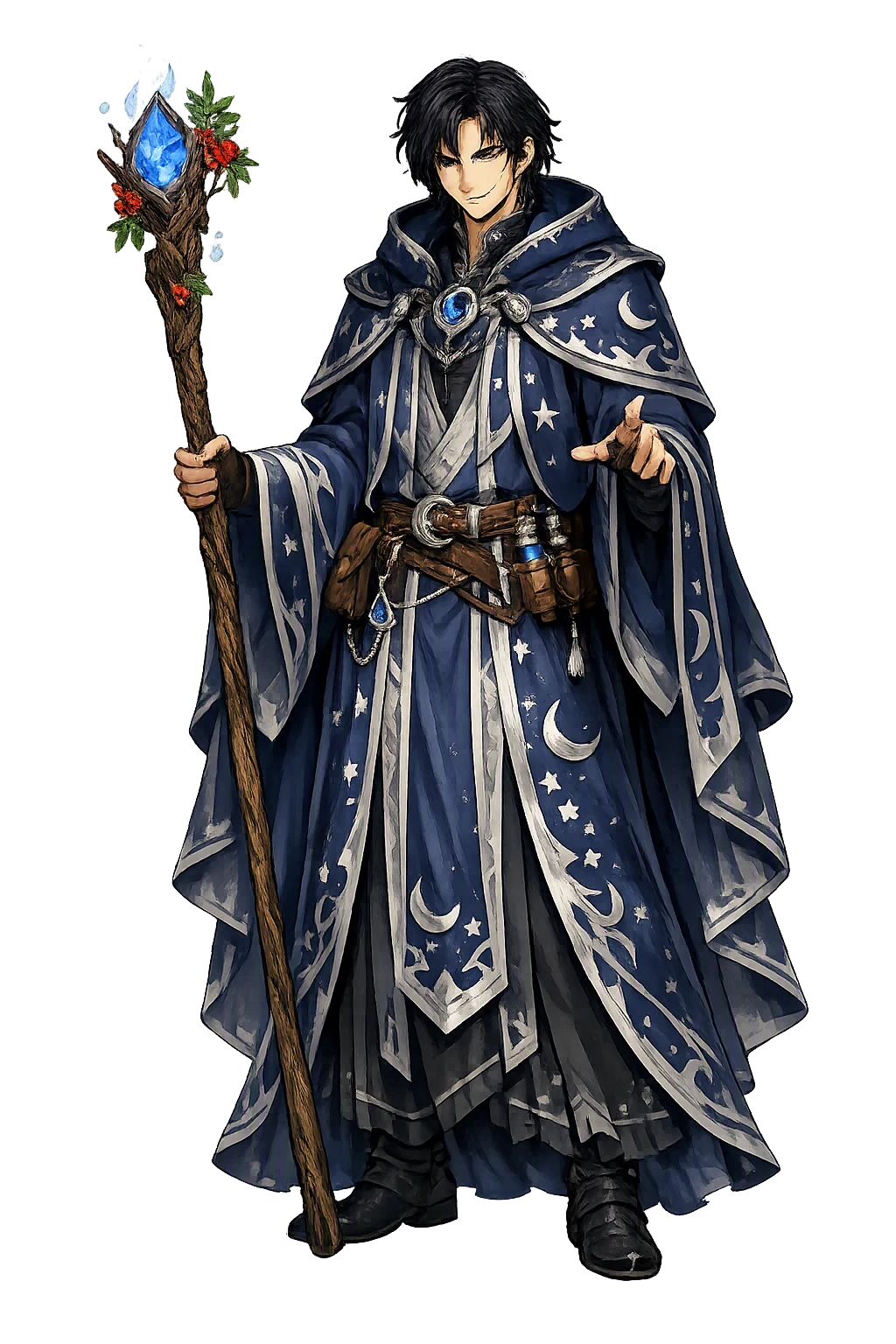
Ancient Domain
In the celtic tradition, Gwydion governed magic, craft, vengeance. The name encodes a sphere of power that shaped ritual, narrative, and social order.
Extended Lore
Etymology · Phonology · Orthography · Cultural Legacy · Primary Sources

Essential information about Gwydion, Magic, Poetry, Trickery
From original script to Unicode restoration
Middle Welsh Gwydion (Gwydion uab Dôn) is already written in the Latin alphabet, so the ASCII form loses nothing: the name is Tier 2 by the mechanical rule, since the restoration preserves no diacritic or distinctive letter that ASCII drops. The etymology is honestly debated: a derivation from the Celtic root *widu- 'wood, forest' has often been proposed (compare Welsh gwydd 'trees', Old Irish fid, Gaulish vidu-), but the connection is not proven and the standard handbooks mark it uncertain.
Character-by-character philological analysis
| Character | Unicode | Name | Block | Phonetic Role |
|---|---|---|---|---|
| G | U+0047 | Latin Capital Letter G | Basic Latin | Same, capitalized |
| w | U+0077 | Latin Small Letter W | Basic Latin | Same |
| y | U+0079 | Latin Small Letter Y | Basic Latin | Same |
| d | U+0064 | Latin Small Letter D | Basic Latin | Same |
| i | U+0069 | Latin Small Letter I | Basic Latin | Same |
| o | U+006F | Latin Small Letter O | Basic Latin | Same |
| n | U+006E | Latin Small Letter N | Basic Latin | Same |
The Tier 2 classification reflects how much of the original phonology this restoration preserves — stress and vowel length for Greek names, distinctive letters and diacritics for every other tradition.
From ancient cult to modern Unicode
In the celtic tradition, Gwydion governed magic, craft, vengeance. The name encodes a sphere of power that shaped ritual, narrative, and social order.
Gwydion is the Welsh trickster-enchanter, and comparative scholarship has set him beside the other shape-changing cunning figures of Europe: [[loki|Loki]], whose disguises and bargains Gwydion's deceptions recall; [[hermes|Hermês]], the poet-thief of the Greek pantheon; and Óðinn in his sorcerer's aspect. Mac Cana treats him as one of the great magician-figures of the Celtic world, and the comparison holds at the level of motif — illusion, disguise, the hidden name, the shape-shifting punishment — not of borrowing. The deeper kinship is insular: Irish tradition is full of druidic shape-shifters, and Gwydion's transformations of and by Math belong to a shared Celtic idiom of magic as metamorphosis. Scholars have also long linked the Fourth Branch's otherworld material — Arawn's swine, the phantom fleet — to the mythology of [[manawydan|Manawydan]] and the First and Third Branches.
Gwydion's afterlife runs from Welsh tradition into modern letters. Later Welsh usage named the Milky Way Caer Gwydion, 'Gwydion's fortress' — the enchanter's castle written across the night sky — and the antiquarian bards kept his tree-battle in the poetic canon. In the twentieth century he entered world literature twice over: Alan Garner's The Owl Service (1967) rebuilt the Blodeuwedd tragedy as a haunting that repeats itself down the generations of a Welsh valley, and Lloyd Alexander's Chronicles of Prydain gave young readers a Prince Gwydion fab Don, heir of Math, drawn directly from the Fourth Branch. Evangeline Walton's retellings of the Mabinogion made his punishment and restoration the moral hinge of her Fourth Branch volume. In scholarship he remains the standard exhibit of the Welsh magician: Ifor Williams's edition, Mac Cana's study of the Mabinogi, and Koch's Celtic encyclopedia all treat the Fourth Branch as the masterpiece of medieval Welsh prose and Gwydion as its animating intelligence.
Restoring Gwydion in a domain name is more than orthographic accuracy. It is a statement that the internet should recognize the full range of human writing — not only the ASCII keyboard.
Common questions about Gwydion, Magic, Poetry, Trickery, and Unicode restoration
In reconstructed pronunciation, Gwydion is /ˈɡwɪdjɔn/ — approximately GWID-yon — the gw is a single lip-rounded consonant, the y sounds like the i of 'kin', and the stress falls on the first syllable..
Gwydion means Born of trees in the celtic tradition.
Gwydion is associated with The magic wand (Math's wand of transformation — punishment, testing, and restoration carried in a single rod), Oak, broom, and meadowsweet (The three flowers from which Blodeuwedd was made by enchantment), The illusory horses and hounds (Gwydion's conjured wealth, real for a day and gone by morning — craft as currency), The eagle on the oak (Lleu wounded into bird-shape, rotting flesh feeding a sow beneath the tree), The sow (The beast Gwydion followed through the valley to find his foster-son).
Plain ASCII gwydion strips the stress, length, and script that make the name specific. Unicode restoration returns the name to its original written dignity.
King Math of Gwynedd could live only with his feet in the lap of a virgin, except in time of war, and the maiden Goewin held that office. When Gilfaethwy desired her, Gwydion devised the remedy: war. He went to Pryderi of Dyfed in the guise of a poet and asked for the swine — the hobeu, the first pigs ever brought to Wales, a gift from Arawn of Annwfn. Refused, he conjured twelve stallions with golden harness, twelve greyhounds with golden collars, and twelve golden shields, and traded the apparitions for the herd. By the time Pryderi's glamour faded, Gwydion was gone, and Pryderi came north with an army.While Math marched to meet him, Gwydion and Gilfaethwy forced Goewin. At the peace-talks Pryderi demanded single combat, 'for it was because of me that the hosts came'; at Maenor Penard, the tale says, Gwydion slew him 'by strength and valour and by magic and enchantment', and Dyfed went home under tribute. The victory is real and so is its cost: Gwydion's finest trick is also his crime, and the Fourth Branch never lets the two be separated.
The philological foundations of this restoration
Every claim on this page is grounded in established scholarship. The orthographic restorations follow disciplinary convention. The etymological chain follows the best available reference works. This is not invention — it is resurrection through scholarship.
You have traced the name from its earliest attestation to its Unicode restoration. Now return to the myth. The story is where the name lives.
Back to Lore