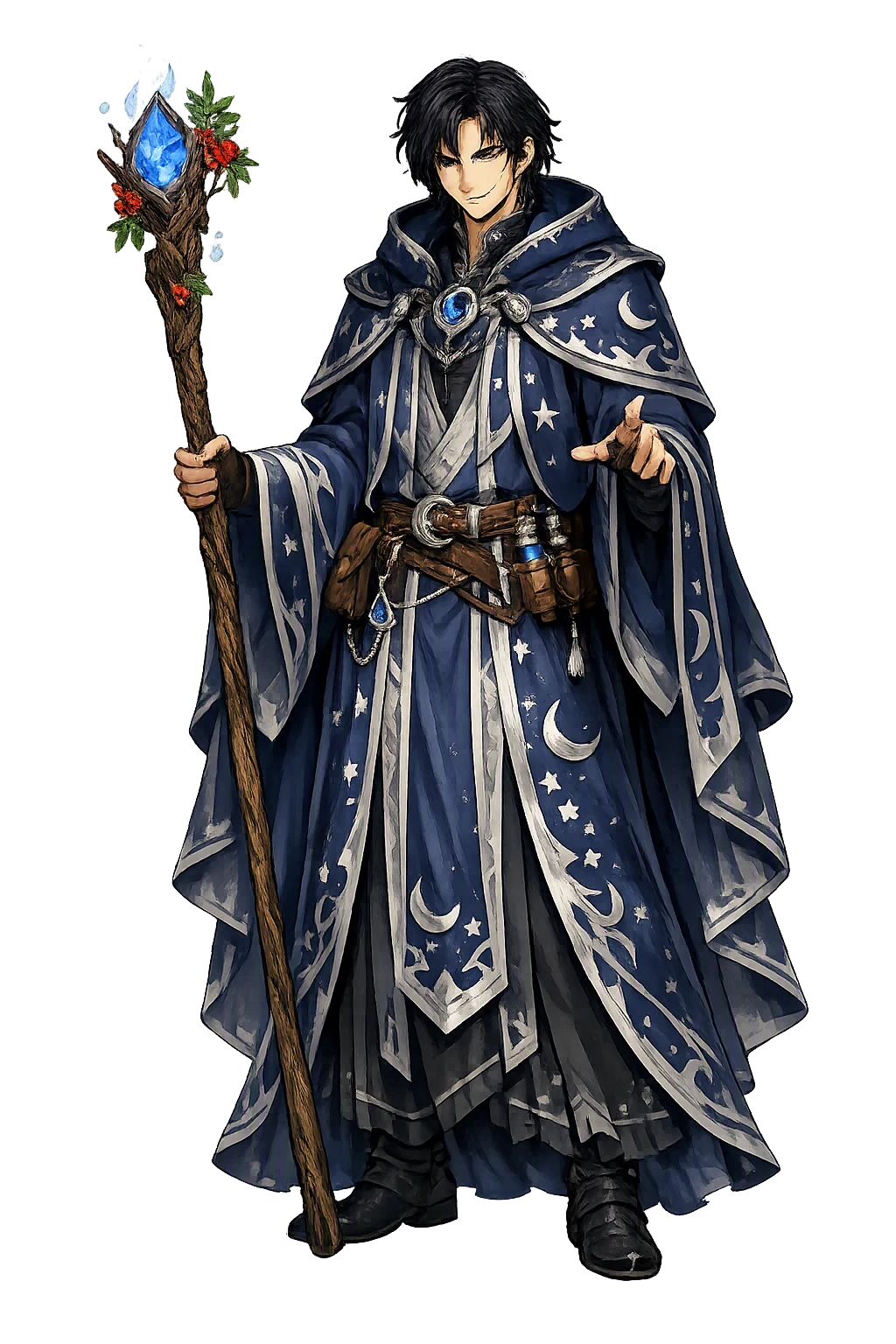
Stories of Gwydion
Gwydion fab Dôn is the enchanter of the Fourth Branch of the Mabinogi, 'Math fab Mathonwy': nephew of Math the king of Gwynedd, brother of Gilfaethwy, and the foremost magician of medieval Welsh literature. He is poet, trickster, foster-father, and avenger in one figure — the man who makes illusions that pass for wealth, who pays for his crimes in animal skins, and who ends the tale as the careful hand that puts a broken world back into shape.
King Math of Gwynedd could live only with his feet in the lap of a virgin, except in time of war, and the maiden Goewin held that office. When Gilfaethwy desired her, Gwydion devised the remedy: war. He went to Pryderi of Dyfed in the guise of a poet and asked for the swine — the hobeu, the first pigs ever brought to Wales, a gift from Arawn of Annwfn. Refused, he conjured twelve stallions with golden harness, twelve greyhounds with golden collars, and twelve golden shields, and traded the apparitions for the herd. By the time Pryderi's glamour faded, Gwydion was gone, and Pryderi came north with an army.
While Math marched to meet him, Gwydion and Gilfaethwy forced Goewin. At the peace-talks Pryderi demanded single combat, 'for it was because of me that the hosts came'; at Maenor Penard, the tale says, Gwydion slew him 'by strength and valour and by magic and enchantment', and Dyfed went home under tribute. The victory is real and so is its cost: Gwydion's finest trick is also his crime, and the Fourth Branch never lets the two be separated.
Math's justice is the strangest in the Mabinogi. He struck Gwydion and Gilfaethwy with his magic wand and turned them into a stag and a hind, and sent them into the wild for a year; when they returned with a fawn, he made them a boar and a sow for the second year, and a wolf and a she-wolf for the third. Each year their offspring — Hyddwn, Hychddwn Hir, and Bleiddwn — were sent to the court, baptized, and raised.
After the third year Math struck them back into their own shapes: 'You have had punishment enough, and you have been greatly shamed.' The punishment is exact and even-handed — the brothers suffer in the flesh what they did, and when the debt is paid the king takes them back into honour. It is the Fourth Branch's doctrine of justice in miniature: transformation as sentence, restoration as mercy. And it matters that the wand passes finally into Gwydion's own hand: the man punished by shape-shaping becomes the master of it, and the tale watches to see what he does with the power that once unmade him.
When Gwydion proposed his sister Arianrhod as Math's new footholder, she stepped over the wand for the virginity test and dropped a yellow-haired boy — Dylan, who made for the sea — and 'something small' that Gwydion hid in a chest at the foot of his bed. From the chest came the boy who would be Lleu. Gwydion fostered him, and Arianrhod, shamed, laid three tynghedau upon him: he should have no name until she named him, no arms until she armed him, and no wife of any race then on earth.
Gwydion undid the destinies by craft. Disguised as a shoemaker with the boy at his side, he came beneath Caer Arianrhod, and when Lleu flung a stone and struck a wren's leg askew, Arianrhod cried that the fair one had struck it with a skilful hand — and so named him Lleu Llaw Gyffes. For the arms, Gwydion conjured a phantom fleet against the castle until Arianrhod herself armed the defenders. The magician wins not by force but by arranging the world so that his opponent speaks the words he needs: the tynged is a lock, and Gwydion's trade is keys.
For the third tynged there was no earthly answer, so Gwydion and Math made one: from the flowers of the oak, the broom, and the meadowsweet they fashioned the fairest woman anyone had seen, and named her Blodeuwedd, 'Flower-face'. She married Lleu — and betrayed him with Gronw Pebr of Penllyn, drawing from her husband the secret of how he could be killed, so that Gronw's spear struck him at the impossible meeting of conditions and Lleu flew off in the shape of an eagle, screaming.
Gwydion searched Gwynedd and Powys until he followed a sow to an oak where rotten flesh fell to her snout, and in the top of the tree sat the eagle. He sang three englynion down the perches of the years until Lleu came to his knee, then struck him with the wand back into human shape — skin and bone, to be nursed with doctors and good care. The vengeance was as crafted as the rescue: Blodeuwedd he would not kill, but turned into an owl, 'the shape hated by all the birds'; and Gronw, standing where Lleu had stood, took Lleu's spear-cast through the slab at Llech Gronw and died. Maker of the woman, finder of the man, instrument of the sentence: Gwydion's whole domain is in this last movement.
Outside the Mabinogi, the Book of Taliesin preserves Gwydion's other great fame: Kat Godeu, 'The Battle of the Trees', in which he enchants the trees of the forest to march as an army — the alder in the van, the oak amid the hosts. The poem's speaker, Taliesin, boasts that he was there when Gwydion 'made the sally of the trees'. In the tale-material gathered around the poem, the sons of Dôn fight the forces of Annwfn over a white roebuck, a whelp, and a lapwing, and the battle turns when the hidden name of the enemy's champion is guessed from the alder twigs in his hand — the same magic of the name that the Fourth Branch shows in the wren scene. Whether the poem preserves older myth or later learned fancy is honestly debated, but its Gwydion is unmistakably the Mabinogi's: the magician whose weapons are other things' natures, who wins by knowing what a thing is called and what it can be made to do.
Enchanter of Gwynedd — illusion, craft, and the fate of Lleu Llaw Gyffes
In the Welsh tradition, Gwydion fab Dôn is the foremost magician of the Mabinogi: master of illusion, disguise, and the hidden name, whose tricks win a war — and whose craft finally puts a broken world back together.
Disguised as a poet, Gwydion conjured illusory stallions, hounds, and shields to trade for Pryderi's otherworld pigs — the first swine in Wales — and started a war with a vanishing herd.
The wand that transformed Gwydion and Gilfaethwy into deer, boars, and wolves for three years — and that later struck Lleu from eagle back into man.
With Math, Gwydion fashioned Blodeuwedd from the flowers of oak, broom, and meadowsweet — a wife made by craft for the man no earthly wife was allowed.
When Lleu was struck into eagle-shape, Gwydion followed a sow to the oak, sang three englynion to bring him down, and turned vengeance into restoration.
From the original script to the living URL
Gwydion
The name survives in scholarly transliteration. Gwydion is the standard Celtic romanisation, documented in academic sources — “Born of trees”. Because the spelling uses only Latin letters, the form is the same in both ASCII and Unicode.
No indigenous writing system is securely attested for individual celtic names. The form shown is a modern scholarly transliteration.
gwydion
The plain gwydion form is identical to the Unicode restoration. Because this name is already written in Latin letters, no diacritics, stress, or script information were lost — only capitalization differs.
Gwydion
The Unicode restoration does not need to recover lost marks for Gwydion. Its value is canonical spelling and consistent cataloguing, not the reconstruction of erased orthography. The domain is readable as-is to both DNS and humanity.
Gwydion.com
This restoration is written entirely in ASCII letters — no Punycode encoding stands between Gwydion and the DNS. The domain reads identically to machines and to human eyes.
Owned, ideal, and ASCII forms of Gwydion
Gwydion
The full Unicode restoration. gwydion.com is not in the PuniCodex collection — it is watched for release; if it drops, this temple upgrades to an owned flagship.
How Gwydion was spoken
How Gwydion is preserved in writing
No indigenous writing system is securely attested for individual celtic names. The form shown is a modern scholarly transliteration.
Contribute scholarly provenance →The lore you have read is the living myth. Extended Lore opens the scholarly vault beneath it: the cult and its material remains, a history of the image, the name after antiquity, a meditation on what the name still means, and the full scholarly apparatus — etymology, orthography, sources.
Enter Extended Lore