
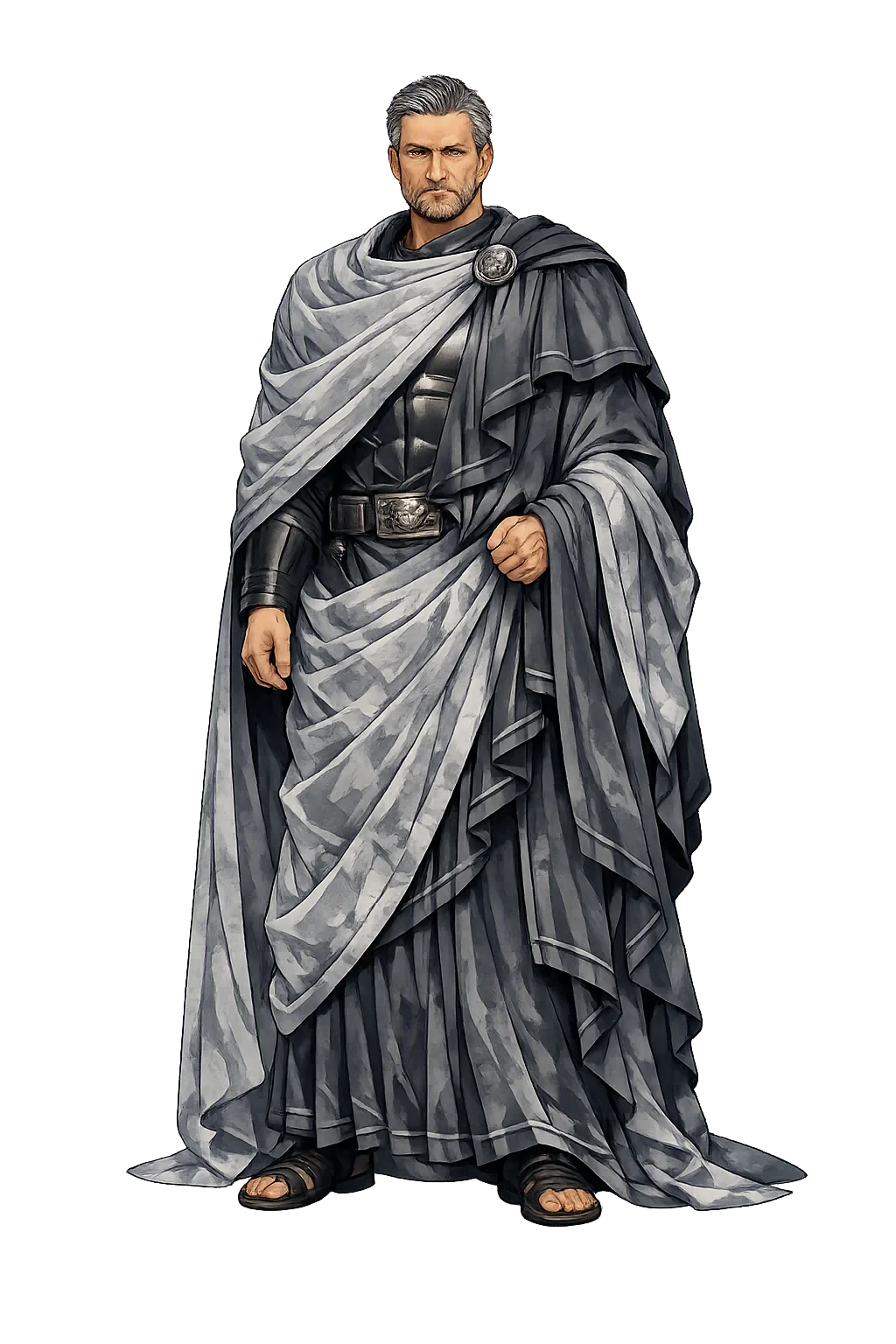
How Gravitas was rebuilt, mark by mark
The workshop file for Gravitas. Every rejected form is recorded here too — that is the point of keeping notes.
What We Found
The attestation runs through the tradition's own sources: GRAVITAS. Meaning: "Weight, importance".
The figure behind the name: Gravitas has no cult, no temple, and no goddess — it is a Roman virtue, not a Roman deity.
What the Name Carried In
The Dictator Who Went Home. In 458 BCE a Roman army under the consul Minucius lay trapped in a mountain defile by the Aequi, and the Senate did what Roman law allowed in mortal danger: it named a dictator, a single magistrate above all appeal, to save the state. The envoys found their man behind his plough on a four-acre farm across the Tiber, Lucius Quinctius, called Cincinnatus from his uncut hair.
The Face That Feigns Hope. When Aeneas came up from the shore of Libya after the storm that had smashed his fleet, seven ships left of twenty, he found his own crews already gathered, grieving for the lost and for themselves. Virgil gives the scene its unforgettable line: spem vultu simulat, premit altum corde dolorem — 'he feigns hope on his face, and presses his deep grief down in his heart' (Aeneid 1.
A spelling that has to carry stories like these is not a label. It is equipment.
Where It Stood Before Us
Gravitas survives most vividly in portraiture: the bronze statue known as the Arringatore (Aule Metele, c. 100–90 BCE, now in Florence) shows an Etruscan-Roman orator in full toga with his right arm raised in precisely the gesture Quintilian prescribes — the body arranged for public weight a century before the Institutio was written. Rows of togate statues marked the tombs along the Via Appia and the family dead in house atria; the wax ancestor masks (imagines) themselves decayed, but cupboards for them are built into surviving atrium houses, and their descendants in marble crowd the museums of the Roman world. Imperial mints later personified the abstract virtues on coinage — Pietas, Virtus, Clementia, Concordia — a type-set of Rome's character struck in silver and spent across three continents. The bench inherits all of it — the web temple is the newest site, not the first.
What We Rejected
The plain ASCII gravitas — admissible as a fallback, never as the primary. A wrong accent would have been worse: the rulebook is explicit that a misplaced mark is worse than none.
What We Set Down
Gravitas — The restoration keeps one feature the ASCII form drops. One is enough to matter, and the label says so plainly: Tier-2.
For the voice: 'GRAH-wih-tahs' — three syllables, the first stressed and grounded, the ending short and definite; no diphthongs, no drift.
The temple stands at /gravitas/ — the notes above are public in its Scholarly Edition, sources and all.
At a Glance
- Restored name: Gravitas
- ASCII form: gravitas
- Meaning: "Weight, importance"
- Domain of influence: Weight, Seriousness, Dignity
- Pantheon: Greek
- Classification: Tier 2
- Original script: GRAVITAS
- Series: The Restoration Files, No. 179 of 548
The File Continues
The temple's founding dispatch tells the name's story; its Resonance File reads the myths into the industries; the blog index holds the whole archive.
Continue the series — previous file: Goshin (read it here) · next file: Guāndì (read it here).
The Restoration Files are written from the same canonical record as the temples themselves: the lexicon, the lore catalog, the pattern atlas, and the cited scholarly sources. If a file ever disagrees with its temple, the temple is right — tell us, and the file will be corrected.