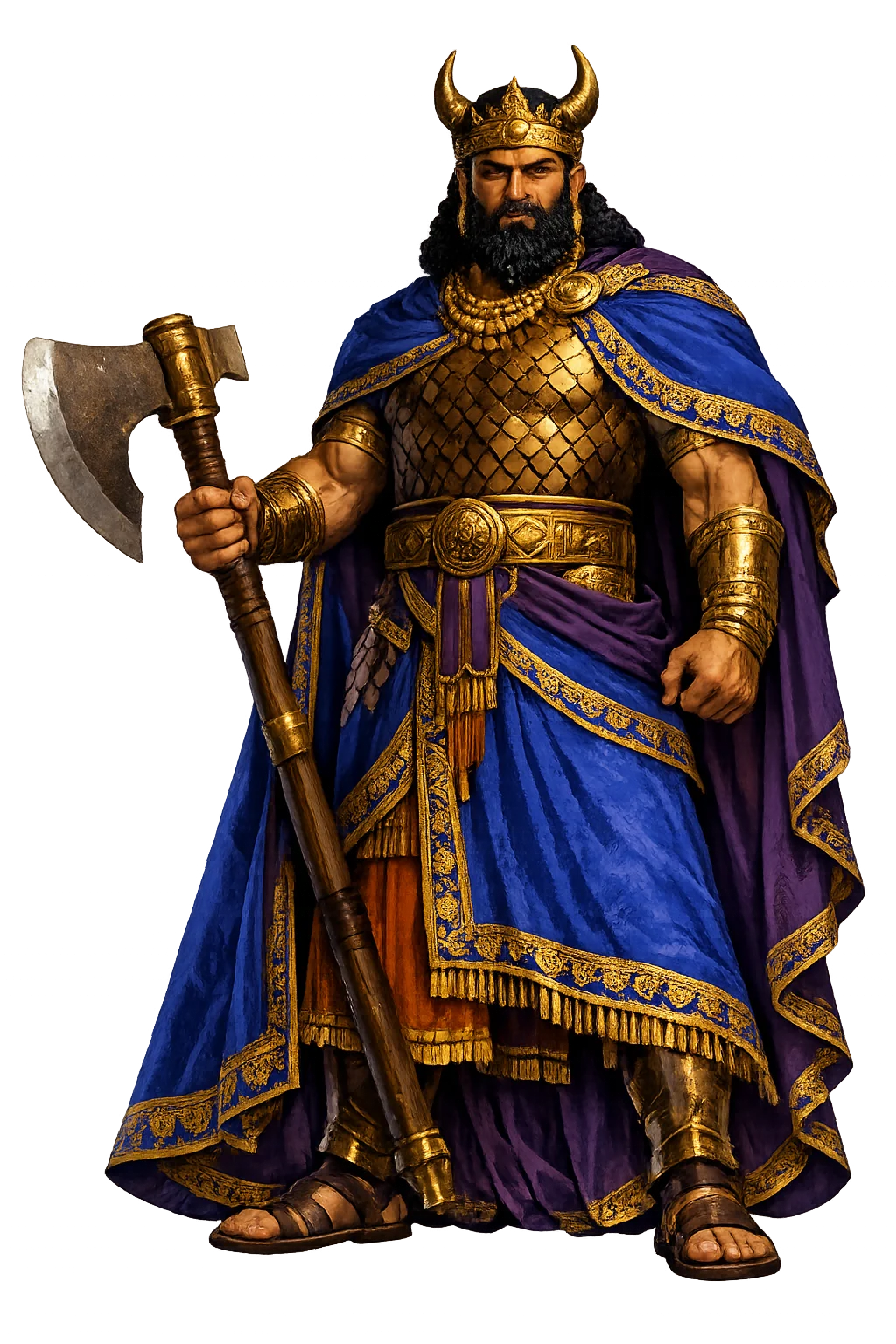
Stories of Gilgameš
The Standard Babylonian epic, 'He who saw the deep', runs from the streets of Uruk to the waters of death. Its twelve tablets hold the first full arc of friendship, loss, and wisdom in world literature — and its last line is a tour of brickwork.
Uruk groans under its young king — Gilgameš harries his people 'like a wild bull on the rampage', claiming the wedding-night privilege no bridegroom can refuse — and the gods answer by fashioning his equal from clay: Enkidu, a wild man who runs with gazelles, eats grass, and wrecks the trapper's snares. The trapper's stratagem became proverbial: send Šamhat the prostitute, and let bread, beer, and seven days of loving make a man of him. It works, and it costs him — Enkidu is diminished and civilized at once, weaker in the wild and kin to everyone. When he hears of Gilgameš's abuses he travels to Uruk and blocks him at the wedding-house door. They wrestle until the doorframe shudders; and the fight ends in embrace. From that day the king has a second self, and the epic has its thesis: civilization is both a loss and a gift, and friendship is the treaty that makes it bearable.
Hungry for a name that will outlast him, Gilgameš proposes the impossible: the expedition to the Cedar Forest, sacred to Enlil and guarded by the monstrous Humbaba, whose roar is the storm-flood and whose mouth is fire. Enkidu knows that wilderness and begs off — he has walked it — but goes for his friend's sake. The road is paved with dreams: each night the king climbs the mountain-pass to pray, and each dream comes down terrible, and Enkidu, the former wild man, stands at his head and interprets the terror favorable. With the thirteen winds of Šamaš bound around Humbaba, the friends bring him down, pleading and cursing, and fell the great cedar for the door of Uruk. The fame is real — and fatal. The gods have not forgiven the killing of Humbaba and the cutting of the sacred trees, and the two heroes sail home carrying their doom as the timber comes home on the river, sweet-smelling and already marked.
Back in Uruk the goddess Ištar offers Gilgameš marriage, and he answers with the catalogue of her dead lovers — Dumuzi turned into a bird of grief, the shepherd, the herdsman, the gardener, all used and discarded — and the immortal insult: 'Thou art but a brazier that goes out in the cold, a flimsy door that keeps not the blast' (SB tablet VI). Ištar, shamed, demands the Bull of Heaven from Anu and leads it down to gore the city; its snort opens pits that swallow hundreds of young men. Gilgameš and Enkidu kill it, and Enkidu flings the bull's haunch into the goddess's face. That night Enkidu dreams the judgment: Anu, Enlil, and Ea have conferred, and because Humbaba was slain and the Bull insulted, one of the two must die — and Enlil says: not Gilgameš. The epic's first half ends where its second begins, with the decree that sends the wild man back to clay and the king out of the world after him. The friend made to restrain the king becomes the sacrifice that unmakes him.
Clothed in a lion's skin, Gilgameš wanders beyond the maps: to the twin-peaked Mount Mašu, where scorpion-men guard the sun's gate; through the long tunnel of night; down to the garden of jeweled trees whose fruit is lapis and carnelian; to Šiduri the ale-wife behind her veil, who tells him what every wisdom text after her will repeat — eat thy bread, dance and be merry, hold thy child's hand; and at last across the waters of death with the ferryman Ur-šanabi (SB tablets IX–X). There sits Utnapishtim, the mortal whom the gods made deathless after the flood. He tests the king: stay awake six days and seven nights — the one feat that would prove a man worthy of endless life. Gilgameš falls asleep on the first watch, and sleeps seven days. The man who bested Humbaba cannot defeat the smallest of human needs: rest. The flood-hero's wife bakes a loaf for each day he slept, and the loaves, rotting in a row, count out the verdict better than any speech.
Utnapishtim gives him one last chance: a thorny plant at the bottom of the sea, 'the old man becomes young' — rejuvenation, not immortality, which the gods have put out of mortal reach. Gilgameš ties stones to his feet, dives through the deadly water, and wins the plant, planning to eat it in his own old age. Then, on the road home, at a cool pool, he stops to bathe — and a serpent, drawn by the plant's fragrance, rises from the water, takes it, and sheds its skin as it goes. The king sits down and weeps: not for the serpent, he says bitterly, but for himself — for all the labor spent, and for the endless toil still owed on Uruk's wall. Then he turns for home, brings Ur-šanabi up onto the wall, and shows him the brickwork and the threshold-stone: this, the epic's last line insists, is what a man leaves. The plant was for the body; the wall is for the city; and four thousand years have judged the trade fair.
Kingship, Friendship, and the Quest Against Death
Gilgameš, king of Uruk, 'two-thirds god and one-third man', is the hero of the oldest great epic we possess. He builds walls, slays the guardian of the Cedar Forest, spurns a goddess, loses his friend, and walks to the end of the world to ask the flood's survivor the only question that matters: must we die?
The epic opens and closes on the walls he built — 'go up on the wall of Uruk and walk around' — kingship as masonry.
Enkidu, the wild man fashioned from clay to match him; their friendship is the first great love story of literature.
The road west to the Cedar Forest and the slaying of Humbaba, its monstrous guardian — fame won at the price of doom.
Utnapishtim's ark, the waters of death, and the plant 'the old man becomes young', stolen by a serpent while the king slept.
From the original script to the living URL
𒄑𒂆𒈦
The name in its original Mesopotamian form. Gilgameš (𒄑𒂆𒈦) is attested in the source tradition — “The old man became young”. Its original diacritics and script distinctions carry the full phonetic and orthographic weight of the source tradition.
gilgamesh
Reduced to plain gilgamesh, the name loses everything that made it specific: original diacritics and script distinctions. What remains is an ASCII string that machines can parse but that no longer speaks with its original voice.
Gilgameš
The Unicode restoration recovers what ASCII flattened. Gilgameš restores original diacritics and script distinctions, returning the name to its original written dignity. The domain encodes to Punycode, but the browser displays the truth.
Gilgameš.com → xn--gilgame-wqb.com
The non-ASCII characters in Gilgameš are encoded while the ASCII remains visible. To the DNS, it is Punycode. To humanity, it is Gilgameš.
Owned, ideal, and ASCII forms of Gilgameš
Gilgameš
Restores 𒄑𒂆𒈦. The live temple domain — gilgameš.com.
gilgamesh
Flattens 𒄑𒂆𒈦. The plain ASCII fallback — what DNS and legacy systems see.
How Gilgameš was spoken
How Gilgameš travels from ancient script to the modern URL
The Sumerian royal name Gilgameš is of uncertain etymology; it has been explained as “old man who became young" or as a shortened theophoric name.
The lore you have read is the living myth. Extended Lore opens the scholarly vault beneath it: the cult and its material remains, a history of the image, the name after antiquity, a meditation on what the name still means, and the full scholarly apparatus — etymology, orthography, sources.
Enter Extended Lore