PuniCodex

Extended Lore

ᚴᛁᚠᛁᚢᚾ Gefjun

Etymology · Phonology · Orthography · Cultural Legacy · Primary Sources

Tier 2 Gefjun
Gefjun — Fertility, Agriculture
01

Quick Facts

Essential information about Gefjun, Fertility, Agriculture

Original Scriptᚴᛁᚠᛁᚢᚾ
Unicode RestorationGefjun
Reconstructed Pronunciation/ˈɡev.jun/
PantheonNorse
DomainFertility, Agriculture
MeaningGiving
ClassificationTier 2
Primary DomainGefjun
Sacred SymbolsThe plough, The four oxen, The plough-land, The answering coasts
02

Etymology & Word Family

From original script to Unicode restoration

Original Script ᚴᛁᚠᛁᚢᚾ Gefjun — "Giving"
Unicode Restoration Gefjun Restored stress, length, and script
Modern ASCII gefjon Plain-ASCII fallback

Old Norse Gefjun derives transparently from gefa, 'to give': Cleasby-Vigfusson enter the goddess under that root, and Zoëga glosses the name as the giver. The restoration Gefjun is plain ASCII — the normalized Old Norse spelling carries no diacritic and no distinctive letter — so the mechanical rule places the name in Tier 2. The working ASCII form 'gefjon' respells the ending with an o; the manuscripts know only Gefjun.

03

Unicode Character Breakdown

Character-by-character philological analysis

CharacterUnicodeNameBlockPhonetic Role
GU+0047Latin Capital Letter GBasic LatinSame, capitalized
eU+0065Latin Small Letter EBasic LatinSame
fU+0066Latin Small Letter FBasic LatinSame
jU+006ALatin Small Letter JBasic LatinSame
uU+0075Latin Small Letter UBasic LatinSpecial character
nU+006ELatin Small Letter NBasic LatinSame

The Tier 2 classification reflects how much of the original phonology this restoration preserves — stress and vowel length for Greek names, distinctive letters and diacritics for every other tradition.

04

Cultural Significance

From ancient cult to modern Unicode

Ancient Domain

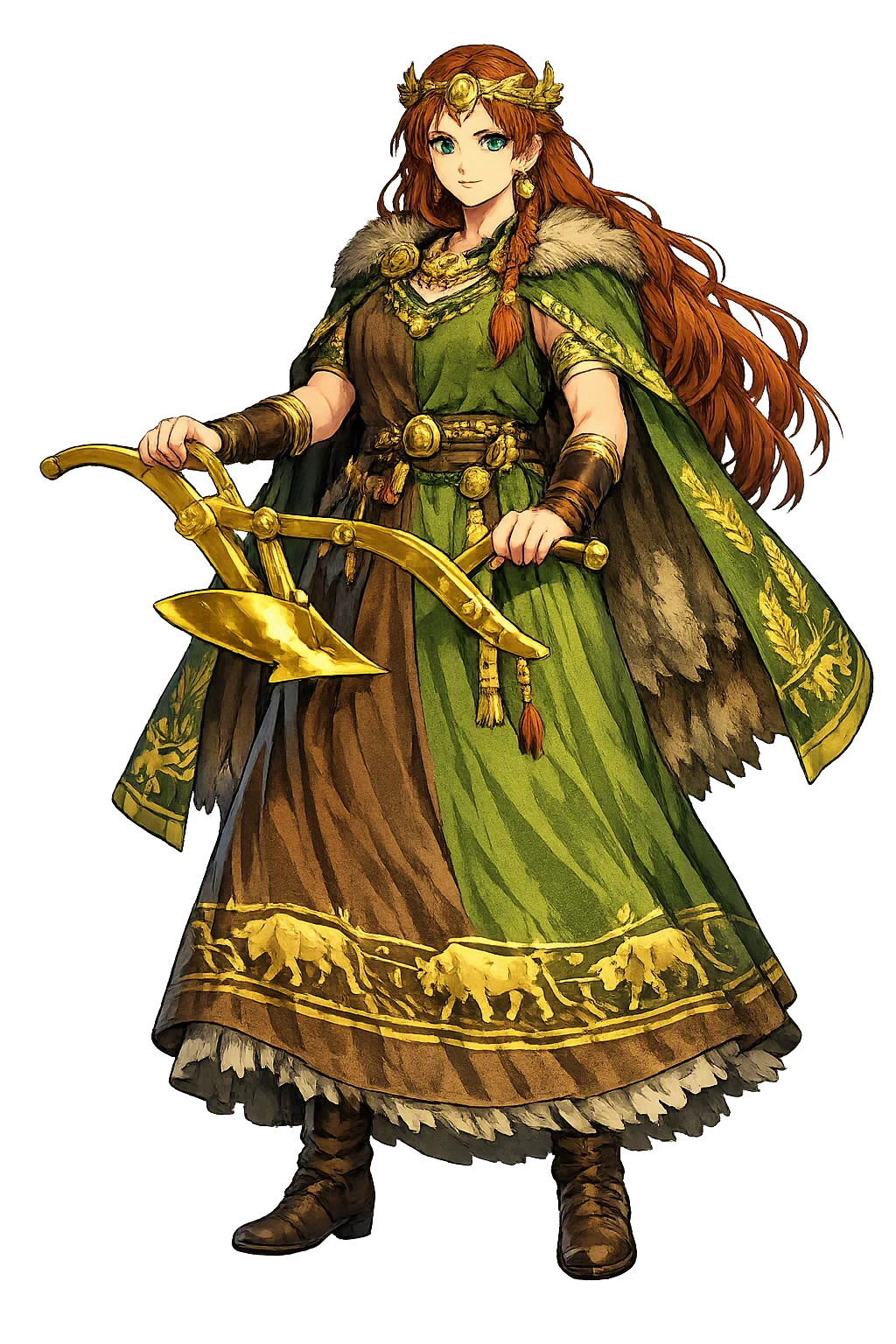
Gefjun is the giver who made an island: the Æsir-born goddess who accepted King Gylfi's jest of a plough-land — as much as four oxen could turn in a day and a night — and answered it by begetting four sons on a giant, yoking them as oxen, and dragging the whole of Zealand out of Sweden into the sea.

Gefjun in Later Traditions

Gefjun's nearest relative lives inside the pantheon itself. Gylfaginning names Gefn — 'the giver' — among Freyja's bynames, and both names stand on the same root, gefa; Simek treats the two as possibly once-connected figures, distinct in the surviving sources. Beyond the North, scholars have long set her story among the land-measure foundation legends of the ancient world — the type of tale in which a people explains how its territory was won by stretching a definition, Dido's ox-hide at Carthage being the classical case — with the difference that Gefjun stretches not a hide but a day's ploughing, and the unit she stretches is agricultural. Her other life is dynastic: through Skjöldr she belongs to the origin-complex of the Danish kings, the same stratum that produced Beowulf's Scyld Scefing and Saxo's Skioldus. The handbooks read the marriage as the point where myth and royal genealogy were deliberately joined — a plough-goddess at the root of a farming aristocracy's line.

Modern Legacy

Gefjun's afterlife is monumental and national. The Gefion Fountain on Copenhagen's harbourfront — Anders Bundgaard's great bronze group, unveiled in 1908 as the Carlsberg Foundation's gift to the city — shows her exactly where the myth leaves her: driving the four oxen as they strain toward the sea. It is among the largest monuments in Copenhagen and the standard image of the goddess worldwide, and the story itself remains Denmark's foundation tale, the way Danish children learn why Zealand lies apart in the sea. Her name has even left the planet: the main-belt asteroid 1272 Gefion, discovered in 1931, gives its name to the Gefion family of asteroids. The name never became a common given name in the North, but in Denmark it needs no introduction.

Unicode Restoration as Cultural Act

Restoring Gefjun in a domain name is more than orthographic accuracy. It is a statement that the internet should recognize the full range of human writing — not only the ASCII keyboard.

05

Frequently Asked Questions

Common questions about Gefjun, Fertility, Agriculture, and Unicode restoration

01How do you pronounce Gefjun?

In reconstructed pronunciation, Gefjun is /ˈɡev.jun/ — approximately 'GEV-yoon' — the g hard as in 'give', the e short as in 'bed', the second syllable like 'yoon' with a light v-glide before it; stress the first syllable, as in modern Icelandic Gefjun..

02What does Gefjun mean?

Gefjun means Giving in the norse tradition.

03What are the symbols of Gefjun?

Gefjun is associated with The plough (Creation by furrow: land made by turning earth — the oldest technology of order doing the work of a god), The four oxen (Giant strength yoked to a goddess's purpose: brute force given direction), The plough-land (The wager's unit — a day and a night's ploughing, stretched within its own terms until it holds an island), The answering coasts (Zealand's headlands and Mälaren's bays: the two halves of one tear, the myth's own map).

04Why restore Gefjun in Unicode?

Plain ASCII gefjon strips the stress, length, and script that make the name specific. Unicode restoration returns the name to its original written dignity.

05What is the most important myth about Gefjun?

When Snorri opens Gylfaginning, before Gylfi ever reaches Ásgarðr, he tells how the king was first tricked out of a piece of his kingdom. Gylfi gave a wandering beggar-woman, as reward for the entertainment she gave him, one plough-land in his realm — as much as four oxen could plough up in a day and a night. But the woman was of the family of the Æsir, and her name was Gefjun. She took four oxen out of Jötunheimr — her own sons, begotten on a certain giant — and set them before the plough. The share went so deep and hard that it tore the land loose, and the oxen drew it out into the sea and westward until it stopped in a sound. There Gefjun set the land and named it Selund, Zealand. And where the land had been taken from, the water filled in: that is now the lake called Lögrinn, Mälaren, and the bays of the lake, Snorri says, correspond to the headlands of Zealand.

06

Scholarly Sources

The philological foundations of this restoration

Every claim on this page is grounded in established scholarship. The orthographic restorations follow disciplinary convention. The etymological chain follows the best available reference works. This is not invention — it is resurrection through scholarship.

Lexicography & Philology

  • Prose Edda
  • Cleasby-Vigfusson

Primary Texts

  • Snorri Sturluson, Prose Edda: Gylfaginning 1 (the ploughing of Zealand) and the ásynjur catalogue; Skáldskaparmál (þulur; woman-kennings)
  • Poetic Edda: Lokasenna 20–22 (Gefjun's intervention, Óðinn's rebuke, Loki's taunt)
  • Snorri Sturluson, Heimskringla: Ynglinga saga 5 (the völva, Skjöldr, Hleiðra), quoting Bragi inn gamli
  • Beowulf, prologue (Scyld Scefing and the Scylding line)

Archaeology & Art History

  • Material evidence — iconography, inscriptions, and temple archaeology — for Gefjun and related cults.
  • Gefjun is a textual goddess whose evidence is a landscape. Her attestations are literary — the Codex Regius Lokasenna, Snorri's Gylfaginning, and the Ynglinga saga of Heimskringla — and no cult site, votive deposit, or runic inscription names her; the place-name claims sometimes advanced are insecure. What the myth itself offers as evidence is the map: Zealand's headlands and the bays of Lake Mälaren, which the story explains as the two halves of a single tear. Her one fixed point on the ground is Hleiðra — Lejre, near Roskilde — where the saga seats her marriage to Skjöldr; excavations there since the 1980s have uncovered successive great-hall complexes of the Iron Age and Viking Age, confirming Lejre's real antiquity as a royal power centre, though nothing found names the goddess. The oldest datable witness to the myth is not a stone but a stanza: Bragi's ninth-century verse, quoted by both Snorri and the saga. Her most famous monument is modern: Bundgaard's Gefion Fountain in Copenhagen, unveiled 1908.

Religious Studies

  • Cleasby–Vigfusson, An Icelandic-English Dictionary, s.v. Gefjun, gefa
  • Zoëga, A Concise Dictionary of Old Icelandic, s.v. Gefjun, gefa
  • Simek, Dictionary of Northern Mythology; Lindow, Norse Mythology: A Guide — s.v. Gefjun, Gefn
Return

The Surface Awaits

You have traced the name from its earliest attestation to its Unicode restoration. Now return to the myth. The story is where the name lives.

Back to Lore
Gefjun mascot