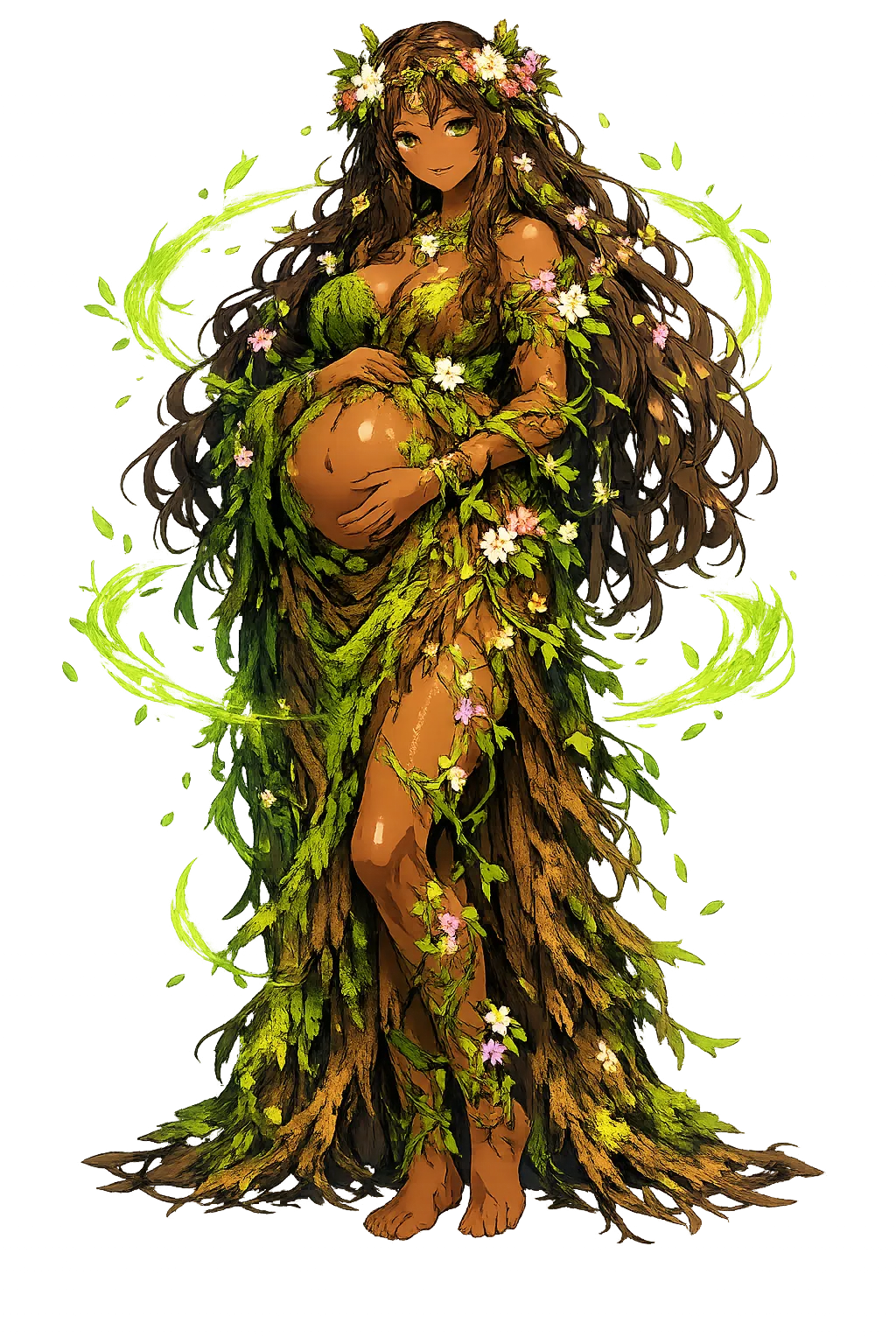
Stories of Gē
Gē is a primordial power whose myths are acts of generation and revenge. She creates without a mate, then conspires with her son Kronos against her husband Ouranos — and when the Titans fall, she arms the gods' last enemy.
First came Chaos; then Gē, 'broad-breasted,' the ever-sure seat of all the immortals who hold the peaks of snowy Olympus — and with her dark Tartaros in the depths, and Eros, fairest among the deathless gods (Hesiod, Theogony 116–122). Gē needs no consort for her first births: Ouranos, starry heaven, her equal in size, to cover her all around; the long Mountains, delightful haunts of the nymphs; and Pontos, the barren deep with its swelling breast (Theogony 126–132). The reverence behind the poem is far older than Hesiod — the Mycenaean tablets already know ma-ka, Mother Earth — and the goddess is present wherever Greeks stood on ground, every oath sworn 'by Earth' being hers. Before any god ruled, there was ground; before any temple, a floor of her body. The Theogony's opening makes one quiet claim that the whole poem then obeys: everything in it, Olympians included, will be a tenant of Gē.
Gē grew weary of Ouranos, who night after night covered her and pushed the children she bore back into her womb, giving them no light (Hesiod, Theogony 156–160). She fashioned the great sickle of adamant and unburdened herself to her sons, but only Kronos, the youngest and most terrible, took the weapon and lay in ambush; when Ouranos came down covering her, Kronos reached out and struck — and the drops of blood that fell on Gē produced the Erinyes, the great Giants, and the ash-tree nymphs, while what fell into the white foam of the sea produced Aphrodítē (Theogony 173–200). Hesiod does not soften the scene: the mother arms the son against the father, and from that violence the next generation of powers is born. The cosmos changes hands not by negotiation but by surgery — and notice what Gē herself does with the power she wins. She does not seize the throne; she engineers the future and lets her children fight for it, remaining what she always was: the ground under every regime.
For all her cosmic acts, Gē's worship in the Greek cities was domestic and quiet. At Athens her altar stood in the Agora beside that of Gē Kourotrophos, Earth the Child-Nurse, among the crossroads shrines — modest stone and ash where marble would have been pretentious, and the excavated altars of the Agora still mark the spot. At Delphi the Pythia opened her formal prayer with Earth first — 'first in my prayer I honor Earth, the first prophetess' (Aeschylus, Eumenides 1–2) — because the oracular succession of the sanctuary began, in tradition, with Gē herself, before Themis, before Phoibe, before Apollo took the tripod. Oaths were sworn by her in court and treaty: she was the one power guaranteed to be standing under both parties' feet. The oldest goddess in Greece asks for almost nothing — which is exactly why she was never, anywhere, omitted.
When the Titans fell, Gē did not reconcile. Angry on her children's behalf, she lay with Tartaros in a hollow cave of Cilicia and bore her youngest and most terrible child: Typhoeus — a hundred serpent heads, fire for eyes, and voices that ranged from the language of gods to the bellowing of bulls (Hesiod, Theogony 820–835). The whole Olympian order trembled; Zeus met the monster with thunderbolt and sickle, burned its hundred heads, and cast it down wounded beneath the earth — and the flames that pour from Mount Aetna are, Hesiod says, the monster's breath to this day (Theogony 853–868). Apollodorus tells the parallel story of the Gigantomachy (Bibliotheca 1.6.3): Gē armed her Giant sons against the gods and hunted the magic herb that would make them unbeatable — Zeus got to it first, on Athena's advice. The mother who produced the gods also produces their last enemy. For Gē, creation and rebellion are the same act repeated — the ground brings forth whatever the age requires, against whoever currently rules.
Motherhood, Fertility, Primordial Ground
Gē is the earth as goddess, the primordial ground from which gods, Titans, and mortals arise. She is not a distant creator but the very substance beneath our feet, venerated in every Greek city and invoked in oaths, harvests, and burials.
From Gē spring the Titans, the Giants, the Erinyes, and — with Ouranos — the whole cosmos.
Agricultural fertility and the annual return of grain depend on her body.
She receives the dead and regenerates life; grave and cradle are the same soil.
Her chthonic power underlies oracles and dream-visions at sanctuaries of the underworld.
From the original script to the living URL
Γῆ
The name in its original Greek form. Gē (Γῆ) is attested in the source tradition — “Earth”. Its long vowels and acute accents carry the full phonetic and orthographic weight of the source tradition.
ge
Reduced to plain ge, the name loses everything that made it specific: long vowels and acute accents. What remains is an ASCII string that machines can parse but that no longer speaks with its original voice.
Gē
The Unicode restoration recovers what ASCII flattened. Gē restores long vowels and acute accents, returning the name to its original written dignity. The domain encodes to Punycode, but the browser displays the truth.
Gē.com → xn--g-pia.com
The non-ASCII characters in Gē are encoded while the ASCII remains visible. To the DNS, it is Punycode. To humanity, it is Gē.
Owned, ideal, and ASCII forms of Gē
Gē
Restores Γῆ. The live temple domain — gē.com.
ge
Flattens Γῆ. The plain ASCII fallback — what DNS and legacy systems see.
How Gē was spoken
How Gē is preserved in writing
A bespoke provenance study for Gē is being prepared by the PUNICODEX scholarly team.
Contribute scholarly provenance →The lore you have read is the living myth. Extended Lore opens the scholarly vault beneath it: the cult and its material remains, a history of the image, the name after antiquity, a meditation on what the name still means, and the full scholarly apparatus — etymology, orthography, sources.
Enter Extended Lore