PuniCodex

Extended Lore

Γῆ Gē

Etymology · Orthography · Cult · Iconography · Reception · Sources

Tier 1 Gē.com
Gē — Earth
01

Quick Facts

Essential information about Gē, Earth

Original ScriptΓῆ
Unicode RestorationGē
Reconstructed Pronunciation/gɛː/
PantheonGreek
DomainEarth
MeaningEarth
ClassificationTier 1
Primary DomainGē.com
Sacred SymbolsCornucopia, Serpent, Oak or olive tree, Black stone
02

Etymology & Word Family

From original script to Unicode restoration

Original Script Γῆ Gē — "Earth"
Unicode Restoration Gē Restored stress, length, and script
Modern ASCII ge Plain-ASCII fallback

The name Gē carries the orthographic signature of the greek tradition: Γῆ. Unicode restoration recovers what ASCII flattens.

03

Unicode Character Breakdown

Character-by-character philological analysis

CharacterUnicodeNameBlockPhonetic Role
GU+0047Latin Capital Letter GBasic LatinG uppercase
ēU+0113Latin Small Letter E with MacronLatin Extended-AMacron: long vowel

The Tier 1 classification reflects how much of the original phonology this restoration preserves — stress and vowel length for Greek names, distinctive letters and diacritics for every other tradition.

04

Cult & Worship

How the sacred was kept — rites, sanctuaries, remains

The Cult

Gē asked little and received everything. Every Greek stood, swore and was buried on her body: oaths in court and treaty invoked her as the one witness who could not be excluded, and every grave returned its dead to her. Her shrines were modest by Olympian standards. At Athens the excavated Agora preserves her twin altars — Gē and Gē Kourotrophos, 'Earth the Child-Nurse' — plain stone beside the civic buildings, fed with liquid offerings rather than grand sacrifice. At Delphi her precedence was ritual rather than architectural: the Pythia opened her mantic session by honoring Earth first (Aeschylus, Eumenides 1–2), and a small black conical stone, anciently sacred to her, sat inside Apollo's own adyton as a relic of the older dispensation. Pausanias records altars of Gē at Olympia and elsewhere; the pattern everywhere is aniconic — stones, offering pits, libations, first fruits at harvest — the oldest layer of Greek religion surviving in plain sight beneath the marble.

In the Earth

Gē was worshipped at numerous sites without always receiving monumental temples. The Athenian Agora preserves her altar and that of Gē Kourotrophos near the crossroads. Aniconic stones, pits for liquid offerings, and boundary markers attest her chthonic cult across Greece. The Pythion at Athens and the Eleusinion also honor her as the maternal earth underlying Demeter's mysteries.

05

Iconography

How Gē was imaged across the ages

The Image

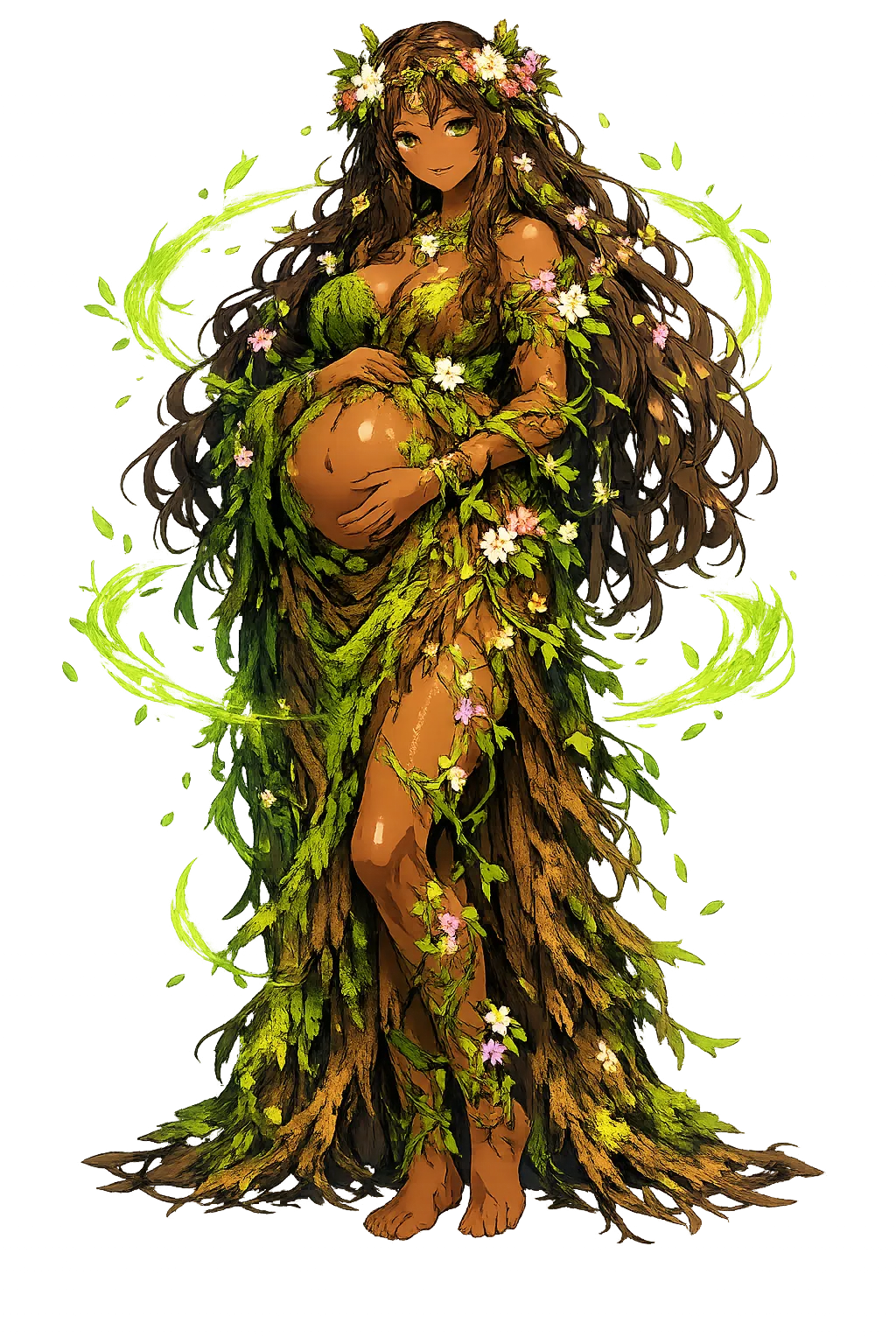
Gē began, fittingly, as stone. Her earliest images are aniconic: the black boulders that served as cult objects at Delphi and other old shrines, the kind of thing Pausanias still saw standing inside Apollo's temple. When she takes human form in the fifth century BCE it is always from the ground up — the goddess shown rising from the earth, waist-deep in her own substance, the visual signature of an immanent power. The motif anchors the Gigantomachy: on the Great Altar of Pergamon (c. 180–160 BCE, now in Berlin) she surges from below between the combatants, cornucopia in hand, pleading for her Giant sons — the masterpiece of her iconography and her only monumental survival. Vase painters of the same era show her gentler face: on a celebrated cup in Berlin, Gē rises to hand the infant Erichthonios up to Athena. The type never froze into a fixed cult statue; it remained what it was at the beginning — the earth briefly becoming a woman, then closing over her again.

06

Reception & Transformation

The name after its own age — transmission, translation, survival

Afterlives

Rome received Gē as Terra Mater, and her grandest single image is Roman: the seated, fruit-laden matron of the Ara Pacis (13–9 BCE), children and animals at her lap — the fecund earth guaranteeing Augustan peace, argued over in identification ever since and read as Earth still. Through the Middle Ages she subsided, as gods do, into a word: every page of Latin terra kept her shadow. The Renaissance re-personified her through Cesare Ripa's Iconologia (1593), whose crowned, sown, lion-riding 'Terra' became the template for element-allegory across Europe for two centuries. Meanwhile the poem that made her primordial had ridden Byzantine manuscripts into print: the editio princeps of Hesiod (Milan, 1495) put Chaos and broad-breasted Earth into every European library, seeding the learned nature-devotion from which Romanticism grew. Modern scholarship then recovered the real cult: nineteenth- and twentieth-century excavations at the Athenian Agora and Delphi restored the plain altars, black stones and oath-formulas, turning Gē from an allegory back into what she had always been — the oldest continuously honored power of the Greek world.

Identifications Across Traditions

Gē was identified early with the Minoan-Mycenaean earth mother and later with the Anatolian Cybele and the Roman Terra Mater. In Orphic cosmogonies she is sometimes preceded by Night or Water, but she remains the foundational maternal power. Neoplatonists interpreted her as the material substrate of the visible world, the 'receptacle' of becoming. Modern ecological movements have reclaimed Gaia/Gē as a symbol of the living planet.

Modern Legacy

The name Gē survives in English 'geo-' (geology, geography, geometry) and in the scientific Gaia hypothesis, which proposes that Earth functions as a self-regulating system. She is the oldest layer of Greek religion: not a specialist deity but the ground of all being. Every seed planted and every body buried returns to her, making her the most democratic of goddesses.

07

The Meditation

What Gē means — beyond the dictionary

Gē does not choose sides; she is the board on which the game is played. Titans and Olympians alike are her children, and in the end all bodies return to her. This gives her a strange neutrality: she can conspire against the sky and still receive the sky-god's thunderbolts into her breast.

To meditate on Gē is to remember dependence. We do not stand apart from nature; we stand on it. The modern ecological crisis is, at root, a forgetting of Gē — a pretense that the ground is merely resource rather than kin. Restoring her name in Unicode is a small symbolic act of remembering that the earth is older than all our conflicts and more patient than all our gods.

08

Frequently Asked Questions

Common questions about Gē, Earth, and Unicode restoration

01How do you pronounce Gē?

In reconstructed pronunciation, Gē is /gɛː/ — approximately 'GAY' — one long, level syllable, like the sustained note of a deep drum.

02What does Gē mean?

Gē means Earth in the greek tradition.

03What are the symbols of Gē?

Gē is associated with Cornucopia (The abundance that rises from her soil), Serpent (The earth-bound creature that glides through her body and guards her sanctuaries), Oak or olive tree (The rooted life that grows directly from her), Black stone (Aniconic representation of the earth goddess at numerous archaic shrines).

04Why restore Gē in Unicode?

Plain ASCII ge strips the stress, length, and script that make the name specific. Unicode restoration returns the name to its original written dignity.

05What is the most important myth about Gē?

“Broad-Breasted, First of All” — the The Birth story that anchors the mythology of Gē, told in full on the lore page.

09

Scholarly Sources

The philological foundations of this restoration

Every claim on this page is grounded in established scholarship. The orthographic restorations follow disciplinary convention. The etymological chain follows the best available reference works. This is not invention — it is resurrection through scholarship.

◈

Lexicography & Philology

  • Liddell, H. G., Scott, R., & Jones, H. S. A Greek-English Lexicon. Oxford: Clarendon Press, 9th ed. 1996.
◎

Primary Texts

  • Hesiod
  • Hesiod, Theogony 116–210, 820–880
  • Homer, Iliad and Odyssey
  • Aeschylus, Eumenides 1–2; Apollodorus, Bibliotheca 1.6.3
  • Pausanias, Description of Greece
◉

Archaeology & Art History

  • Material evidence — iconography, inscriptions, and temple archaeology — for Gē and related cults.
✦

Religious Studies

  • Beekes, Etymological Dictionary of Greek
Return

The Surface Awaits

You have traced the name from its earliest attestation to its Unicode restoration. Now return to the myth. The story is where the name lives.

Back to Lore
Gē mascot