PuniCodex

Extended Lore

ᚴᛅᚱᛘᚱ Garmr

Etymology · Phonology · Orthography · Cultural Legacy · Primary Sources

Tier 2 Garmr
Garmr — Guardian, Underworld Hound
01

Quick Facts

Essential information about Garmr, Guardian, Underworld Hound

Original Scriptᚴᛅᚱᛘᚱ
Unicode RestorationGarmr
Reconstructed Pronunciation/ˈɡɑrmr̩/
PantheonNorse
DomainGuardian, Underworld Hound
MeaningHowler
ClassificationTier 2
Primary DomainGarmr
Sacred SymbolsGnipahellir, The fetter, The thrice-sounded bay, The bloodied breast, The mutual death
02

Etymology & Word Family

From original script to Unicode restoration

Original Script ᚴᛅᚱᛘᚱ Garmr — "Howler"
Unicode Restoration Garmr Restored stress, length, and script
Modern ASCII garmr Plain-ASCII fallback

Old Norse Garmr names the hound of the underworld and nothing else: Cleasby–Vigfusson record the word only as a mythological proper name, 'the dog of the nether world'. Its etymology is genuinely uncertain — de Vries lists it under the unsolved names — and the standing line connects it with a Germanic root for growling or hoarse crying, whence the traditional gloss 'Howler'. The normalized Old Norse form is already plain ASCII — no diacritic and no distinctive letter — so the name is Tier-2 by the mechanical rule: nothing is lost in transit, a statement about orthography, never about the hound.

03

Unicode Character Breakdown

Character-by-character philological analysis

CharacterUnicodeNameBlockPhonetic Role
GU+0047Latin Capital Letter GBasic LatinSame
aU+0061Latin Small Letter ABasic LatinSame
rU+0072Latin Small Letter RBasic LatinSame
mU+006DLatin Small Letter MBasic LatinSame
rU+0072Latin Small Letter RBasic LatinSame

The Tier 2 classification reflects how much of the original phonology this restoration preserves — stress and vowel length for Greek names, distinctive letters and diacritics for every other tradition.

04

Cultural Significance

From ancient cult to modern Unicode

Ancient Domain

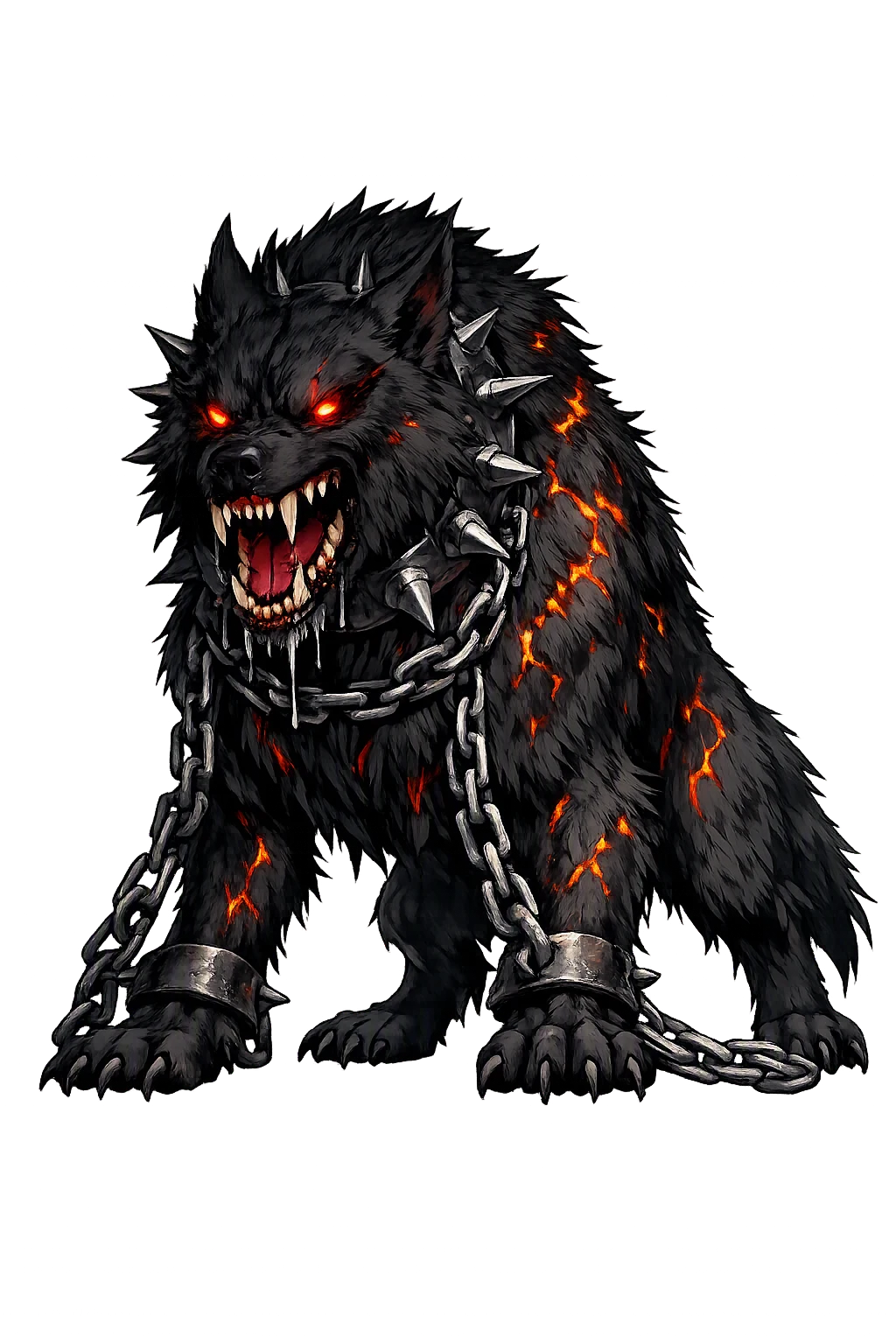
Garmr is the blood-bayed watchdog of Helheim: the hound bound before the cave of Gnipahellir whose howling, sounded three times in Vǫluspá, opens the world's last age. Grímnismál calls him simply the best of hounds; at Ragnarök he breaks his fetter and meets one-handed Týr, and each is the other's death.

Garmr in Later Traditions

Garmr belongs to one of the oldest comparative dossiers in Indo-European studies: the hellhound. Greece keeps Kerberos, the many-headed hound of Hades whom Hesiod names among the monstrous brood of Echidna; the Ṛgveda gives Yama, the first of the dead, two four-eyed brindled hounds — the Sárameyas — who guard the path and watch over men; and Wales keeps the Cŵn Annwn, the white, red-eared hounds of Arawn's otherworld pack in the First Branch of the Mabinogion. Linguists since the nineteenth century have connected Kerberos with Sanskrit śarvara-, the epithet of Yama's hounds, and Bruce Lincoln's classic study 'The Hellhound' traces the full complex — the watcher at death's border, the barred return, the dog that must be fed or fought by the crossing hero. The North's witness fits the pattern with one northern difference: where Kerberos guards the gate of a permanent kingdom, Garmr guards a gate that will not hold. He is the hellhound of a mythology whose underworld itself has an expiry date.

Modern Legacy

Garmr's afterlife runs on the two rails his sources laid down: the watchdog and the countdown. Victorian and modern retellings of Ragnarök keep the Vǫluspá refrain as the moment the end becomes audible — the howl before the fire. Tolkien gave the name, half in jest, to the talking dog Garm of Farmer Giles of Ham, a watchdog who cannot keep watch; and the modern games industry has restored the full terror, with God of War Ragnarök (2022) casting Garm as the giant unkillable wolf whose unbinding threatens the realms. In Iceland the name never left the kennels: Garmur remains an ordinary dog's name, which is perhaps the truest survival of all — the hound of Hel, brought home and given a bowl.

Unicode Restoration as Cultural Act

Restoring Garmr in a domain name is more than orthographic accuracy. It is a statement that the internet should recognize the full range of human writing — not only the ASCII keyboard.

05

Frequently Asked Questions

Common questions about Garmr, Guardian, Underworld Hound, and Unicode restoration

01How do you pronounce Garmr?

In reconstructed pronunciation, Garmr is /ˈɡɑrmr̩/ — approximately GAHRM-ur — nearly a single syllable: a hard g, a short open 'ah', the r and m run together, and the final nominative -r sounded as a light syllabic trill, as in Icelandic..

02What does Garmr mean?

Garmr means Howler in the norse tradition.

03What are the symbols of Garmr?

Garmr is associated with Gnipahellir (The overhanging cave at Hel's border — the fixed post of the watcher until the end of the world), The fetter (The binding that is only a postponement — every chain in the Edda is a clock), The thrice-sounded bay (The howl that punctuates Vǫluspá's collapse — the sound by which the seeress counts down the world's ending), The bloodied breast (The mark of the hound that comes out of Hel — death's evidence carried on the watcher's own body), The mutual death (Garmr and Týr killing each other — the Edda's justice, in which even Ragnarök's victories are paid for in kind).

04Why restore Garmr in Unicode?

Plain ASCII garmr strips the stress, length, and script that make the name specific. Unicode restoration returns the name to its original written dignity.

05What is the most important myth about Garmr?

Grímnismál closes its catalogue of the world's first things with a litany every Norse listener could recite: Yggdrasill is the best of trees, Skíðblaðnir of ships, Óðinn of the Æsir, Sleipnir of steeds, Bifrǫst of bridges, Bragi of skalds, Hábrók of hawks — and Garmr of hounds. The hound of Hel takes his place in the superlative order of the cosmos without explanation and without rival: whatever else the poets disagreed about, the office of watchdog at the world's border had one incumbent.

06

Scholarly Sources

The philological foundations of this restoration

Every claim on this page is grounded in established scholarship. The orthographic restorations follow disciplinary convention. The etymological chain follows the best available reference works. This is not invention — it is resurrection through scholarship.

Lexicography & Philology

  • Cleasby-Vigfusson
  • Zoëga

Primary Texts

  • Poetic Edda: Vǫluspá 44, 49, 58 (the thrice-sounded refrain: Garmr bays before Gnipahellir); Grímnismál 44 (best of hounds); Baldrs draumar 2–3 (the bloodied hound on the Hel-road)
  • Snorri Sturluson, Prose Edda: Gylfaginning 51 (Garmr breaks loose at Ragnarök and kills, and is killed by, Týr); Skáldskaparmál (kennings for Týr as one-handed god and feeder of the wolf)
  • Comparative witnesses: Hesiod, Theogony 310–312 (Kerberos); Ṛgveda 10.14 (Yama's hounds, the Sárameyas); Pwyll Pendeuic Dyuet, First Branch of the Mabinogion (the Cŵn Annwn); Lincoln, 'The Hellhound', Journal of Indo-European Studies 7 (1979)

Archaeology & Art History

  • Material evidence — iconography, inscriptions, and temple archaeology — for Garmr and related cults.
  • Garmr is an entirely textual hound: no runestone names him, no votive deposit is his, and no image can be securely identified with him. The picture-stone corpus of Gotland preserves riders and beasts at the borders of the world, and the bloodied hound of Baldrs draumar has occasionally been sought among the animal figures that attend the dead on stones such as Ardre VIII — but the stones carry no inscription, and the identifications remain suggestions. His witnesses are the manuscripts: the Codex Regius for Vǫluspá and Grímnismál, the fourteenth-century AM 748 I 4to for Baldrs draumar — the poem's sole medieval home — and the Codex Regius and Codex Wormianus of the Prose Edda for Gylfaginning's Ragnarök chapter. The absence of cult is itself the record: Garmr was never prayed to, because he was never anyone's god. He was the North's watchdog, and a watchdog needs no temple — only a post, a chain, and the hour he is waiting for.

Religious Studies

  • Cleasby–Vigfusson, An Icelandic-English Dictionary, s.v. garmr ('the dog of the nether world'), gnipa; Zoëga, A Concise Dictionary of Old Icelandic, s.v. Garmr; de Vries, Altnordisches etymologisches Wörterbuch, s.v. Garmr (etymology uncertain)
  • Simek, Dictionary of Northern Mythology, s.v. Garmr (double of the Fenris-wolf); Orchard, Dictionary of Norse Myth and Legend; Lindow, Norse Mythology: A Guide — s.v. Garmr, Týr, Ragnarök
Return

The Surface Awaits

You have traced the name from its earliest attestation to its Unicode restoration. Now return to the myth. The story is where the name lives.

Back to Lore
Garmr mascot