The Living Myth
Sacred River, Purification · The River That Fell From Heaven
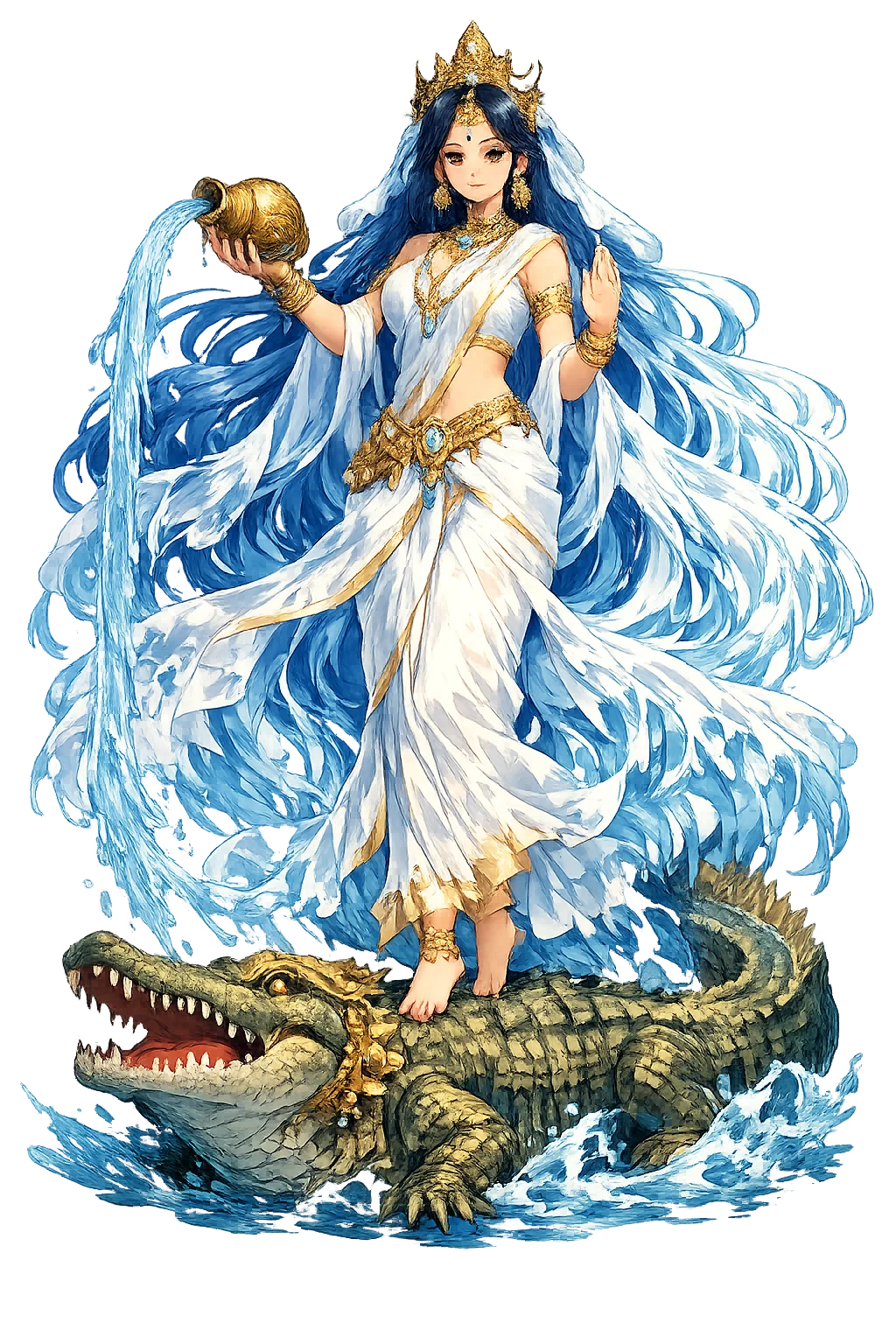
Stories of Gaṅgā
Gaṅgā's myths are hydrology as theology: the river's own biography — source, fall, and ford — told as the goddess's descent to save the dead. The epics and Purāṇas disagree on details and never on the shape: she comes from above, she must be caught, and whoever reaches her water is carried home.
King Sāgara's sixty thousand sons were burned to ash by the angry glance of the sage Kapila — a debt no rite could pay until the heavenly river touched their remains. Their descendant Bhagīratha did what the epics reward: he stood in the high Himalaya and practiced austerity until Brahmā granted the boon, and Śiva agreed to break the fall (Rāmāyaṇa, Bālakāṇḍa 38–44). For the Ganga of heaven — Akāśagaṅgā, the river that runs in the sky — could not simply drop to earth: gathered into one stream she would have shattered the mountains. So she fell first onto the matted hair of Śiva, who stood on the peak, and wandered in its tangles while the king waited. When she issued forth, Śiva divided her into seven streams, three running east, three west, and the seventh, the Bhāgīrathī, following the king down to the sea and the waiting ashes of Sāgara's sons. The epic's geography is theology: salvation arrives only through an intercessor's body, and the holiest river on earth descends, like grace, through another's patience.
The Mahābhārata gives the river a human marriage, and it is the strangest in the epic. Gaṅgā came to King Śantanu as a woman of unearthly beauty and consented to wed him on one condition: never question what she does. Then, seven times, she bore a son and drowned him in her own waters — until the king, breaking his vow, stopped her from the eighth. Her answer ends the marriage and explains everything: the children were the Vasus, gods cursed to be born as mortals, and she had only been loosening the curse (Mahābhārata, Ādi Parvan 91–96). She kept the eighth child, Devavrata — the future Bhīṣma, grandsire of the war — and vanished back into her element. The river that saves the dead also, just once, hands one back; and the epic's most self-denying mortal hero was raised by the same current that drowned his brothers. The condition of the marriage is the epic's deepest theme in miniature: the sacred cannot be questioned into staying.
Purāṇic cosmology gives her an origin older than either epic. When the dwarf Vāmana covered the universe in three strides, a rivulet broke from the great toe of Viṣṇu's raised foot — the first Ganga, washing the highest heaven (Vāmana Purāṇa; Kāśīkhaṇḍa of the Skanda Purāṇa). She was caught in Brahmā's water-pot, poured out across the sky as the Akāśagaṅgā, and then — in the great descent — entrusted to Śiva's locks. In this telling the river is not a gift won by a king's penance but a permanent feature of the cosmos: whatever footstep measures the universe leaves her springing from it. It is why her water is said to absolve even ancestors no rite can reach — she fell from the measure of all things, and a drop of that outranks every other medicine. The Rāmāyaṇa's penance and the Purāṇa's toe are two doors into the same room.
Even a goddess can be swallowed. As Bhagīratha led the flood down from the mountains, it tore away the sacrificial ground of the sage Jahnu, drowning his fire and his stores. Jahnu drank the whole river in a single draught — goddess, flood, and all — and released her only when the gods and the penitent king pleaded (Bhāgavata Purāṇa 9.15.3; Viṣṇu Purāṇa 4.7). From her second birth she took the patronymic Jāhnavī, 'daughter of Jahnu.' The little myth carries a large doctrine: the river is a person, not a force, and can therefore be received as a guest, punished as a trespasser, and adopted as a child. Every Hindu who names her Jāhnavī remembers that the holiest water in the world once spent a moment inside a very angry sage — and came out, as she comes out of everything, as a daughter.
At Kāśī — Vārāṇasī — the river does something no river should: she turns and flows north, back toward her source, which the tradition reads as a bow toward the city of Śiva. Here the oldest bargains hold: the dying carried to her ghāts are not buried but released into a current that already connects them to heaven, and the cremation ground at Maṇikarṇikā, crowded for three thousand years, is called the most efficient doorway in the world (Skanda Purāṇa, Kāśīkhaṇḍa). Each evening the Ganga āratī sets a thousand lamps on her water — arguably the oldest continuously performed river ritual on earth — and every pilgrimage either ends at her fords or carries her water home in brass vessels. The city exists because the river turned; the river, the tradition says, turned because Śiva will not leave her bank. Dying, in Kāśī, is not an end but a crossing already paid for.
Purification, Descent, and the Locks of Śiva
Gaṅgā is the river that is a goddess: brought down from heaven by the sage-king Bhagīratha to free his burnt ancestors, caught in Śiva's matted locks so the earth could survive her fall, and worshipped ever since at every ford — the holiest water in the world to more than a billion people.
Gangāvataraṇa: her fall from heaven, broken into seven streams by Śiva's hair.
Her source at Gaumukh in the Himalaya — the ice cave where the Bhāgīrathī is born.
A drop of her water absolves: the cremation grounds of Vārāṇasī keep her oldest bargain.
Her celestial form — the river of heaven mirrored as the river of earth.
From the original script to the living URL
गङ्गा
The name in its original Sanskrit form. Gaṅgā (गङ्गा) is attested in the source tradition — “The river Ganges personified — eldest daughter of Himavat, brought from heaven by Bhagīratha's austerities”. Its macron-length vowels and nasal retroflexes carry the full phonetic and orthographic weight of the source tradition.
ganga
Reduced to plain ganga, the name loses everything that made it specific: macron-length vowels and nasal retroflexes. What remains is an ASCII string that machines can parse but that no longer speaks with its original voice.
Gaṅgā
The Unicode restoration recovers what ASCII flattened. Gaṅgā restores macron-length vowels and nasal retroflexes, returning the name to its original written dignity. The domain encodes to Punycode, but the browser displays the truth.
Gaṅgā.com → xn--gag-3oa2758a.com
The non-ASCII characters in Gaṅgā are encoded while the ASCII remains visible. To the DNS, it is Punycode. To humanity, it is Gaṅgā.
Owned, ideal, and ASCII forms of Gaṅgā
Gaṅgā
Restores गङ्गा. The live temple domain — gaṅgā.com.
ganga
Flattens गङ्गा. The plain ASCII fallback — what DNS and legacy systems see.
How Gaṅgā was spoken
How Gaṅgā travels from ancient script to the modern URL
The lore you have read is the living myth. Extended Lore opens the scholarly vault beneath it: the cult and its material remains, a history of the image, the name after antiquity, a meditation on what the name still means, and the full scholarly apparatus — etymology, orthography, sources.
Enter Extended Lore