PuniCodex

Extended Lore

Gaṅgā — The Deeper Record

Etymology · Orthography · Cult · Iconography · Reception · Sources

Preserves vowel length Gaṅgā.com
Gaṅgā — Sacred River, Purification
01

At a Glance

Gaṅgā — every fact links to its home

PantheonSanskrit
DomainSacred River, Purification
Original Scriptगङ्गा →
Primary Sources3 cited →
02

Etymology & Word Family

From original script to Unicode restoration — the full etymology page →

Original Script गङ्गा Gaṅgā — "The river Ganges personified — eldest daughter of Himavat, brought from heaven by Bhagīratha's austerities"
Unicode Restoration Gaṅgā Restored stress, length, and script
Modern ASCII ganga Plain-ASCII fallback

The name Gaṅgā carries the orthographic signature of the sanskrit tradition: गङ्गा. Unicode restoration recovers what ASCII flattens.

03

Unicode Character Breakdown

Character-by-character philological analysis

CharacterUnicodeNameBlockPhonetic Role
GU+0047Latin Capital Letter GBasic LatinSame
aU+0061Latin Small Letter ABasic LatinSame
ṅU+1E45Latin Small Letter N with Dot AboveUnknownN with dot above
gU+0067Latin Small Letter GBasic LatinSame
āU+0101Latin Small Letter A with MacronLatin Extended-AMacron: long a

The restoration of Gaṅgā preserves what it can of the original phonology — stress and vowel length for Greek names, distinctive letters and diacritics for every other tradition.

04

Cult & Worship

How the sacred was kept — rites, sanctuaries, remains

The Cult

Her cult is the simplest and most continuous on earth: go to the water, at dawn, and enter it. The tīrtha — the ford — is her true temple; the Ṛgveda already praises her among the great rivers in the Nadīsūkta (10.75), two millennia before the ghāts were stone. Bathing has its grammar: the bather speaks a sankalpa, plunges, and sets a lamp or garland on the current; at Prayāgrāj the saṅgam of Gaṅgā, Yamunā, and the unseen Sarasvatī concentrates the merit of all three in one crossing. For the dead the rites move to her banks — śrāddha oblations to the ancestors at Vārāṇasī, where the cremation ground of Maṇikarṇikā has taken the dead into her current for millennia. A hereditary guild of pilgrim-priests, the paṇḍās of the ghāts, keeps the ledgers of families who return generation after generation, and no household rite is complete without her water poured from the brass lota kept for that purpose.

In the Earth

Her source at Gaumukh (Gangotri glacier) is a measured pilgrimage; the Gangotri temple (18th c., rebuilt) marks it. Haridwar's Har Ki Pauri, Prayāgrāj's trivenī saṅgam (where she meets Yamunā and the unseen Sarasvatī), and Vārāṇasī's ghāts — landing-places in continuous use for over a millennium — are her living monuments. The glacier's measured retreat (on the order of twenty meters a year in recent decades) is tracked as carefully as her temples are kept.

05

Iconography

How Gaṅgā was imaged across the ages

The Image

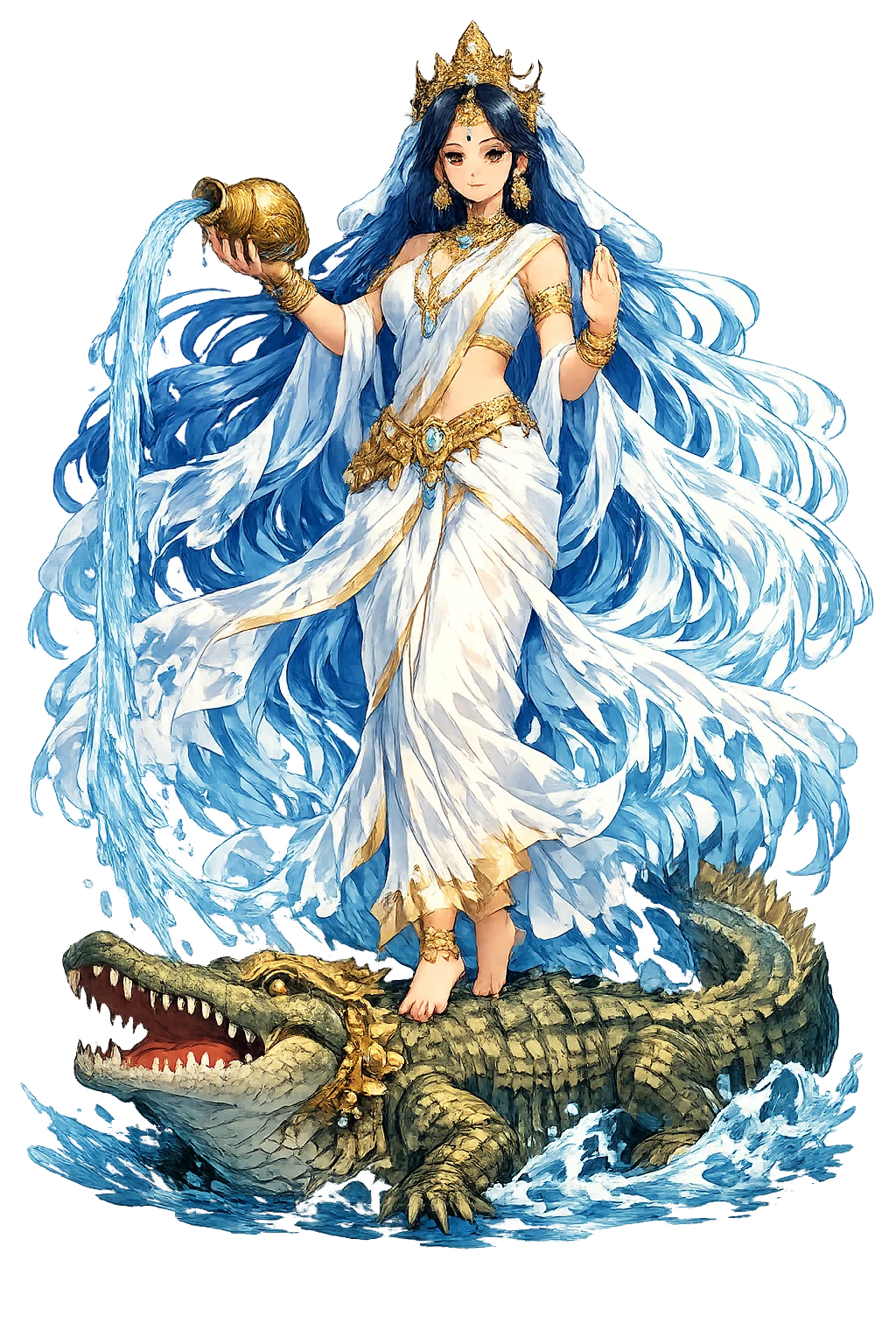
She is recognized by her vehicle and her vessel: standing in gentle tribhaṅga on a makara — the crocodile of the river's power — and carrying the brimming water-pot, one hand raised in blessing. The type is old: Mathura sculptors of the Kushan centuries were already carving river goddesses, and by the Gupta age Gaṅgā and Yamunā had become the canonical pair flanking temple doorways, the threshold guarded by living geography — the sixth-century doorframes of the Deogarh temple carry the scheme at full dignity. Her great narrative image is rock-cut: the colossal seventh-century descent relief at Mamallapuram, where the river falls in a sheet of carved water between gods, animals, and ascetics. In painting she keeps the same grammar — makara, pot, parasol — from Pala-period manuscript pages to Rajput miniatures: a river you can recognize with your eyes closed, whatever the century or the court.

06

Reception & Transformation

The name after its own age — transmission, translation, survival

Afterlives

The transmission runs from the Veda to the photograph album without a break. Megasthenes, Seleucus' ambassador at the Mauryan court around 300 BCE, described the Ganges to the Greek world in an Indica now lost but quoted by Strabo and Arrian. Kālidāsa gave the descent its most perfect Sanskrit telling in the Kumārasambhava, and the Purāṇas spent the following millennium expanding her dossier city by city. The eleventh-century polymath al-Bīrūnī, in his Kitāb al-Hind, described the pilgrimage and the water rites of Vārāṇasī for the Islamic world with an ethnographer's patience; three centuries later the travelers Bernier and Tavernier carried the same ghāts to French readers. The river then entered European art: the Daniells' Oriental Scenery, printed between 1795 and 1808, fixed the Benares waterfront as aquatint, and in the 1860s Samuel Bourne's albumen photographs carried it further. Modern scholarship crowned the journey: critical editions of the Purāṇic texts established the dossier, and Diana Eck's Banāras, City of Light of 1982 remains the definitive study of the city the river turned to face.

Identifications Across Traditions

Wherever Indian religion traveled, Gaṅgā went with it — not as export but as kin. Buddhist cosmology keeps her as the river of the devas' heaven, flowing from Mount Meru through the paradises of the Thirty-Three. In Southeast Asia she rides the makara in the sculpture of Angkor and Java, water-pot in hand beside Śiva, and the sacred-water rites of Bali's temples invoke her as the ultimate source of tīrtha; the great Khmer river-cult wats and the Lao and Thai royal water ceremonies descend from the same goddess. The Chinese pilgrims to India recorded her as the great river of the holy land, and the Japanese world-map mandalas place her at the world's edge. Her farthest journey is the quietest: the brass lota in a diaspora kitchen, a household quantity of 'Ganga jal' carried to countries the river will never see.

Modern Legacy

Ganga Dussehra and the Kumbh Mela — the largest gatherings of human beings on the planet — are hers. 'Ganga jal', her water, is kept in Hindu homes for births, weddings, and the last anointment; poured into the mouth of the dying, it is thought to carry the soul home. In 2017 a High Court briefly declared her and Yamunā legal persons — world jurisprudence took notice. 'Namami Gange', India's vast cleanup program, is the largest river-restoration project on earth, and the glacier that feeds her is measured every year like a patient. Her name has branded everything from navy ships to lunar missions. The river that is a goddess remains, by every measure of faith if not of chemistry, the most sacred geography on earth — and the busiest.

08

The Original Script Note

What the written record preserves — and what it does not

Original Script

The Devanagari form is गङ्गा, Gaṅgā. The anusvāra ṅ before the velar g represents the nasal [ŋ] — written with the anusvāra sign ं before the velar g in Devanāgarī. In the Ṛgveda's oldest layer the great eastern river is not yet named Gaṅgā — the name rises to prominence in the later Vedic prose and the epics, where Bhagīratha's austerities drag her from heaven to earth through Śiva's hair. The long final ā completes the name. Purāṇic geography made her the eldest daughter of Himavat, elder sister to Yamunā and the chief of the seven sacred rivers.

09

The Meditation

What Gaṅgā means — beyond the dictionary

Gaṅgā is the proof that holiness is a relationship, not a property. The same water is chemistry at the glacier, sacrament at the ghāt, and memory in the diaspora's brass lota. She asks every river's question of every people: what do you owe the water that carries your dead?

The engineers and the priests now share her future — the measured glacier, the treated outfall, the cleaned ghāt: the first generation to keep her holiness by maintenance rather than miracle. Her oldest myth supplies the instruction. She could not fall to earth without a body willing to receive her — Śiva's matted hair, a thousand years of patience — and she cannot survive the century without the same willingness at civilizational scale. The dam builders and the pilgrims meet on the same bank and ask the same question: how do you use a goddess without using her up? The river has carried answers downstream for three thousand years. The newest ones will have to be carried upstream.

10

Frequently Asked Questions

Deep-dives into the cult, attestation, reception, and sources of Gaṅgā

01How do we know how Gaṅgā was worshipped?

Her source at Gaumukh (Gangotri glacier) is a measured pilgrimage; the Gangotri temple (18th c., rebuilt) The full cult record →

02Where do the earliest attestations of Gaṅgā come from?

The record rests on Rāmāyaṇa, Bālakāṇḍa 38–44, Mahābhārata, Ādi Parvan 91–96, Bhāgavata Purāṇa 9.15.3, among 6 cited works. The full source apparatus →

03How did later traditions reinterpret Gaṅgā?

The transmission runs from the Veda to the photograph album without a break. Reception & transformation →

04What do the surviving images of Gaṅgā actually show?

She is recognized by her vehicle and her vessel: standing in gentle tribhaṅga on a makara — the crocodile of the river's power — and carrying the brimming water-pot, one hand raised in blessing. The iconography →

05What does the written record of Gaṅgā actually preserve?

The Devanagari form is गङ्गा, Gaṅgā. The Original Script note →

11

Scholarly Sources

The philological foundations of this restoration

Every claim on this page is grounded in established scholarship. The orthographic restorations follow disciplinary convention. The etymological chain follows the best available reference works. This is not invention — it is resurrection through scholarship.

◈

Lexicography & Philology

  • MW
  • KEWA
◎

Primary Texts

  • Bhāgavata Purāṇa 9.15.3
  • Viṣṇu Purāṇa 4.7
  • Skanda Purāṇa, Kāśīkhaṇḍa
◉

Archaeology & Art History

  • Banerjea, J. N. The Development of Hindu Iconography.
✦

Religious Studies

  • Rāmāyaṇa, Bālakāṇḍa 38–44
  • Mahābhārata, Ādi Parvan 91–96
  • Monier-Williams, Sanskrit-English Dictionary
Return

The Surface Awaits

You have traced the name from its earliest attestation to its Unicode restoration. Now return to the myth. The story is where the name lives.

Back to Lore
Gaṅgā mascot