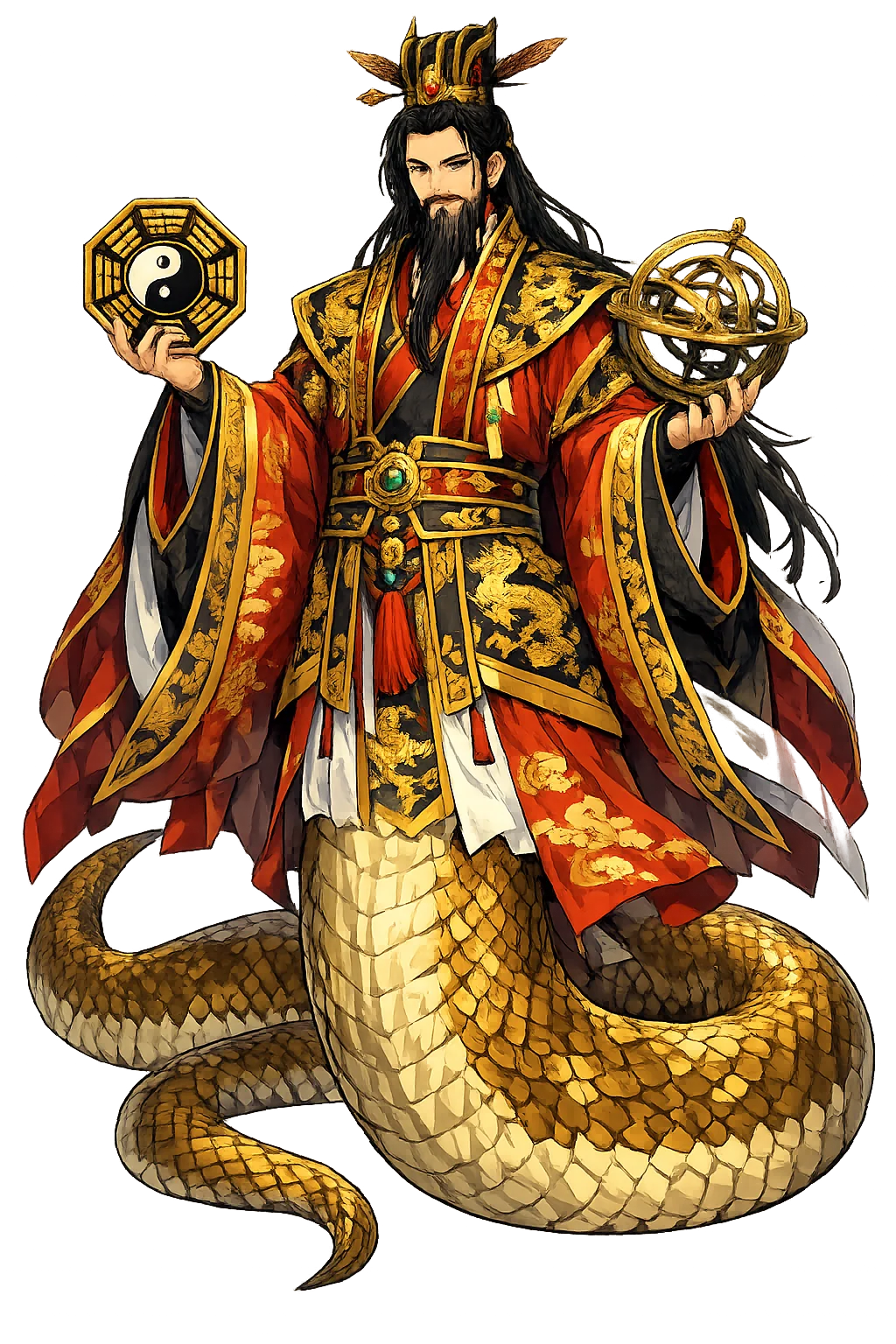
Stories of Fúxī
Fúxī's myths are all acts of notation: he does not fight or flee — he observes, abstracts, and teaches. He is the culture-bringer as draftsman.
The Yìjīng's Great Treatise records the founding act: Fúxī looked up and contemplated the images of heaven, looked down and contemplated the patterns of earth, contemplated the markings of birds and beasts and the order of the near at hand — and from all three made the eight trigrams, "to comprehend the powers of the spirits and to classify the natures of the ten thousand things." Writing, mathematics, and divination begin as one gesture of attention.
Later tradition gives the revelation a courier: a dragon-horse rose from the Yellow River bearing on its back the Hétú, the River Chart — the arrangement of numbers and marks from which Fúxī drew the trigrams. Paired with the Luò River Writing that inspired the Great Plan, the Chart made the Yellow River itself the first text of Chinese civilization.
In the flood myth of brother-sister survivors — recorded among the Miao peoples and in Tang-era collections, and later attached to Fúxī and Nǚwā — the couple alone outlive the waters, taking refuge on Mount Kūnlún. Versions differ on the test: they roll millstones down opposite slopes and watch the stones meet at the bottom, or light two fires and watch the smoke columns join above them. The divination read as consent: brother and sister marry and repopulate the drowned world. The myth explains both marriage institution and humanity second beginning. A nameless ancestral pair becomes the first couple only after the flood makes it necessary — and the divination that permits the union is itself Fúxī own art, pattern read from the behavior of things.
The tradition credits him with the survival-arts in sequence: knotting cords into nets for fishing and hunting, keeping domestic animals (hence one reading of his name, "subduer of beasts"), making the thirty-five-stringed se zither, and fixing the marriage rites. Civilization, in his legend, is a curriculum — and he is its whole faculty.
The Eight Trigrams, the Net, and the Marriage on the Mountain
Fúxī is where Chinese civilization says it learned to think: the sage-king who looked up at the heavens, down at the earth, and at the markings on birds and beasts — and abstracted the eight trigrams, the first writing of pattern itself.
Bāguà: broken and unbroken lines in threes — the binary alphabet of the Yìjīng, attributed to his observation.
He taught the people to knot cords into nets — fishing, hunting, and the technology of the snare.
Han art shows him and Nǚwā as serpents intertwined — the primal pair, measuring square and compass in hand.
He instituted the rites of marriage and the bride-price of deer skins — order after the flood.
From the original script to the living URL
伏羲
The name in its original Chinese form. Fúxī (伏羲) is attested in the source tradition — “Hidden one”. Its macron-length vowels and acute stress marks carry the full phonetic and orthographic weight of the source tradition.
fuxi
Reduced to plain fuxi, the name loses everything that made it specific: macron-length vowels and acute stress marks. What remains is an ASCII string that machines can parse but that no longer speaks with its original voice.
Fúxī
The Unicode restoration recovers what ASCII flattened. Fúxī restores macron-length vowels and acute stress marks, returning the name to its original written dignity. The domain encodes to Punycode, but the browser displays the truth.
Fúxī.com → xn--fx-rka1r.com
The non-ASCII characters in Fúxī are encoded while the ASCII remains visible. To the DNS, it is Punycode. To humanity, it is Fúxī.
Owned, ideal, and ASCII forms of Fúxī
Fúxī
Restores 伏羲. The live temple domain — fúxī.com.
fuxi
Flattens 伏羲. The plain ASCII fallback — what DNS and legacy systems see.
How Fúxī was spoken
How Fúxī is preserved in writing
A bespoke provenance study for Fúxī is being prepared by the PUNICODEX scholarly team.
Contribute scholarly provenance →The lore you have read is the living myth. Extended Lore opens the scholarly vault beneath it: the cult and its material remains, a history of the image, the name after antiquity, a meditation on what the name still means, and the full scholarly apparatus — etymology, orthography, sources.
Enter Extended Lore