PuniCodex

Extended Lore

Fúxī — The Deeper Record

Etymology · Orthography · Cult · Iconography · Reception · Sources

Preserves stress & vowel length Fúxī.com
Fúxī — Culture, Writing, Divination
01

At a Glance

Fúxī — every fact links to its home

PantheonChinese
DomainCulture, Writing, Divination
Original Script伏羲 →
Cited Works7 cited →
02

Etymology & Word Family

From original script to Unicode restoration — the full etymology page →

Original Script 伏羲 Fúxī — "Hidden one"
Unicode Restoration Fúxī Restored stress, length, and script
Modern ASCII fuxi Plain-ASCII fallback

The name Fúxī carries the orthographic signature of the chinese tradition: 伏羲. Unicode restoration recovers what ASCII flattens.

03

Unicode Character Breakdown

Character-by-character philological analysis

CharacterUnicodeNameBlockPhonetic Role
FU+0046Latin Capital Letter FBasic LatinSame, capitalized
úU+00FALatin Small Letter U with AcuteLatin-1 SupplementStress on u
xU+0078Latin Small Letter XBasic LatinSame
īU+012BLatin Small Letter I with MacronLatin Extended-ALong vowel

The restoration of Fúxī preserves what it can of the original phonology — stress and vowel length for Greek names, distinctive letters and diacritics for every other tradition.

04

Cult & Worship

How the sacred was kept — rites, sanctuaries, remains

The Cult

Fúxī's cult grew from the diviner's mat outward. No shrine of him is attested in the early strata — the Warring States and Han texts venerate him as the first sage, not a resident god — but the rite he invented became one of China's most practised: yarrow-stalk divination with the Yìjīng is his act of reading pattern, repeated by every generation of consultants for two thousand years. The temple cult arrived by accretion. Tianshui in Gansu keeps his birthplace temple and a great annual public memorial rite; grander still is the Taihao Mausoleum at Huaiyang in Henan — palace upon palace over his traditional tomb, its second-month temple fair described in imperial gazetteers and now on China's national register of intangible cultural heritage. There the offering is addressed to the First Ancestor: incense, opera, dragon lanterns, and trigram banners flying from his halls. The votive logic is unique in this catalog: his pilgrims come less to ask favors than to thank the inventor — of pattern, of nets, of marriage — at the source.

In the Earth

The Wu Liang shrine reliefs (2nd century CE, Shandong) show Fúxī and Nǚwā with serpent bodies entwined, square and compass raised — the canonical image, replicated across Han tomb art from Sichuan to Xinjiang (the famous Astana cemetery banner). The myth's textual archaeology runs from the Zhuangzi and Xunzi mentions to the Tang's flood-cycle records: a steady accretion from sage-king to cosmic progenitor, all preserved in the transmitted classics.

05

Iconography

How Fúxī was imaged across the ages

The Image

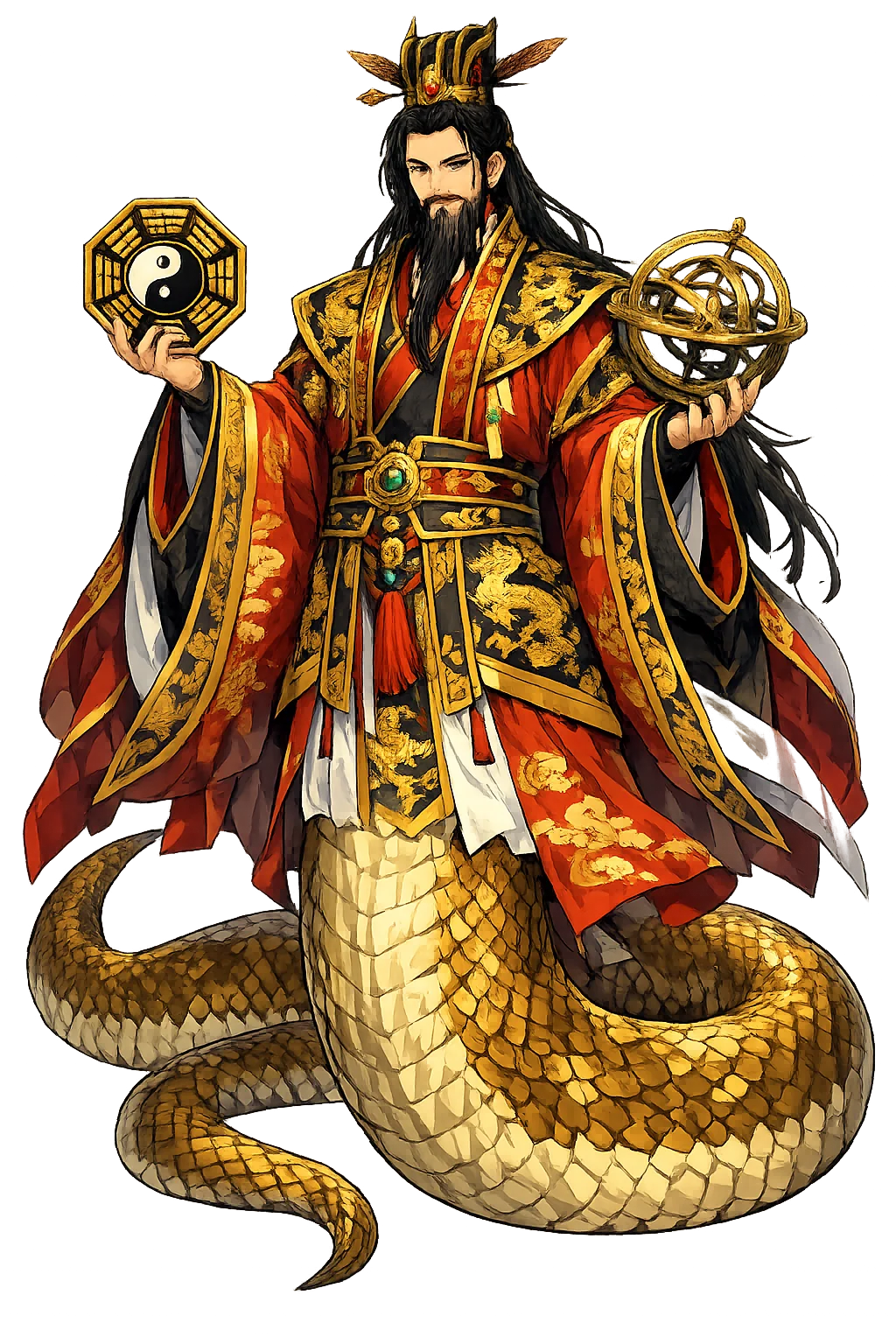
Fúxī's canonical body is half serpent — and it is Han. The earliest certain images are the pictorial stones of the second century CE: the Wu Liang shrine in Shandong shows him and Nǚwā entwined, serpent tails braided below the waist, human heads above, and in their raised hands the instruments of order — his carpenter's square, her compass. The type crossed the empire and the centuries: Tang-dynasty tomb banners from the Astana cemetery at the Silk Road's far end give each primal partner a cosmic lamp, sun-disc against crescent moon, set on the tomb's axis as its guardians. There the image did its work and stopped: the serpent-pair is the fixed Han-Tang canon, replicated on coffins, mirrors, and lintels from Sichuan to Xinjiang. After the Tang he changed species — in later ancestral scrolls he is a bearded human emperor in court robes, the snake shed entirely. The trigrams went with him either way: eight short bars, broken and unbroken, his signature wherever pattern is claimed.

06

Reception & Transformation

The name after its own age — transmission, translation, survival

Afterlives

Fúxī reached Europe as a sage before Europe knew China had gods. The Jesuits' Confucius Sinarum Philosophus (1687) set him before European readers as the first civilizing king — 'Fohi' — and Enlightenment philosophers seized on the eight trigrams as the oldest writing of pattern on earth, a reading that sent the Yìjīng into every later debate on the origins of signs and mathematics. The domestic journey was longer and quieter: named in Warring States texts, enthroned by Sima Qian in the opening chapter of the Shǐjì as first of the line of sage-rulers, dressed by Han apocrypha in the River Chart's numerology, and printed into permanence when the Song and Ming book markets made the Yìjīng, with its commentaries, the most reproduced text in East Asia. Qing evidential scholars began stripping the legend's layers; the twentieth century finished the job — the 'doubting antiquity' school read him as mythic accretion, while archaeology made him the unofficial emblem of the Neolithic dawn. His modern cult is the memorial rite: at Huaiyang and Tianshui the First Ancestor still receives incense from crowds that need no archaeology to keep him.

Identifications Across Traditions

He heads most lists of the Three August Ones (Sānhuáng), paired inseparably with Nǚwā — their intertwined serpent forms in Han art echoing, scholars note, the union of measure and generation. Daoist tradition absorbed him as a revealer of the trigrams to the immortal lineages; Confucian tradition kept him as the first historian of pattern. The serpent-pair iconography has been compared by art historians with intertwined pairs from Egypt to India — diffusion debated, the resemblance celebrated.

Modern Legacy

Every reading of the Yìjīng — the book that shaped Confucian statecraft, Daoist alchemy, and Leibniz's binary arithmetic — begins with his act of looking. The eight trigrams appear on the flag of South Korea; the River Chart structures a millennium of cosmological diagrams; and "Fúxī" remains the standard icon for the inventor-ancestor in Chinese cultural memory, the answer to the question of where pattern-thinking began.

08

The Original Script Note

What the written record preserves — and what it does not

Original Script

Written 伏羲: fú (subdue; the man-radical with the hound) plus xī (the ancient graph for sacrificial breath). The compound is attested from Warring States texts onward — the name predates any agreed reading of it, which is itself a mark of antiquity.

09

The Meditation

What Fúxī means — beyond the dictionary

Fúxī is the patron of the second look — the one that sees not the thing but the pattern. His trigrams are only broken and unbroken lines, yet a civilization read everything in them for three thousand years. He asks the observer's question: what in the world are you willing to look at long enough that it begins, at last, to read back?

Leibniz saw the trigrams and recognized binary arithmetic; the information age looked again and found the whole grammar of bits — the broken and unbroken line as zero and one. Whether or not the old sage intended the code, his lesson stands: the world's patterns are legible to whoever looks long enough, and three lines, honestly observed, can hold a civilization's worth of distinctions. The first technology was attention.

The tradition says he looked at the horse's markings and the turtle's shell and saw not omen but order — the world already written, waiting for a reader. Every analysis since, from the Yìjīng's commentaries to the database schema, is his gesture repeated: reduce the world to its honest marks, and the marks will begin to answer.

10

Frequently Asked Questions

Deep-dives into the cult, attestation, reception, and sources of Fúxī

01How do we know how Fúxī was worshipped?

The Wu Liang shrine reliefs (2nd century CE, Shandong) show Fúxī and Nǚwā with serpent bodies entwined, square and compass raised — the canonical image, replicated across Han tomb art from Sichuan to Xinjiang (the famous Astana cemetery banner). The full cult record →

02Where do the earliest attestations of Fúxī come from?

The record rests on Yìjīng, Xìcí zhuàn (Great Treatise), Shǐjì 1, Wǔdì Běnjì (Sima Qian), Anne Birrell, Chinese Mythology (Johns Hopkins, 1993), among 5 cited works. The full source apparatus →

03How did later traditions reinterpret Fúxī?

Fúxī reached Europe as a sage before Europe knew China had gods. Reception & transformation →

04What do the surviving images of Fúxī actually show?

Fúxī's canonical body is half serpent — and it is Han. The iconography →

05What does the written record of Fúxī actually preserve?

Written 伏羲: fú (subdue; the man-radical with the hound) plus xī (the ancient graph for sacrificial breath). The Original Script note →

11

Scholarly Sources

The philological foundations of this restoration

Every claim on this page is grounded in established scholarship. The orthographic restorations follow disciplinary convention. The etymological chain follows the best available reference works. This is not invention — it is resurrection through scholarship.

◈

Lexicography & Philology

  • Shan Hai Jing
  • Chinese classics
◎

Primary Texts

  • The Shan Hai Jing (Classic of Mountains and Seas); the Huainanzi; the Chuci.
◉

Archaeology & Art History

  • Chang, K. C. Art, Myth, and Ritual: The Path to Political Authority in Ancient China.
✦

Religious Studies

  • Yìjīng, Xìcí zhuàn (Great Treatise)
  • Shǐjì 1, Wǔdì Běnjì (Sima Qian)
  • Anne Birrell, Chinese Mythology (Johns Hopkins, 1993)
  • Zhuāngzǐ (Warring States mention of Fúxī)
  • Wu Liang Ci shrine reliefs, Shandong (2nd c. CE)
Return

The Surface Awaits

You have traced the name from its earliest attestation to its Unicode restoration. Now return to the myth. The story is where the name lives.

Back to Lore
Fúxī mascot