
The many faces of Fulla
No important name has only one face. Fulla appears as a figure of myth, a scholarly reconstruction, a piece of material culture, a memory carried across languages, and — most recently — a Unicode domain. This post looks at each face in turn: the name and its roots, the Younger Futhark original, the reconstructed pronunciation, the mythological record, the symbols and sanctuaries, the cross-cultural afterlife, and the engineering that lets the restored spelling resolve in a browser. Taken together, those faces explain why fulla was never going to be enough — and why the restored form is worth a domain of its own.
At a Glance
- Restored name: Fulla
- ASCII form: fulla
- Meaning: "Bountiful"
- Domain of influence: Abundance, Secrets
- Pantheon: Norse
- Classification: Tier 2
- Original script: ᚠᚢᛚᛚᛅ (Younger Futhark)
Overview
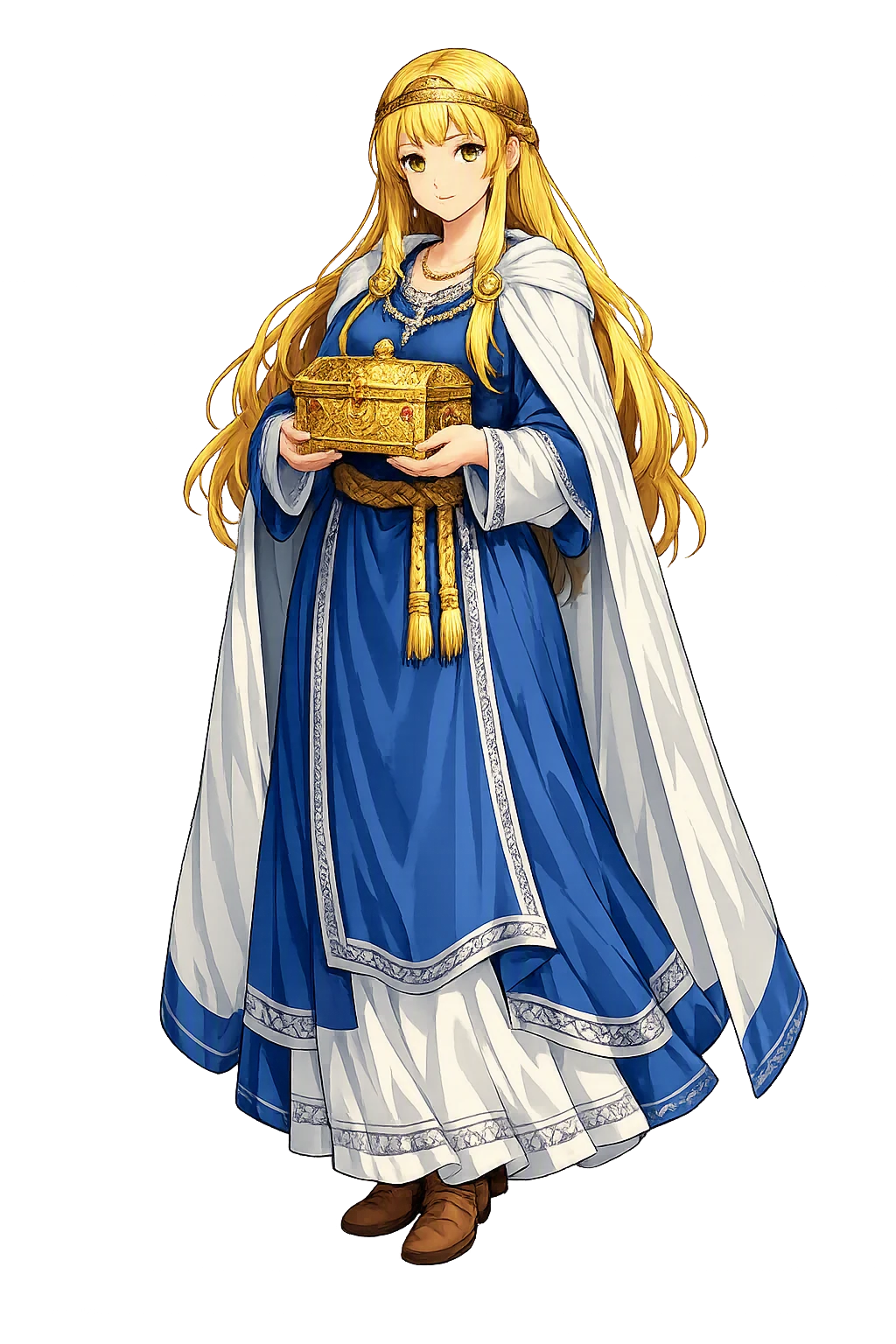
Fulla (fulla) — Abundance, Secrets · Frigg's Handmaid, the Keeper of the Casket — is the most trusted figure in the queen's hall: the virgin ásynja who goes with her hair loose and a golden band about her head, who carries Frigg's little box, looks after her shoes, and shares her secret counsels.
Old Norse Fulla is a transparent formation on fullr 'full' — the same word as English 'full' and German 'voll' — so the name means 'Fullness, Plenty': an abstract noun worn as a personal name, like her sister ásynjur Sjǫfn ('affection') and Lofn ('praise, permission'). Her dossier is four precise notices: Snorri's portrait in Gylfaginning 35, her errand to King Geirröðr in the prose introduction to Grímnismál, the finger-ring Nanna sends her from Hel in Gylfaginning 49, and — if the identification holds — her continental echo as Volla, sister of Friia, in the Second Merseburg Charm.
PuniCodex restores the name as Fulla — identical to the ASCII input, because normalized Old Norse writes no diacritic in this name. The mechanical rule therefore places it in Tier 2: nothing distinctive is lost in transit, a statement about orthography and never about the goddess. This temple is domain-less: the plain-ASCII fulla.com is registered to a third party outside the collection and is watched for release; no form of the name is claimed.
The Name
The name is attested in Old Norse as Fulla — a feminine weak noun formed directly on the adjective fullr 'full', hence 'Fullness, Plenty, the Bountiful one'. It belongs to the family of abstract-noun goddess-names in Gylfaginning's catalogue of the ásynjur: Sjǫfn from sjafni 'affection', Lofn from lof 'praise, permission', Vár from várar 'vows' — qualities and states given names and errands of their own. The name answers her office exactly: the keeper of the queen's treasure-box is herself called Plenty.
The ASCII form and the restored form are identical because the normalized Old Norse spelling carries no diacritic and no distinctive letter: five plain Latin letters. The mechanical tier rule therefore classifies the name Tier 2 — the restoration preserves nothing the ASCII form loses. This is an orthographic report, not a judgment of standing.
The letter-by-letter transformation runs:
- f → F — Same, capitalized
- u → u — Same
- l → l — Same
- l → l — Same
- a → a — Same
No form of the name is held in the collection: the plain-ASCII fulla.com is registered outside the project and watched for release.
The Original Script
The name is preserved in medieval Icelandic manuscripts in the Latin alphabet as Fulla — Old Norse (North Germanic), attested 13th c. CE in the Codex Regius (the Grímnismál prose) and the Prose Edda codices, recording material centuries older. Before the Latin bookhand, Old Norse names were carved in the Younger Futhark; no runic attestation of this theonym survives, so the manuscript form is the primary witness.
The scholarly rendering proceeds step by step:
- The name is a feminine weak noun formed on the adjective fullr 'full'; as an a-stem it carries no nominative -r, which is why the name ends in plain -a.
- The double l is a true geminate /lː/; the Younger Futhark rendering ᚠᚢᛚᛅ writes it with a single ᛚ, as the runic row does not mark consonant length.
- The vowels are short: no length marks appear in normalized Old Norse orthography, and none are restored.
- The Unicode restoration Fulla is therefore identical to the ASCII form apart from the capital: the name carries no diacritic and no distinctive letter, and is Tier 2 by the mechanical rule.
The temple claims no domain: the plain-ASCII fulla.com is held by a third party outside the collection and is watched for release.
Pronunciation
The reconstructed pronunciation of the name is /ˈful.la/ — Old Norse Reconstruction.
Phoneme by phoneme:
- Fu- — Voiceless labiodental [f], short close rounded [u] as in English put; stressed first syllable, as in every Old Norse word
- -lla — A true geminate [lː], the double l held twice as long as a single l, then a short open [a]
For the modern speaker, the closest approximation is: 'FULL-ah' — but with the vowel of put, not pool, and the l genuinely doubled, two even syllables with the weight on the first.
Kindred and historical forms of the name:
- Old Norse — Fulla, Frigg's handmaid; from fullr, 'full'
- Old High German — Volla, Friia's sister in the Second Merseburg Charm, widely read as the same figure
- Proto-Germanic — *fullaz, 'full' — the ancestor of English 'full', German 'voll', Gothic fulls, and Norse fullr
- Owned form — None; the temple claims no domain, and fulla.com is held outside the collection
Fulla is Tier 2 by rule: the normalized Old Norse form is already plain ASCII, and the restoration loses nothing in transit. The doubled l — which the runic row would write with a single ᛚ — is the one feature no plain spelling can show.
Mythology
Fulla has no saga of her own: her mythology is four precise notices, and every one of them places her at Frigg's side. What the tradition lost in narrative it kept in definition — no goddess in the Edda is more exactly described in a single sentence.
The Keeper of the Casket (Gylfaginning 35)
Snorri's catalogue of the ásynjur gives Fulla her entire portrait at once: 'Fulla is a virgin and goes with her hair loose and a golden band about her head; she carries Frigg's eski, looks after her footwear, and shares her secret counsels with her.' The three duties descend in rank and rise in intimacy — the box is treasure, the shoes are service, the counsels are trust itself. She is named immediately after Gná, Frigg's errand-rider, and the pairing has stuck: where Gná carries the queen's words out through the worlds, Fulla keeps the queen's words that never leave the hall.
The Warning to Geirröðr (Grímnismál, prose)
Her one errand in the Poetic Edda is given in prose. Óðinn and Frigg had quarrelled over their foster-sons: Frigg accused King Geirröðr, Óðinn's favourite, of being so stingy he tortured his guests, and Óðinn laid a wager and set off disguised to test him. Frigg sent her handmaid Fulla to Geirröðr ahead of him, to warn the king to beware of a sorcerer coming to bewitch him — with the token that no dog, however fierce, would leap at the man. The warning is the trap: Geirröðr seized the stranger, named Grímnir, and tortured him between two fires, and out of that fire the god spoke the whole catalogue of the worlds. Fulla appears only to deliver the message and vanish, but the wager, the torture, and the poem's entire revelation turn on her errand.
The Ring from Hel (Gylfaginning 49)
When Hermóðr rode nine nights to ransom Baldr and came home with the tidings, he brought tokens from the dead: Baldr sent back the ring Draupnir to Óðinn, and Nanna — Baldr's wife, who had died of grief on his pyre — sent gifts out of Hel to the two women of Frigg's hall: a linen headdress for Frigg, and a finger-ring for Fulla. When a dead goddess thinks of Ásgarðr's household, she thinks of the queen and of the queen's handmaid by name.
Volla, Friia's Sister (Second Merseburg Charm)
The one continental witness is the Second Merseburg Charm, the only pagan theogonic text in Old High German: Phol and Wodan rode to the wood, Balder's foal wrenched its foot, and the goddesses chant over it in sequence — Sinthgunt, Sunna her sister; Friia, Volla her sister; and at last Wodan, who knows how. Since Jacob Grimm, Volla — Friia's sister — has widely been read as Fulla: the name is the exact Old High German form of the same word, and the charm puts her, precisely as the Edda does, at Friia's right hand. The identification is argued, not proven.
Symbols & Iconography
Fulla's iconography is the iconography of trust — Snorri fixes her appearance and office in a single sentence, and the tradition never adds to it:
- The eski — Frigg's little casket, which Fulla carries: the portable treasury of the queen of the gods, and the clearest badge of her office
- The golden band — the gold snood she wears about her loose hair: unmarried freedom dressed in plenty, and Snorri's one detail of dress
- The loose hair itself — the virgin's unbound hair, the visible sign of her status in a hall of married goddesses
- Frigg's shoes — the queen's footwear in her keeping: the humblest duty in the catalogue, and the surest sign of a servant admitted to every chamber
- The finger-ring from Hel — Nanna's gift, carried back by Hermóðr: a token from the dead addressed, of all the ásynjur, to her
Archaeology & Evidence
Fulla is an entirely textual goddess: no cult site, toponym, votive deposit, or inscription names her, and the runic corpus is silent — unsurprising for a figure the sources place inside the queen's household rather than in the public cult. Her witnesses are manuscripts. The Grímnismál prose, which preserves her one errand, survives in the Codex Regius (c. 1270); her portrait in Gylfaginning 35 and her ring in Gylfaginning 49 come with the Prose Edda codices of the thirteenth and fourteenth centuries; and her name recurs in the þulur, the metrical name-lists appended to Skáldskaparmál.
The one continental witness is the Second Merseburg Charm, copied into a theological manuscript at Fulda in the tenth century and now in the Merseburg cathedral library: its Volla, sister of Friia, is the only attestation of the figure outside Iceland and, if the identification holds, the oldest by centuries. Against this single Carolingian-era survival, the whole archaeological record — the Migration-Age gold of the period's hoards, the picture stones, the amulets — offers atmosphere rather than attribution: golden bands are abundant in the ground, but none can be assigned to Fulla.
Realm & Domain
Fulla is catalogued under Abundance, Secrets — and the sources earn both terms of it: her name is Fullness itself, and her defining duty is the keeping of what the queen does not say aloud.
Abundance
Her name is the abstract noun of fullr, 'full': Plenty given a person, a golden band, and a casket to carry — the goddess in whose keeping the queen's portable wealth actually lives.
Secrets
She shares Frigg's leyniráðagørðir, the queen's secret deliberations: of the three duties in her portrait, the counsels are the one that admits her past every door.
Fidelity and Service
The casket and the shoes are the badges of the trusted chamber-servant — the lowest duties of the hall held, in her case, at the highest level of confidence.
The Queen's Hall
Every notice the tradition keeps of her places her at Frigg's side: named beside Gná, Frigg's errand-rider, in the catalogue of the ásynjur, and remembered beside the queen herself when Nanna's gifts come back from Hel.
Across Cultures
Fulla's cross-border life runs through one word and one relationship. The word is fullr: Proto-Germanic fullaz gives English 'full', German 'voll', Gothic fulls, and Old Norse Fulla — a goddess whose name is the ordinary adjective turned abstract noun, 'Fullness'. The relationship is the one the Merseburg Charm preserves: Volla beside Friia, as Fulla beside Frigg — and since Grimm the identification of the two has been the standing reading, with Simek registering both the fit and the doubt.
The deeper question is what kind of being she is. Gylfaginning's ásynjur catalogue is full of abstract-noun goddesses — Sjǫfn, Lofn, Vár — and scholars have long suspected that Fulla, Gná, and their sisters are facets of Frigg herself: the queen's plenitude and far-ranging given names and errands of their own. Whether she began as an independent goddess of plenty or as an aspect that walked off on its own, the sources keep her a person: she receives a ring, runs an errand, and wears her own gold. Within the corpus, her closest kin are the figures of Frigg's household: Frigg herself, Nanna, who sends her the ring, and the other ásynjur of Snorri's catalogue, among them Syn, who guards the door against those who should not enter, and Eir, the best of physicians.
Cultural Legacy
Fulla's afterlife is scholarly and liturgical rather than popular. Grimm devoted sustained attention to her and Volla in Teutonic Mythology, and every handbook since — Simek, Orchard, Lindow — keeps her as the standing example of the abstract-noun ásynja: the goddess whose name tells you exactly what she is. Her image — loose hair, golden band, the queen's casket on her arm — became the fixed picture of the trusted northern handmaid, and she enters nearly every retelling of the Baldr cycle by virtue of one finger-ring.
In contemporary practice, modern Heathen and Ásatrú communities keep her at Frigg's side as a goddess of plenty, household trust, and well-kept secrets, invoked where abundance must be held in confidence. She never became a pop-culture figure; she remained what the Edda made her — the most trusted person in the queen's hall, and the tradition's proof that even abundance has a keeper.
The Scholarly Record
The account of Fulla given in this edition rests on the witnesses and reference works listed below. Gylfaginning 35 supplies the portrait, Gylfaginning 49 the ring, the Grímnismál prose the errand, and the Second Merseburg Charm the continental question; the lexica secure the name's etymology, and the handbooks arbitrate the Volla identification and the abstract-noun ásynjur.
- Snorri Sturluson, Edda, Gylfaginning 35 (Fulla's portrait: virgin, golden band, eski, shoes, secret counsels), ed. and trans. Anthony Faulkes (London: Everyman, 1987).
- Grímnismál, prose introduction (Fulla sent to warn Geirröðr), trans. Carolyne Larrington, The Poetic Edda, 2nd ed. (Oxford: Oxford University Press, 2014).
- Snorri Sturluson, Edda, Gylfaginning 49 (Hermóðr's ride; Nanna's finger-ring for Fulla), trans. Faulkes (1987).
- The Second Merseburg Charm (Friia and Volla her sister), ed. Braune–Ebbinghaus, Althochdeutsches Lesebuch, 16th ed. (Tübingen: Niemeyer, 1979).
- Cleasby, Richard, and Guðbrandur Vigfússon, An Icelandic-English Dictionary, 2nd ed. (Oxford: Clarendon Press, 1957), s.v. Fulla, fullr.
- Zoëga, Geir T., A Concise Dictionary of Old Icelandic (Oxford: Clarendon Press, 1910), s.v. Fulla.
- Simek, Rudolf, Dictionary of Northern Mythology, trans. Angela Hall (Cambridge: D. S. Brewer, 1993), s.v. Fulla, Gná.
- Lindow, John, Norse Mythology: A Guide to the Gods, Heroes, Rituals, and Beliefs (Oxford: Oxford University Press, 2001), s.v. Fulla.
- Snorri Sturluson, Edda, Skáldskaparmál, þulur of the ásynjur, trans. Faulkes (1987).
- Grimm, Jacob, Teutonic Mythology, trans. James Steven Stallybrass, 4 vols. (London: George Bell, 1882–88).
- de Vries, Jan, Altnordisches etymologisches Wörterbuch, 2nd ed. (Leiden: Brill, 1962), s.v. fullr.
A Meditation
Fulla is the goddess of what is held in trust. Every detail of her portrait is a form of custody: the casket she carries but does not own, the shoes she tends but does not wear, the counsels she shares but does not speak. Even her name works this way — Fullness is not a thing she does but a thing she keeps.
The tradition gives her no adventure because her office is the adventure's opposite: Gná rides out with the queen's words; Fulla stays, and what is entrusted to her stays with her. Nanna's ring from Hel is the tradition's own verdict on that office — when the dead send gifts home, they send one to the keeper. In a mythology that ends in fire and betrayal, Fulla is the quiet counterweight: the proof that some things, once entrusted, are simply kept.
The Unicode Restoration
Fulla is classified as Tier 2: the restoration needs no distinctive letters or diacritics its ASCII form would lose. The ASCII fallback fulla still resolves everywhere, but it is the restored form that carries the name's full information. That is the whole thesis of this temple: the marks are the message.
Why This Restoration Matters
Myth, script, sound, cult, legacy, domain: the faces of Fulla add up to a single argument — that a name is a record, and records deserve fidelity. The PuniCodex restoration keeps that record in working order: the temple presents it, the Scholarly Edition footnotes it, the lexicon catalogs it, and the domain makes it addressable. fulla will always exist as a fallback. But fallback is not identity. Fulla is the name; everything else is a convenience.
Explore Further
This post is one doorway into the temple. The home page carries the full character breakdown and the ambient canvas; the lore page tells the myths in long form; the Scholarly Edition preserves the sources, pronunciation data, and revision history; and the patron wall supports the restoration directly. For the wider map, browse the Lexicon, explore the Pantheon, or return to the PuniCodex blog.
Related Names
Sources
The full scholarly apparatus — every citation, revision, and review — lives in the Scholarly Edition. Key references for this post:
- Snorri Sturluson, Edda, Gylfaginning 35 (Fulla's portrait: virgin, golden band, eski, shoes, secret counsels), ed. and trans. Anthony Faulkes (London: Everyman, 1987).
- Grímnismál, prose introduction (Poetic Edda), trans. Carolyne Larrington, The Poetic Edda, 2nd ed. (Oxford: Oxford University Press, 2014).
- Snorri Sturluson, Edda, Gylfaginning 49 (Hermóðr's ride; Nanna's finger-ring for Fulla), trans. Faulkes (1987).
- The Second Merseburg Charm (Friia and Volla her sister), ed. Braune–Ebbinghaus, Althochdeutsches Lesebuch, 16th ed. (Tübingen: Niemeyer, 1979).
- Lexicon authorities for this entry: Prose Edda, Cleasby-Vigfusson.