PuniCodex

Extended Lore

ᚠᚢᛚᛚᛅ Fulla

Etymology · Phonology · Orthography · Cultural Legacy · Primary Sources

Tier 2 Fulla
Fulla — Abundance, Secrets
01

Quick Facts

Essential information about Fulla, Abundance, Secrets

Original Scriptᚠᚢᛚᛚᛅ
Unicode RestorationFulla
Reconstructed Pronunciation/ˈful.la/
PantheonNorse
DomainAbundance, Secrets
MeaningBountiful
ClassificationTier 2
Primary DomainFulla
Sacred SymbolsThe eski (little casket), The golden hair-band, Frigg's shoes, The finger-ring from Hel
02

Etymology & Word Family

From original script to Unicode restoration

Original Script ᚠᚢᛚᛚᛅ Fulla — "Bountiful"
Unicode Restoration Fulla Restored stress, length, and script
Modern ASCII fulla Plain-ASCII fallback

Old Norse Fulla is a transparent formation on fullr, 'full' — the same word as English 'full' and German 'voll' — so the name means 'Fullness, Plenty', an abstract noun worn as a personal name, like her sister ásynjur Sjǫfn and Lofn. The double l is a true geminate, held twice as long as a single l. The normalized Old Norse form is plain ASCII — no diacritic, no thorn or eth — so the name is Tier 2 by the mechanical rule: nothing distinctive is lost in transit, a statement about orthography, never about the goddess.

03

Unicode Character Breakdown

Character-by-character philological analysis

CharacterUnicodeNameBlockPhonetic Role
FU+0046Latin Capital Letter FBasic LatinSame, capitalized
uU+0075Latin Small Letter UBasic LatinSame
lU+006CLatin Small Letter LBasic LatinSame
aU+0061Latin Small Letter ABasic LatinSame

The Tier 2 classification reflects how much of the original phonology this restoration preserves — stress and vowel length for Greek names, distinctive letters and diacritics for every other tradition.

04

Cultural Significance

From ancient cult to modern Unicode

Ancient Domain

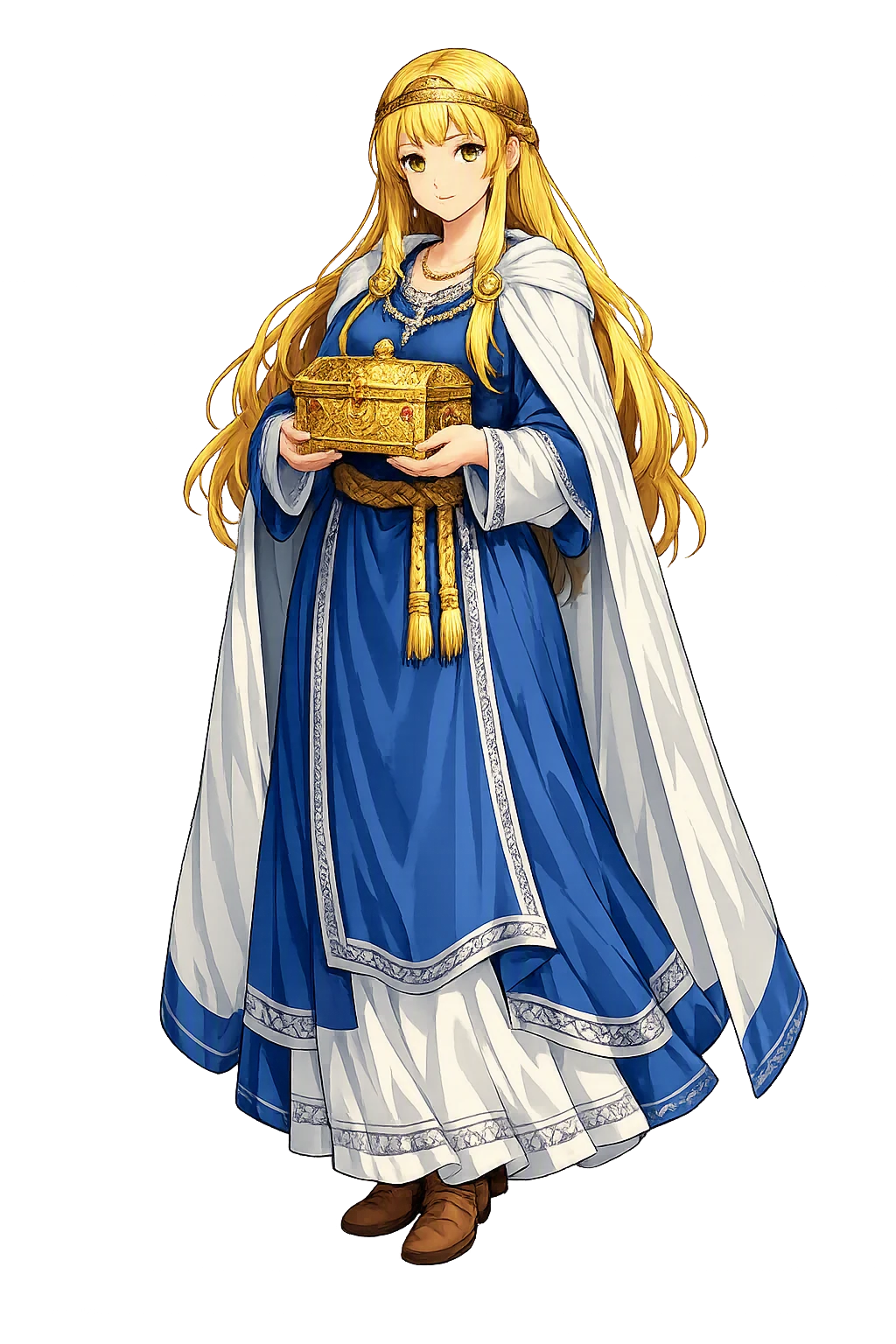
Fulla is Frigg's handmaid and confidante — the virgin goddess who goes with her hair loose and a golden band about her head, who carries the queen's little box, looks after her shoes, and shares her secret counsels. Her name is Fullness itself: plenty made a person, trusted with everything a queen cannot carry alone.

Fulla in Later Traditions

Fulla's cross-border life runs through one word and one relationship. The word is fullr: Proto-Germanic *fullaz gives English 'full', German 'voll', Gothic fulls, and Old Norse Fulla — a goddess whose name is the ordinary adjective turned abstract noun, 'Fullness'. The relationship is the one the Merseburg Charm preserves: Volla beside Friia, as Fulla beside Frigg — and since Grimm, the identification of the two has been the standing reading, with Simek registering both the fit and the doubt. The deeper syncretic question is what kind of being she is. Gylfaginning's ásynjur catalogue is full of abstract-noun goddesses — Sjǫfn ('affection'), Lofn ('praise, permission'), Vár ('vows') — and scholars have long suspected that Fulla, Gná, and their sisters are facets of Frigg herself, the queen's plenitude and far-ranging given names and errands of their own. Whether she began as an independent goddess of plenty or as an aspect that walked off on its own, the sources keep her a person: she receives a ring, runs an errand, and wears her own gold.

Modern Legacy

Fulla's afterlife is scholarly and liturgical rather than popular. Grimm devoted a chapter of Teutonic Mythology to her and Volla, and every handbook since — Simek, Orchard, Lindow — keeps her as the standing example of the abstract-noun ásynja, the goddess whose name tells you exactly what she is. Her image — loose hair, golden band, the queen's casket on her arm — became the fixed Victorian and modern picture of the trusted northern handmaid, and she appears in nearly every retelling of the Baldr cycle by virtue of one finger-ring. Modern Heathen and Ásatrú practice keeps her at Frigg's side as a goddess of plenty, household trust, and well-kept secrets, invoked where abundance must be held in confidence. She never became a Marvel character or a video-game boss; she remained what the Edda made her — the most trusted person in the queen's hall, and the proof that in the northern pantheon even abundance has a keeper.

Unicode Restoration as Cultural Act

Restoring Fulla in a domain name is more than orthographic accuracy. It is a statement that the internet should recognize the full range of human writing — not only the ASCII keyboard.

05

Frequently Asked Questions

Common questions about Fulla, Abundance, Secrets, and Unicode restoration

01How do you pronounce Fulla?

In reconstructed pronunciation, Fulla is /ˈful.la/ — approximately FULL-ah — a short, rounded u as in 'put', a genuinely long, doubled l, and a short open 'ah'; two even syllables, stress on the first..

02What does Fulla mean?

Fulla means Bountiful in the norse tradition.

03What are the symbols of Fulla?

Fulla is associated with The eski (little casket) (Frigg's portable treasure-box, entrusted to the hand that never lets it go — custody as a form of intimacy), The golden hair-band (The virgin's loose hair bound with gold — unmarried freedom dressed in plenty), Frigg's shoes (The queen's footwear in her keeping — the lowest duty held by the highest confidence), The finger-ring from Hel (Nanna's gift carried back by Hermóðr — a token from the dead addressed, of all the ásynjur, to her).

04Why restore Fulla in Unicode?

Plain ASCII fulla strips the stress, length, and script that make the name specific. Unicode restoration returns the name to its original written dignity.

05What is the most important myth about Fulla?

Snorri's catalogue of the ásynjur gives Fulla her entire portrait in one sentence, and the tradition never varies it: 'Fulla is a virgin and goes with her hair loose and a golden band about her head; she carries Frigg's eski, looks after her footwear, and shares her secret counsels with her.' The three duties descend in rank and rise in intimacy — the box is treasure, the shoes are service, the counsels are trust itself. She is named immediately after Gná, Frigg's errand-rider, and the pairing has stuck: where Gná carries the queen's words out through the worlds, Fulla keeps the queen's words that never leave the hall. Scholars since Grimm have read both as hypostases of Frigg — aspects of the queen walking about as attendants — but the Edda keeps them as persons, and Fulla's golden band and loose hair make her the most visually fixed of all the minor ásynjur.

06

Scholarly Sources

The philological foundations of this restoration

Every claim on this page is grounded in established scholarship. The orthographic restorations follow disciplinary convention. The etymological chain follows the best available reference works. This is not invention — it is resurrection through scholarship.

Lexicography & Philology

  • Prose Edda
  • Cleasby-Vigfusson

Primary Texts

  • Snorri Sturluson, Prose Edda: Gylfaginning 35 (Fulla's portrait: virgin, golden band, eski, shoes, secret counsels) and 49 (Nanna's finger-ring); Skáldskaparmál, þulur of the ásynjur
  • Poetic Edda: Grímnismál, prose introduction (Fulla sent to warn Geirröðr), trans. Carolyne Larrington

Archaeology & Art History

  • Material evidence — iconography, inscriptions, and temple archaeology — for Fulla and related cults.
  • Fulla is an entirely textual goddess: no cult site, toponym, votive deposit, or inscription names her, and the runic corpus is silent — unsurprising for a figure the sources place inside the queen's household rather than in the public cult. Her witnesses are manuscripts. The Grímnismál prose, which preserves her one errand, survives in the Codex Regius (c. 1270); her portrait in Gylfaginning 35 and her ring in Gylfaginning 49 come with the Prose Edda codices of the thirteenth and fourteenth centuries, and her name recurs in the þulur, the metrical name-lists appended to Skáldskaparmál. The one continental witness is the Second Merseburg Charm, copied into a theological manuscript at Fulda in the tenth century and now in the Merseburg cathedral library: its Volla, sister of Friia, is the only attestation of the figure outside Iceland and, if the identification holds, the oldest by centuries.

Religious Studies

  • The Second Merseburg Charm (Friia and Volla her sister), in Braune–Ebbinghaus, Althochdeutsches Lesebuch
  • Cleasby–Vigfusson, An Icelandic-English Dictionary, s.v. Fulla, fullr; Zoëga, A Concise Dictionary of Old Icelandic, s.v. Fulla
  • Grimm, Teutonic Mythology, trans. Stallybrass (Fulla and Volla)
  • Simek, Dictionary of Northern Mythology; Orchard, Dictionary of Norse Myth and Legend; Lindow, Norse Mythology: A Guide — s.v. Fulla (etymology, the Volla question, the abstract-noun ásynjur)
Return

The Surface Awaits

You have traced the name from its earliest attestation to its Unicode restoration. Now return to the myth. The story is where the name lives.

Back to Lore
Fulla mascot