
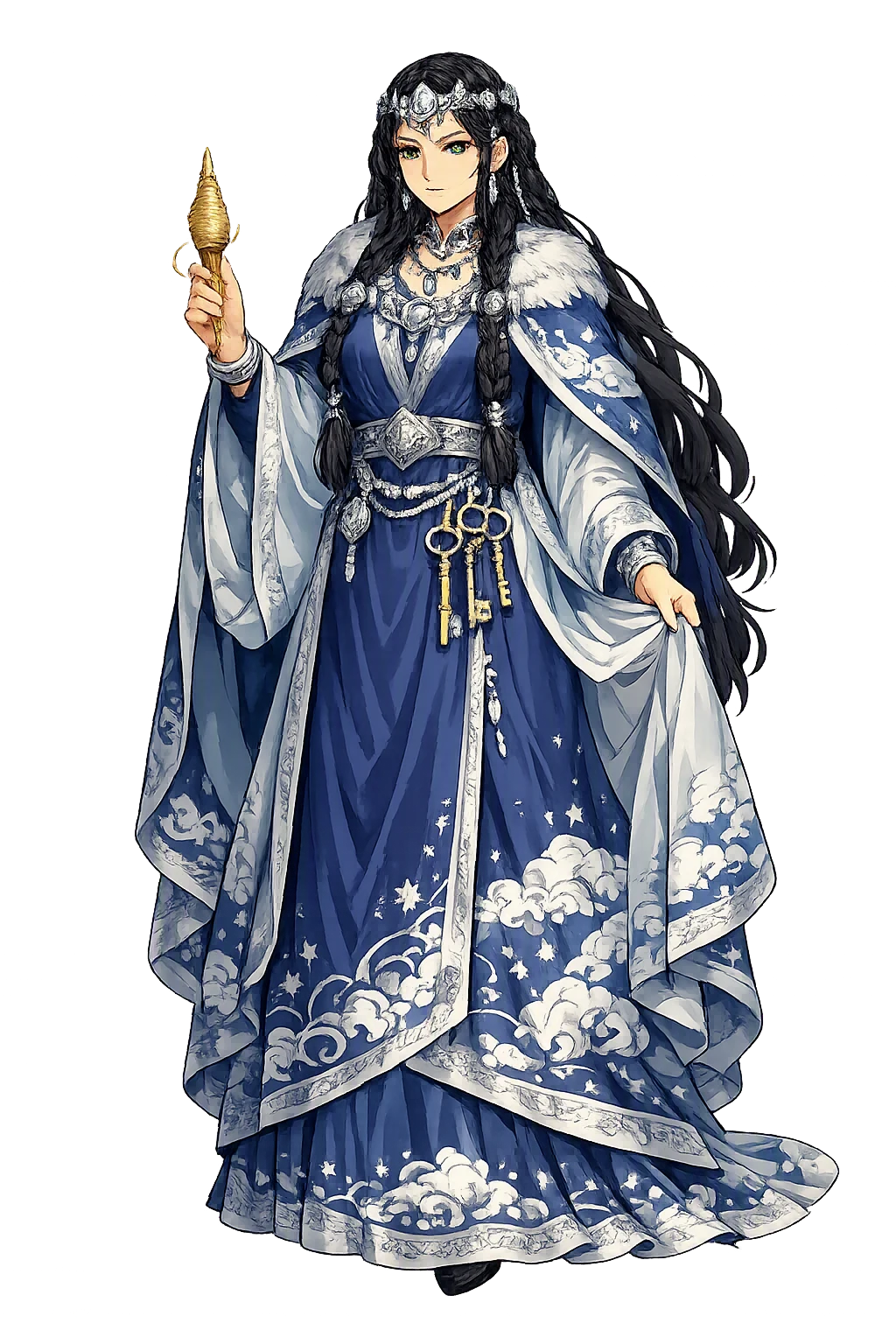
Pronouncing Frigg: a guide for the curious
Saying Frigg aloud requires more than reading Latin letters on a screen. The conventional spelling is only the entry point into a reconstructed sound and a much older tradition. This post unpacks that sound, the evidence assembled in the scholarly record, the kindred forms, and the mythological record, then shows how the temple preserves the whole argument without pretending that a diacritic was ever lost.
At a Glance
- Canonical name: Frigg
- ASCII form: frigg
- Meaning: "Beloved (from *frijjō)"
- Domain of influence: Marriage, Motherhood, Queenship
- Pantheon: Norse
- Restoration: ASCII-equivalent form
- Reconstructed form: ᚠᚱᛁᚴᚴ (Younger Futhark)
Overview
Frigg (frigg) — Marriage, Motherhood, Queenship · Beloved (from frijjō) — belongs to the Norse tradition, where it is catalogued under the domain "Marriage, Motherhood, Queenship". The name means "Beloved (from frijjō)".
Frigg is the foremost of the ásynjur: daughter of Fjörgynn, wife of Óðinn, mother of Baldr. Her hall is Fensalir, the fen-halls, where she wept for her slain son; her gift is the heaviest in the Edda — she knows all fate, and says none of it.
PuniCodex records the canonical scholarly spelling Frigg and serves its temple at its temple. The displayed form is ASCII-equivalent — a description computed from the displayed form itself. The plain ASCII form frigg contains the same letters: no recovered diacritics or special encoding is claimed. The work here is consistent citation, capitalization, provenance, and cultural context.
The Name
The name is attested in Younger Futhark as ᚠᚱᛁᚴᚴ. Etymologically it means "Beloved (from *frijjō)".
The reconstructed proto-form is frijjō (proto-indo-european, "Beloved"). Beloved (from *frijjō)
The canonical spelling Frigg matches the conventional scholarly romanization. The plain ASCII form frigg contains the same letters, so no lost diacritics or encoding transition is claimed. The editorial work is to fix one reviewed reference spelling, preserve capitalization and provenance, and keep the original evidence visible. The displayed form is ASCII-equivalent — a description computed from the displayed form itself.
The letter-by-letter transformation runs:
- f → F — Same
- r → r — Same
- i → i — Same
- g → g — Same
- g → g — Same
Etymology & Roots
The recorded derivation reads: Beloved (from *frijjō)
The reconstructed proto-form is *frijjō (proto-indo-european), glossed as "Beloved".
The reconstruction is classed as attested.
The Original Script
The name is preserved in Younger Futhark as ᚠᚱᛁᚴᚴ.
The scholarly transliteration is frikk.
The rendering proceeds step by step:
- ᚠ (fé) writes both /f/ and /v/
- ᚱ (reið) writes /r/
- ᛁ (ís) writes both /i/ and /e/
- The spelling frikk is a normalized phonetic reconstruction; Younger Futhark does not distinguish voiced/voiceless stops or separate short and long vowels
The normalized Old Norse form is Frigg — already plain ASCII, with no diacritic or distinctive letter for the restoration to recover; in the Younger Futhark the name would have been carved ᚠᚱᛁᚴ (f-r-i-k, the k-rune writing the geminate gg, into which the old nominative ending has been assimilated). Because the name is pure ASCII, its domain was registered decades ago in the ordinary way: frigg.com is held by a third party outside the PuniCodex collection and is watched for release — no form of the name is currently owned, and this temple claims none.
Pronunciation
The reconstructed pronunciation of the name is /ˈfriɡː/ — Old Norse Reconstruction.
Phoneme by phoneme:
- Fr- — Voiceless labiodental [f] and trilled [r]; Old Norse keeps the cluster firm at the head of the word, with stress on this single syllable.
- -i- — Short close front [i], held brief — the vowel of English 'bit', not a long ī.
- -gg — Long voiced velar stop [ɡː], the true geminate: the consonant is held and released, as in modern Icelandic Frigg. The old nominative ending has been swallowed into this double-g.
For the modern speaker, the closest approximation is: 'FRIG' with the g held long — rhymes with 'big', the r lightly trilled, and the double-g pressed and released like the 'dg' said twice over, as in modern Icelandic Frigg.
Kindred and historical forms of the name:
- Old Norse — Frigg, wife of Óðinn and foremost of the ásynjur; the final -gg subsumes the old nominative ending (genitive Friggjar).
- Proto-Germanic — *Frijjō, 'the beloved one' — the root of the etymology the handbooks accept.
- Langobardic — Frea, wife of Godan in Paul the Deacon's Historia Langobardorum — the continental witness to the goddess.
- Old English — Frīg (genitive Frīge), preserved in Frīgedæg — Friday, the Germanic translation of dies Veneris.
- Modern Icelandic — Frigg, unchanged in spelling.
Frigg is a plain restoration by the mechanical rule: the normalized Old Norse form is already plain ASCII — there is no diacritic and no distinctive letter for the ASCII alphabet to lose. The queen of the gods carries a name so plain that only the capital distinguishes the restored form from the input.
Mythology
Frigg is the foremost of the ásynjur: daughter of Fjörgynn, wife of Óðinn, mother of Baldr. Her hall is Fensalir, the fen-halls, where she wept for her slain son; her gift is the heaviest in the Edda — she knows all fate, and says none of it. Around those two facts, the almost-complete oath and the kept silence, the tradition builds its portrait of the queen who governs the household of the gods.
The Oath of All Things (Gylfaginning 49)
When Baldr dreams baleful dreams for his life, Frigg does the one thing foresight permits: she fights the future with an oath. She travels the world and exacts from all things — fire and water, iron and every metal, stones, earth, trees, sicknesses, beasts, birds, poison, serpents — the promise that they will not harm Baldr. Only the mistletoe, growing west of Valhöll, seemed too young to demand the oath of. The completeness of the list is the point: Snorri enumerates creation itself, and the myth hangs its whole catastrophe on the one category a mother's thoroughness could not imagine mattering — a plant too young to swear. The oath worked exactly as designed: blades and brands turned aside, and the gods made a sport of hurling weapons at Baldr as he stood laughing and unhurt — the very sport that would give Loki his opening. Frigg's foresight is never faulted in the sources; the myth faults the world for containing even one thing too small to swear.
The Tears in Fensalir (Gylfaginning 49 · Völuspá 33)
Loki, in a woman's shape, comes to Fensalir and draws the single omission out of Frigg herself — she tells the stranger that nothing east or west of Valhöll was left unsworn except one young shoot. When the throw falls and Baldr lies dead, it is Frigg who finds the first voice in the silent hall and asks who among the Æsir will ride to Hel and offer ransom — the grief-struck mother still doing strategy. Völuspá gives her the briefest and heaviest line in the poem: 'Then Frigg wept in Fensalir over Valhöll's woe.' And when Hermóðr rides back from the dead, he carries a gift addressed to her: from Nanna, her son's wife who died of grief on the pyre, a linen robe — one bereaved woman remembering another, out of Hel itself.
She Knows All Fate, and Says It Not (Lokasenna 26–30)
The Poetic Edda's flyting gives Frigg her doctrine. When Loki turns his slander on the queen — taunting her with the allegation that she has taken both of Óðinn's brothers to her bed, the poem's malice contradicted by nothing else in the tradition — Óðinn answers for her, calling Loki a fool and mad; the queen herself does not deign to reply. Then Freyja speaks the line that defines her: 'Frigg knows, I think, all fate, though she does not speak it.' Snorri repeats the same fact as plain prose in Gylfaginning: she knows the fates of men, though she prophesies nothing. In a pantheon where Óðinn hangs nine nights on the tree for knowledge and buys the runes' wisdom with an eye, his wife simply has it — and her power is exactly her refusal to spend it.
The Foster-Mother's Wager (Grímnismál, prose prologue)
The prose frame of Grímnismál shows Frigg playing and winning the household's long game. Óðinn and Frigg foster two shipwrecked princes, Agnarr and Geirröðr; Óðinn backs Agnarr, Frigg backs Geirröðr, and Geirröðr takes the throne. When Óðinn boasts of his foster-son's hospitality, Frigg calls it false — Geirröðr starves his guests — and the wager is laid. She then sends Fulla to warn the king that a dangerous wizard is coming, easily known because no dog will leap at him. Óðinn arrives, is seized, and hangs tortured between two fires for eight nights — outmaneuvered by his own wife, until Geirröðr's young son brings him the horn and the whole poem of Grimnir's sayings pours out. It is the one myth where the queen moves the plot against the Allfather, and she wins the move.
Frea and the Naming of the Longbeards (Paul the Deacon, Historia Langobardorum 1.8)
The goddess's clearest continental appearance is Latin and eighth-century. Paul the Deacon tells how the Winnili, few and threatened by the Vandals, were claimed by Godan (Óðinn) for his enemies' demand of tribute. Frea, Godan's wife — the Langobardic form of Frigg — counselled them: at sunrise the Winnili women were to let down their hair around their faces like beards and stand with their husbands. At dawn Frea turned Godan's bed toward the east and woke him; he looked out, saw the bearded women, and asked, 'Who are these longbeards?' And Frea answered: you have given them a name — now give them the victory. Godan granted both, and the Winnili became the Langobardi. The tale is an origin-legend, but it is also proof that the migration-age mainland knew a goddess Frea at Godan's side, counsellor and kingmaker, centuries before the Icelandic Eddas wrote her as Frigg.
Symbols & Iconography
The iconography associated with Frigg concentrates in a small set of recurring attributes, each a compressed statement about the name:
- Fensalir — The fen-halls where the queen keeps her knowledge and her grief — the Edda's only named home for her
- The unsworn mistletoe — The one shoot too young for the oath — the single gap through which all her foresight could not reach
- Fulla's casket — The kept counsel of the queen: secrets carried, never spoken
- The linen robe from Hel — Nanna's gift sent back with Hermóðr — a wife's token to the mother-in-law, carried out of the land of the dead
- Frigga's distaff — Orion's belt in northern folk tradition — the later ages giving the queen the spindle the Eddas forgot
Archaeology & Evidence
Frigg is an essentially textual goddess: no runestone invokes her, no votive deposit names her, and the place-name evidence sometimes claimed for her in Sweden and Denmark is contested by the place-name scholars. Her material footprint is calendrical and linguistic — the weekday itself: the substitution of Frigg for Venus in the Germanic translation of the seven-day week (Old English Frīgedæg, Old Norse frjádagr) is the fossil of the interpretatio romana, preserved in every modern Germanic language. The narrative witnesses are the Codex Regius of the Poetic Edda and the Codex Regius and Uppsala manuscripts of Snorri's Edda; her continental attestation, Paul the Deacon's Historia Langobardorum, survives in a rich manuscript tradition descending from the eighth-century original. Scandinavian folk astronomy, recorded by nineteenth-century collectors and noted by Grimm, kept the name Friggerock — 'Frigga's distaff' — for the three stars of Orion's belt, the nearest thing to a living material tradition attached to her.
Realm & Domain
Frigg is the foremost of the ásynjur: daughter of Fjörgynn, wife of Óðinn, mother of Baldr. Her hall is Fensalir, the fen-halls, where she wept for her slain son; her gift is the heaviest in the Edda — she knows all fate, and says none of it.
Fensalir
'The fen-halls', Frigg's dwelling — the place Völuspá names when it tells that she wept there over Valhöll's woe.
Fulla's Casket
Frigg's handmaid Fulla, golden-banded, carries her casket, minds her footwear, and shares her secret counsels (Gylfaginning 35).
Gná and Hófvarpnir
Frigg's messenger Gná rides Hófvarpnir, 'hoof-thrower', through air and sea on her errands — the queen's word carried between worlds.
The Distaff
Frigga's distaff — Scandinavian folk astronomy's name for Orion's belt, noted by Grimm; the Eddas themselves give her no loom.
Across Cultures
The Roman interpretatio fixed Frigg's identity for all posterity through the calendar: when the Germanic peoples translated the seven-day week, dies Veneris — Venus's day — became Frigg's day, Old English Frīgedæg, Old Norse frjádagr, whence Friday. The equation is Venus-as-consort: the wife of the chief god takes the day of the goddess of love. Greek comparison runs to Hera, the queen and goddess of marriage, but the structural fit is imperfect — Frigg keeps a seeress's knowledge Hera never claims. The deepest syncretic debate is internal: since Grimm, scholars have asked whether Frigg and Freyja were originally one goddess — both ride falcon-cloaks, both are sought by giants, both weep for absent mates — and the handbooks (Simek, Orchard, Lindow) still print the question open. Her one firm continental witness is Langobardic Frea in Paul the Deacon; Saxo, euhemerizing, gives a Frigga who strips gold from Óðinn's statue and disgraces herself — a scandal-story that belongs to Saxo's literary workshop, not to cult.
Within the Norse tradition, closely related names in the corpus include Álfheimr, Andvari, Angrboða, Auðhumla, Baldr, and Baugi.
Cultural Legacy
Frigg's most durable legacy is the fifth weekday: Friday carries her name in every Germanic language, the Germanic answer to the day of Venus. The Victorian revival made her the weeping mother of the North — Matthew Arnold's 'Balder Dead' gives her long grieving speeches the Eddas only imply — and the same century's folklore collectors recorded 'Frigga's distaff' (Friggerock) as the folk name of Orion's belt, from which the romantic image of the cloud-weaving queen descends; the Eddas themselves never give her a loom. Wagner recast her as Fricka, the severe guardian of marriage in the Ring, the operatic portrait most moderns know first. Modern Heathenry honors her as the goddess of hearth, household, and the keeper of frith, and modern fantasy keeps her at Óðinn's side. Her name never needed restoring — it never left the week.
The Scholarly Record
The account of Frigg given in this edition rests on the witnesses and reference works listed below. Lexica and etymological dictionaries secure the form and meaning of the name; the literary and religious texts supply the narrative evidence.
- Poetic Edda: Völuspá 33 (Frigg weeps in Fensalir), 53 (the second grief at Óðinn's fall); Grímnismál, prose prologue (the fostering and the wager); Lokasenna 26–30 (the flyting; 'she knows all fate').
- Snorri Sturluson, Prose Edda: Gylfaginning 20 (she knows the fates of men, though she prophesies nothing), 35 (foremost of the ásynjur; Fensalir; Fulla, Gná, Hlín), 49 (the oath, the mistletoe, the question of ransom, Nanna's gifts); Skáldskaparmál (kennings for Frigg).
- Paul the Deacon, Historia Langobardorum 1.8 (Frea and Godan; the naming of the Langobards).
- Saxo Grammaticus, Gesta Danorum, Book 1 (Frigga and the statue of Óðinn), trans. Peter Fisher, ed. Hilda Ellis Davidson.
- Cleasby–Vigfusson, An Icelandic-English Dictionary, s.v. Frigg, Fensalir, Fulla.
- Zoëga, A Concise Dictionary of Old Icelandic, s.v. Frigg.
- Simek, Dictionary of Northern Mythology; Orchard, Dictionary of Norse Myth and Legend; Lindow, Norse Mythology: A Guide — s.v. Frigg (etymology and the Frigg–Freyja question).
- Grimm, Jacob, Teutonic Mythology, trans. Stallybrass (Frigga's distaff in folk astronomy; the day-name).
A Meditation
Frigg is the patron of the knowledge that cannot be used. She knows all fate and speaks none of it — not from coldness, but because the Edda understands what foresight costs: she sees the mistletoe coming and still must live the days before it falls. Her one permitted weapon is thoroughness, and she wields it to the limit of the world — fire, water, iron, stone, sickness, serpent, all sworn — and the future enters through the single twig too young to swear. What the tradition leaves her is not failure but a harder thing: the discipline of the one who knows. Every keeper of unwelcome certainty — the parent who sees, the friend who cannot say, the expert whose warning would only spread the panic — works in Fensalir, keeping counsel with a knowledge that has nowhere to go.
The Canonical Spelling
Frigg is the canonical spelling used by this temple. The plain ASCII form frigg contains the same letters, so there are no lost diacritics to recover and no special encoding transition to explain. What the temple preserves is the reviewed reference form: capitalization, conventional romanization, original evidence, and a stable place to inspect them. The value here is not added decoration; it is fidelity to the attested record.
Why This Record Matters
Pronunciation turns out to be central to the matter. The canonical spelling of Frigg is a guide to the voice, not an incomplete shell awaiting marks. The temple hands the instructions back: say the name as the evidence suggests, write it as the scholarly convention records it, and let the original sources remain visible beside it. That is the work of preservation here — and every reader can inspect it.
Explore Further
This post is one doorway into the temple. The home page carries the full character breakdown and the ambient canvas; the lore page tells the myths in long form; the Scholarly Edition preserves the sources, pronunciation data, and revision history; and the patron wall supports the restoration directly. For the wider map, browse the Lexicon, explore the Pantheon, or return to the PuniCodex blog.
Related Names
Sources
The full scholarly apparatus — every citation, revision, and review — lives in the Scholarly Edition. Key references for this post:
- An Icelandic-English Dictionary, 2nd ed. with supplement, 1874.
- Poetic Edda (Eddukvæði), ed. Neckel-Kuhn; trans. Carolyn Larrington, Oxford World's Classics (2014), 1270.
- Snorri Sturluson, Prose Edda, trans. Anthony Faulkes, Everyman / Viking Society for Northern Research, 1220.
- Poetic Edda: Völuspá 33 (Frigg weeps in Fensalir), 53 (the second grief at Óðinn's fall); Grímnismál, prose prologue (the fostering and the wager); Lokasenna 26–30 (the flyting; 'she knows all fate').
- Snorri Sturluson, Prose Edda: Gylfaginning 20 (she knows the fates of men, though she prophesies nothing), 35 (foremost of the ásynjur; Fensalir; Fulla, Gná, Hlín), 49 (the oath, the mistletoe, the question of ransom, Nanna's gifts); Skáldskaparmál (kennings for Frigg).
- Paul the Deacon, Historia Langobardorum 1.8 (Frea and Godan; the naming of the Langobards).
- Saxo Grammaticus, Gesta Danorum, Book 1 (Frigga and the statue of Óðinn), trans. Peter Fisher, ed. Hilda Ellis Davidson.
- Lexicon authorities for this entry: Cleasby-Vigfusson, Zoëga.