PuniCodex

Extended Lore

ᚠᛁᚾᚱᛁᚱ Fenrir

Etymology · Phonology · Orthography · Cultural Legacy · Primary Sources

Tier 2 Fenrir
Fenrir — Wolf, Destruction, Binding
01

Quick Facts

Essential information about Fenrir, Wolf, Destruction, Binding

Original Scriptᚠᛁᚾᚱᛁᚱ
Unicode RestorationFenrir
Reconstructed Pronunciation/ˈfen.rir/
PantheonNorse
DomainWolf, Destruction, Binding
MeaningFen-dweller (from fen + -ir)
ClassificationTier 2
Primary DomainFenrir
Sacred SymbolsGleipnir, Týr's hand, The gagging sword, The river Ván, Gjǫll and Þviti
02

Etymology & Word Family

From original script to Unicode restoration

Original Script ᚠᛁᚾᚱᛁᚱ Fenrir — "Fen-dweller (from fen + -ir)"
Unicode Restoration Fenrir Restored stress, length, and script
Modern ASCII fenrir Plain-ASCII fallback

Fenrir is Tier 2 by the mechanical rule: the normalized Old Norse form is already plain ASCII — there is no diacritic and no distinctive letter for the ASCII alphabet to lose. The name itself is a transparent compound of fen, 'marsh, moor', with the agentive suffix -ir: 'fen-dweller, the one of the fen' (Cleasby–Vigfusson, Zoëga, Simek, Orchard). The wolf's fame is cosmic; his orthography is humble.

03

Unicode Character Breakdown

Character-by-character philological analysis

CharacterUnicodeNameBlockPhonetic Role
FU+0046Latin Capital Letter FBasic LatinSame
eU+0065Latin Small Letter EBasic LatinSame
nU+006ELatin Small Letter NBasic LatinSame
rU+0072Latin Small Letter RBasic LatinSame
iU+0069Latin Small Letter IBasic LatinSame
rU+0072Latin Small Letter RBasic LatinSame

The Tier 2 classification reflects how much of the original phonology this restoration preserves — stress and vowel length for Greek names, distinctive letters and diacritics for every other tradition.

04

Cultural Significance

From ancient cult to modern Unicode

Ancient Domain

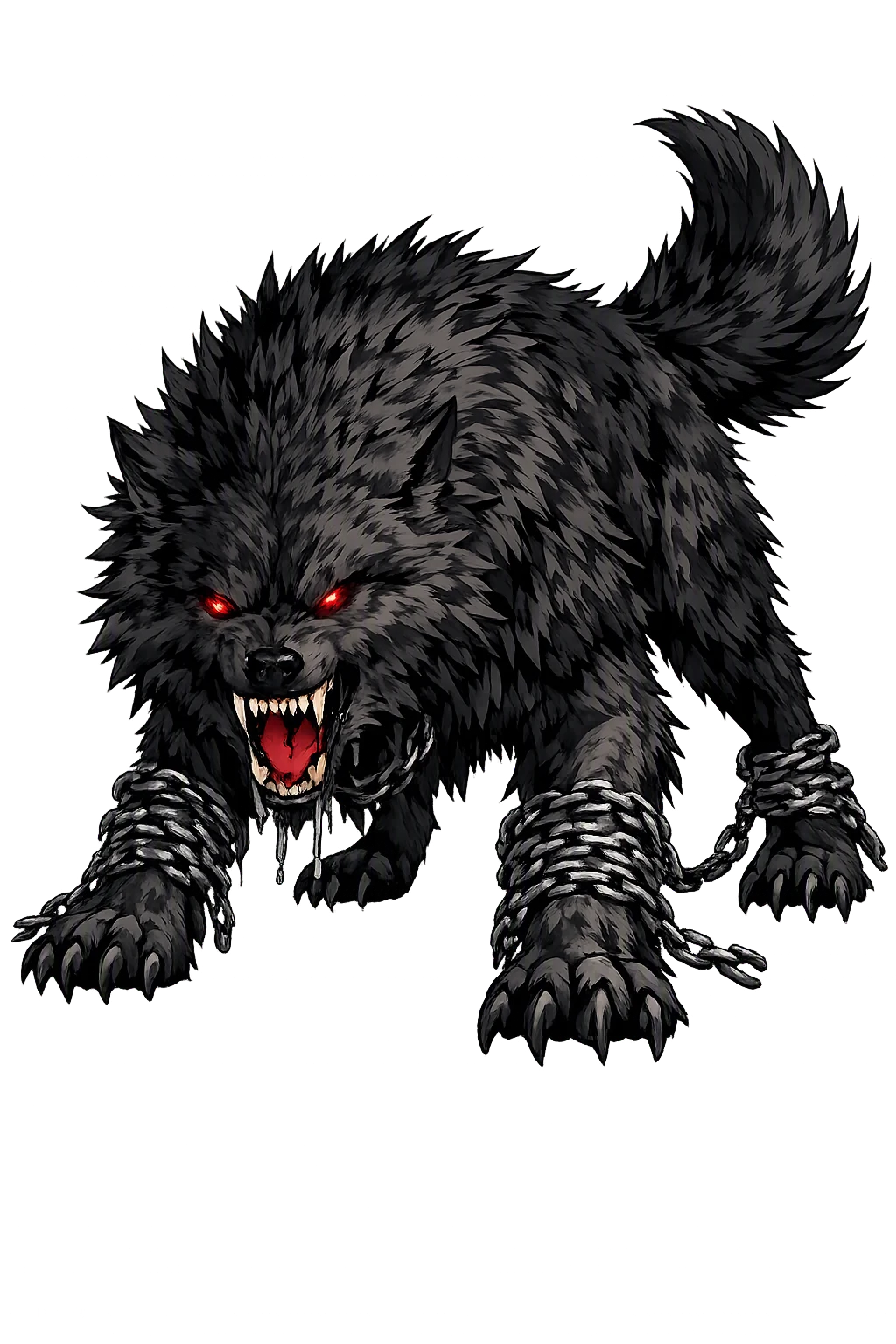
Fenrir is the monstrous wolf of Norse myth — the son of Loki and the giantess Angrboða, reared in the gods' own stronghold because no one dared do otherwise. When the prophecies said he would be Óðinn's death, the Æsir bound him: two fetters of iron broke like string, and the third — Gleipnir, the ribbon made of six things that do not exist — held, at the price of Týr's right hand. Gagged with a sword and chained to a stone beneath the earth, he lies on the isle of Lyngvi until Ragnarök, when he breaks free, swallows the Father of the Slain, and is torn jaw from jaw by Víðarr, the silent avenger.

Fenrir in Later Traditions

Fenrir's closest relative inside his own corpus is the hound Garmr, who breaks his chain before Gnipahellir at Ragnarök and fights Týr to mutual death: Vǫluspá's refrain 'now Garmr howls loud' announces the end, and scholars from Lindow onward have debated whether Garmr is a doublet of the bound wolf or a second beast of the same kennel. The chase-wolves of the sky — Skǫll, who pursues the sun, and Hati Hróðvitnisson, who will take the moon — belong to the same apocalyptic pack, and Vafþrúðnismál gives Fenrir himself the sun-swallowing role, a distribution of doom the sources never fully harmonize. Wider comparisons are made and immediately qualified: Cerberus is the obvious Mediterranean analogue for a chained hell-hound, and the Ironwood's brood of wolves in Vǫluspá has been set beside every Indo-European wolf-pack of the world's end — but Fenrir's story is structurally unique: a monster the gods themselves foster, bind by trickery, and preserve for the apocalypse, because killing him is the one thing their own holiness forbids. His kin in the lexicon are his family: [[loki|Loki]], [[angrboda|Angrboða]], [[jormungandr|Jǫrmungandr]], and [[hel|Hel]] — and [[tyr|Týr]], whose hand is the fetter's true price.

Modern Legacy

Fenrir is the North's most famous monster, and his afterlife runs on two tracks. The scholarly track never stopped: the binding of the wolf was a set-piece of the Victorian Norse revival — the Kearys' Heroes of Asgard (1857) made the fetters and the pledge of Týr's hand a children's classic — and every handbook since has treated Gleipnir's six impossibles as the Edda's signature riddle-image. The popular track is enormous: Marvel's comics gave Thor a recurring Fenris Wolf; J. K. Rowling named her most savage werewolf Fenrir Greyback; the wolf fights through Final Fantasy (where Fenrir is a summoned beast), Smite, and Assassin's Creed Valhalla, and God of War: Ragnarök (2022) built part of its end-of-days on him. The idiom of the bound monster who must not be killed for fear of worse has become a standing political and moral metaphor — the fettered danger whose release is the prophecy. In modern Heathenry Fenrir is no object of cult but the corpus's fixed figure of doom: the destruction the gods themselves are keeping, chained, until the chain is the last thing left.

Unicode Restoration as Cultural Act

Restoring Fenrir in a domain name is more than orthographic accuracy. It is a statement that the internet should recognize the full range of human writing — not only the ASCII keyboard.

05

Frequently Asked Questions

Common questions about Fenrir, Wolf, Destruction, Binding, and Unicode restoration

01How do you pronounce Fenrir?

In reconstructed pronunciation, Fenrir is /ˈfen.rir/ — approximately 'FEN-reer' — a short e as in 'fen', both r's trilled, and the final nominative -r sounded as a light syllabic trill, as in Icelandic..

02What does Fenrir mean?

Fenrir means Fen-dweller (from fen + -ir) in the norse tradition.

03What are the symbols of Fenrir?

Fenrir is associated with Gleipnir (The fetter of six things that do not exist — proof that what binds the unbindable is not strength but impossibility), Týr's hand (The pledge that made the trap honest — justice's price paid in the god of justice's own flesh), The gagging sword (The wolf silenced but never tamed: the gods could stop his bite, not his doom), The river Ván ('Expectation' — the stream of the bound wolf's slaver, flowing from Lyngvi until Ragnarök), Gjǫll and Þviti (The slab and the boulder driven deep into the earth — the world itself recruited as an anchor for the chain).

04Why restore Fenrir in Unicode?

Plain ASCII fenrir strips the stress, length, and script that make the name specific. Unicode restoration returns the name to its original written dignity.

05What is the most important myth about Fenrir?

Hyndluljóð says it in a line: Loki begot the wolf with Angrboða — the giantess 'herald of sorrow' who dwells in Járnviðr, the Ironwood. Snorri names all three children of that union: the wolf Fenrir, Jǫrmungandr the world-serpent, and Hel, who is half the colour of the living and half of the dead. Because all were of giant stock and Loki's, and because the gods had heard prophecies that great harm would come of them, Óðinn had the children fetched.He cast the serpent into the deep sea that lies around all lands, where it grew until it girdled the world; Hel he threw down into Niflheimr and gave her power over nine worlds. But the wolf the Æsir brought home with them and reared in their own stronghold — and only Týr had the courage to go to him and give him food.

06

Scholarly Sources

The philological foundations of this restoration

Every claim on this page is grounded in established scholarship. The orthographic restorations follow disciplinary convention. The etymological chain follows the best available reference works. This is not invention — it is resurrection through scholarship.

Lexicography & Philology

  • Cleasby-Vigfusson
  • Zoëga

Primary Texts

  • Snorri Sturluson, Prose Edda: Gylfaginning 34–35 (the binding of the wolf) and 51 (Ragnarök), trans. Faulkes
  • Poetic Edda: Vafþrúðnismál 46–47, 53 (Fenrir and the sun; Óðinn's doom), trans. Larrington
  • Poetic Edda: Vǫluspá (the Ragnarök stanzas; the Ironwood brood), Grímnismál 17, Lokasenna 38, Hyndluljóð 40

Archaeology & Art History

  • Material evidence — iconography, inscriptions, and temple archaeology — for Fenrir and related cults.
  • Fenrir is an entirely textual monster: no cult site, votive deposit, or runic inscription invokes him, and wolves in the Scandinavian material record are read as Fenrir only by interpretation, never by name. Two famous carvings are the standing candidates. The Gosforth Cross in Cumbria (c. 900–950) carries a panel of a figure rending the jaws of a great beast — a spear in hand, one foot on the lower jaw — within what is widely read as a Ragnarök programme, and the identification with Víðarr and the wolf, argued by Bailey and most subsequent scholars, remains the standard reading, though it is an interpretation, not an inscription. Thorwald's Cross at Kirk Andreas on the Isle of Man (Manx Cross 128, tenth century) shows a figure with a bird on his shoulder and his foot in a wolf's mouth, commonly read as Óðinn devoured at Ragnarök, with his raven still upon him; the Ledberg stone (Ög 181, Sweden) has likewise been given a Ragnarök reading, more controversially. On the textual side, Vǫluspá, Vafþrúðnismál, Grímnismál, and Lokasenna survive in the Codex Regius of the Poetic Edda (GKS 2365 4to, c. 1270), Hyndluljóð in the Flateyjarbók, and Snorri's account of the binding in the Codex Regius of the Prose Edda and its sister codices of the thirteenth and fourteenth centuries.

Religious Studies

  • Cleasby–Vigfusson, An Icelandic-English Dictionary, s.v. Fenrir, Gleipnir, úlfr
  • Zoëga, A Concise Dictionary of Old Icelandic, s.v. Fenrir, Fenrisúlfr, Gleipnir
  • Simek, Dictionary of Northern Mythology; Orchard, Dictionary of Norse Myth and Legend — s.v. Fenrir, Gleipnir, Týr
  • Lindow, Norse Mythology: A Guide — s.v. Fenrir, Garmr (the doublet question)
Return

The Surface Awaits

You have traced the name from its earliest attestation to its Unicode restoration. Now return to the myth. The story is where the name lives.

Back to Lore
Fenrir mascot