
The provenance file on Eurṓpē
The provenance file for Eurṓpē. Nothing here is unsourced; that is what the file is for.
Provenance
1. The attestation. Εὐρώπη — "Broad-faced (from εὐρύς + ὤψ)". On record: Moschus, Europa, Ovid, Metamorphoses 2.836–3.2, Apollodorus, Library 3.1.1–3, Herodotus 4.45.
2. The preserved evidence. e → ē (Eta: long vowel) — absent from the ASCII form europe, present in the restoration, verifiable against the sources above.
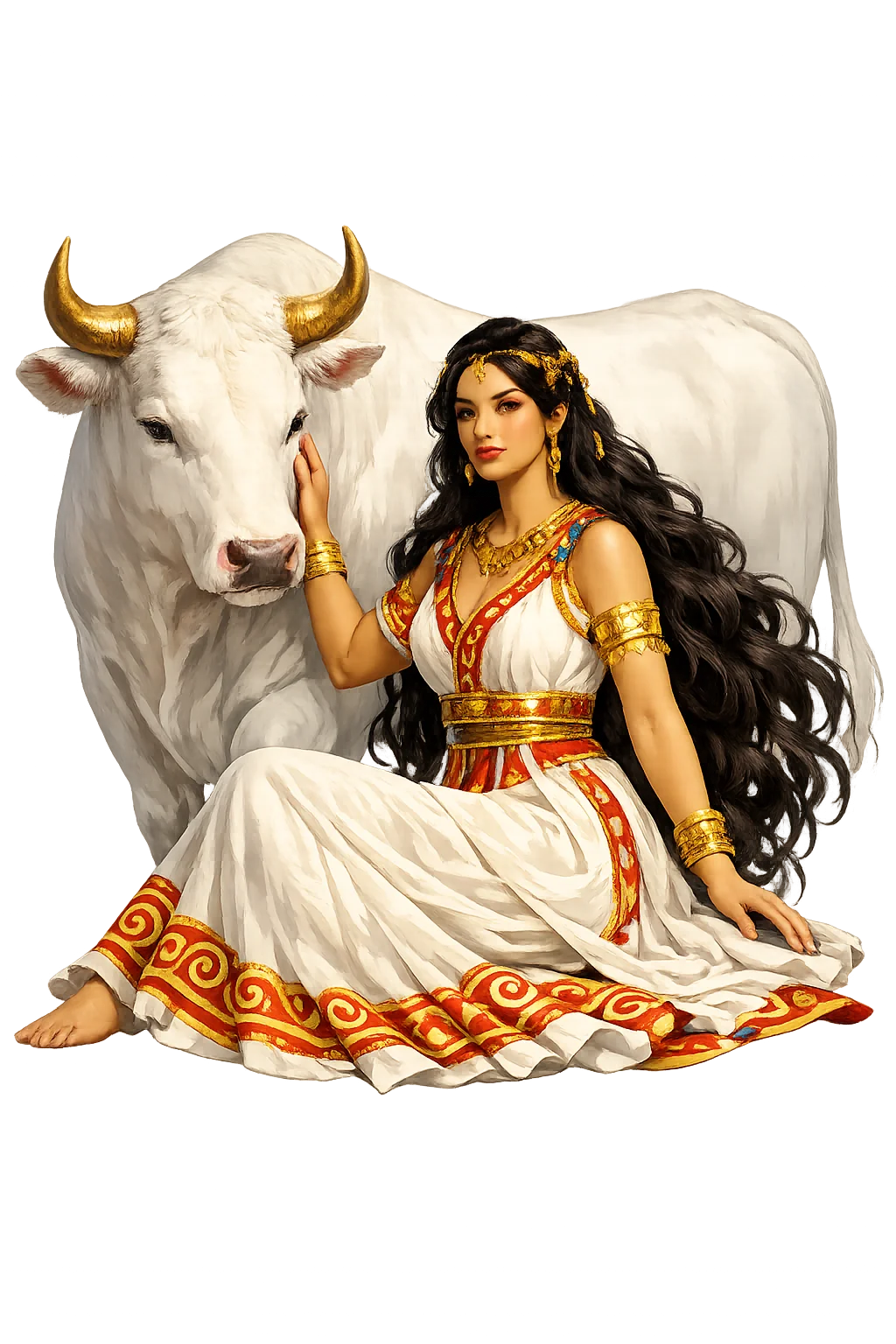
3. The narrative record. Two Lands Quarrel over a Girl — In Moschus' little epic Europa (2nd century BCE) the story opens inside a dream. The Tyrian princess sleeps, and two women struggle over her body: one in foreign dress, one Greek-speaking — Asia and Europe, fighting for the girl (Moschus, Europa 1–45). Carried Across the Sea — Europa climbed onto the bull's back among the flowers, and the beast plunged into the sea. Moschus (Europa 46–165) makes the crossing gorgeous and terrifying: her veil streams, the Nereids rise and dance, Poseidon leads his train beneath the waves, and still she clutches one horn, her free arm lifted to the vanishing shore.
4. The physical record. Europa's oldest described image in art is lost but recorded: the cedar chest of Cypselus at Olympia (before 580 BCE) showed her riding the bull, and Pausanias (5.19.1) noted the scene among its earliest panels. Coins of Gortyn in Crete — the city of her landing — carry the motif from archaic times onward: the girl in the branches of the sacred plane tree, the bull beside her. That tree had a long afterlife: travellers were shown the plane of Gortyn under which Zeus lay with Europa well into late antiquity (Procopius, Buildings 4). Roman floor mosaics from North Africa to the Levant repeat the sea-crossing, and fragments from Antioch and Apamea keep her sidesaddle on the bull across the whole empire.
5. The current holding. The temple at /europe/, classified Tier 1. Tier-1 is not a compliment; it is a measurement. This restoration keeps something the ASCII form provably loses, and the measurement is repeatable.
6. The documented resonances. Travel, Tourism & Place Branding, Mapping & Geospatial, Ancestry & Heritage Services — seats argued and weighted in the pattern atlas, read through the myths in this temple's Resonance File.
7. The primary sources. Theogony, Homeric Hymns, Works and Days — the library this file answers to, open at the Sacred Texts collection.
8. The continuing record. Europa is the only continent whose name carries a story, and the story is an abduction — the West named for a girl carried west. Greek 2-euro coins strike her riding the bull; the European Central Bank chose her face as the hologram of its banknotes; an ocean moon of Jupiter bears her name over a sea of ice.
At a Glance
- Restored name: Eurṓpē
- ASCII form: europe
- Meaning: "Broad-faced (from εὐρύς + ὤψ)"
- Domain of influence: Personified Continent of Europe
- Pantheon: Greek
- Classification: Tier 1
- Original script: Εὐρώπη
- Series: The Restoration Files, No. 153 of 546
The File Continues
Read the founding dispatch for the name's full story, the Resonance File for the archetype at work — or the whole archive in one sitting.
Continue the series — previous file: Ẹṣù (read it here) · next file: Fáfnir (read it here).
The Restoration Files are written from the same canonical record as the temples themselves: the lexicon, the lore catalog, the pattern atlas, and the cited scholarly sources. If a file ever disagrees with its temple, the temple is right — tell us, and the file will be corrected.