PuniCodex

Extended Lore

Εὐρώπη Eurṓpē

Etymology · Orthography · Cult · Iconography · Reception · Sources

Tier 1 Eurṓpē.com · Eurōpē.com
Eurṓpē — Personified Continent of Europe
01

Quick Facts

Essential information about Eurṓpē, Personified Continent of Europe

Original ScriptΕὐρώπη
Unicode RestorationEurṓpē
Reconstructed Pronunciation/eu̯.ˈrɔː.pɛː/
PantheonGreek
DomainPersonified Continent of Europe
MeaningBroad-faced (from εὐρύς + ὤψ)
ClassificationTier 1
Primary DomainEurṓpē.com
Sacred SymbolsBull of Zeus, Cretan labyrinth, Plane tree (plátanos), Continental crown, Phoenician prow
02

Etymology & Word Family

From original script to Unicode restoration

Proto-indo-european *h₁rewr- wide, broad
Original Script Εὐρώπη Eurṓpē — "Broad-faced (from εὐρύς + ὤψ)"
Unicode Restoration Eurṓpē Restored stress, length, and script
Modern ASCII europe Plain-ASCII fallback

From εὐρύς "wide" + ὤψ "face, eye". Broad-faced.

03

Unicode Character Breakdown

Character-by-character philological analysis

CharacterUnicodeNameBlockPhonetic Role
EU+0045Latin Capital Letter EBasic LatinEpsilon
uU+0075Latin Small Letter UBasic LatinUpsilon
rU+0072Latin Small Letter RBasic LatinRho
ṓU+1E53Latin Small Letter O with Macron and AcuteUnknownOmega with acute and length
pU+0070Latin Small Letter PBasic LatinPi
ēU+0113Latin Small Letter E with MacronLatin Extended-AEta: long vowel

The Tier 1 classification reflects how much of the original phonology this restoration preserves — stress and vowel length for Greek names, distinctive letters and diacritics for every other tradition.

04

Cult & Worship

How the sacred was kept — rites, sanctuaries, remains

The Cult

Europa the Tyrian girl was never a goddess, and no altar, priesthood, or festival bears her name. Her cult, if the word can stretch, was topographic: at Gortyn in Crete, the city of her landing, travellers were shown for a thousand years the plane tree under which Zeus lay with her and the spring beside it — sacred geography rather than temple. Procopius, writing in the sixth century CE, says the tree was still being pointed out to visitors then, and Gortyn's coinage, which stamped Europa in the branches as the city's badge across the archaic and classical centuries, is the nearest thing to a civic cult image she ever had. Her brothers' search gave her a hero's legend; the Cretans gave her a landscape. Everything else that bears her name came later, and none of it required worship.

In the Earth

Europa's oldest described image in art is lost but recorded: the cedar chest of Cypselus at Olympia (before 580 BCE) showed her riding the bull, and Pausanias (5.19.1) noted the scene among its earliest panels. Coins of Gortyn in Crete — the city of her landing — carry the motif from archaic times onward: the girl in the branches of the sacred plane tree, the bull beside her. That tree had a long afterlife: travellers were shown the plane of Gortyn under which Zeus lay with Europa well into late antiquity (Procopius, Buildings 4). Roman floor mosaics from North Africa to the Levant repeat the sea-crossing, and fragments from Antioch and Apamea keep her sidesaddle on the bull across the whole empire.

05

Iconography

How Eurṓpē was imaged across the ages

The Image

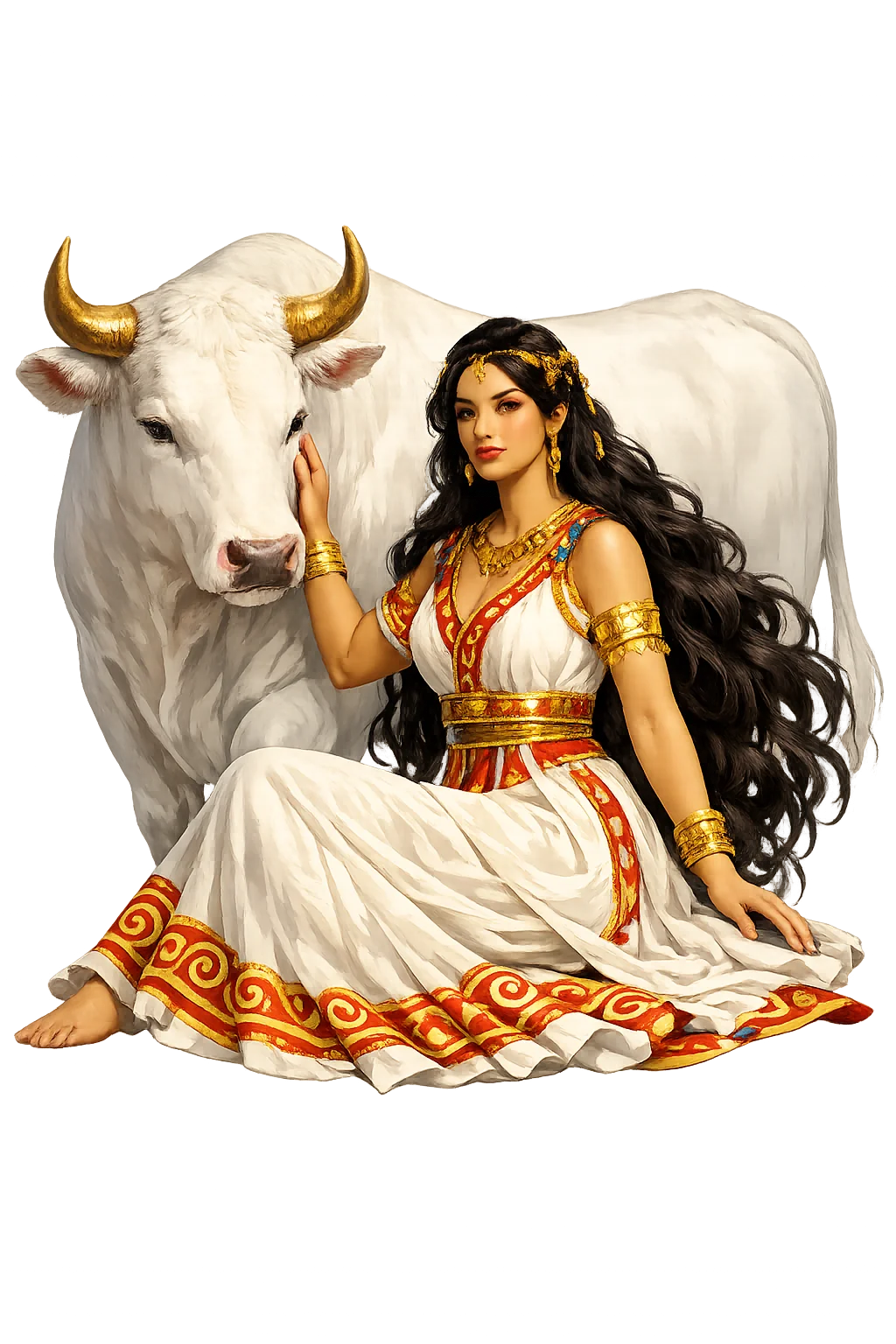
Europa's iconography is one of antiquity's most durable images, and its formula was set remarkably early. The oldest description we have — the cedar chest of Cypselus at Olympia, before 580 BCE — already showed her on the bull, and archaic Gortyn kept her there as its badge: the girl seated sidesaddle among the branches of the plane tree, the bull standing guard. From the classical period the elements never move again: the great white bull with lowered head, the rider gripping one horn, the veil blown into a billowing arc that mirrors the animal's back — a composition red-figure painters perfected, Hellenistic gem-cutters miniaturized, and Roman mosaicists spread across the eastern and southern Mediterranean. Artists loved the moment of maximum unease, the girl mid-crossing with her free hand lifted to the vanishing shore. She is recognizable at a hundred paces still: the only continent whose portrait everyone has seen.

06

Reception & Transformation

The name after its own age — transmission, translation, survival

Afterlives

Europa survived as a name before she survived as a story. Strabo's first book already puzzles over where her continent ends; Pliny carried the division into Latin natural history, Isidore into the medieval encyclopedia, and the medieval world maps quartered the known earth with it — Europa shrunk to the lower-left of every T-O map. The Renaissance re-measured her: Ptolemy's Geography, translated in 1406, let cartographers draw her coasts, and by 1570 Ortelius could print an atlas page titled simply Europa. Then the philologists took up the quarrel Herodotus had reported: nineteenth-century Semitists heard the Phoenician ʿereb, 'west, sunset', in her name, while Greek scholarship kept the old native gloss eurū-ops, 'broad-faced' — a debate that never closed, because a continent named by either etymology remains a name, not a fact. What no scholar could explain away is the myth's permanent freshness: a girl carried west from the East, riding into every atlas ever printed.

Identifications Across Traditions

Rome took the myth without building her a cult — no temple of Europa stood in the city; she persisted as an image. Roman floor mosaics across the empire, from North Africa to Syria, spread the bull-riding princess through the provinces, and Ovid's retelling made her a set piece of school recitation. The Middle Ages allegorized her: in the Ovide moralisé tradition the bull became Christ, carrying the soul-Europa across the sea of the world to salvation. The modern age re-materialized her: when Galileo's moons needed names, Simon Marius called the second one Europa (1614); Titian's Rape of Europa (c. 1562) hangs in Boston as the myth's supreme painting; and since 2013 her portrait watermarks every banknote of the euro's 'Europa series'. A Phoenician girl abducted by a god now certifies the currency of a continent she never saw — the strangest promotion in mythology.

Modern Legacy

Europa is the only continent whose name carries a story, and the story is an abduction — the West named for a girl carried west. Greek 2-euro coins strike her riding the bull; the European Central Bank chose her face as the hologram of its banknotes; an ocean moon of Jupiter bears her name over a sea of ice. In scholarship her myth became a textbook of method: Herodotus doubting the etymology, Hesiod giving a different father, Homer a different son for Sarpedon — a case study in how stories accrete around names. Every map of Europe is, in the end, a retelling of Moschus' dream: two lands quarrelling over a girl, and the girl becoming the prize.

07

The Meditation

What Eurṓpē means — beyond the dictionary

What does it mean that a civilization named itself after an abducted teenager? Europa's myth is the myth of eponymy itself — the moment a story hardens into a label. The Greeks needed the West to have a face, and chose an Eastern one: Europe is named for an import, carried across the sea it now borders.

That is a more honest foundation than most. Continents are conventions, lines argued over by geographers and empires; Europa's story admits as much while insisting the convention still needs a soul. Every time the name is spoken — in councils, on coins, on a moon of Jupiter — the old dream flickers: two lands quarrelling over one girl, and the girl, who had no say in any of it, outlasting both the quarrel and the lands.

08

Frequently Asked Questions

Common questions about Eurṓpē, Personified Continent of Europe, and Unicode restoration

01How do you pronounce Eurṓpē?

In reconstructed pronunciation, Eurṓpē is /eu̯.ˈrɔː.pɛː/ — approximately 'ehv-ROH-pay' — begin with a quick 'eh-oo' glide, hold the 'roh' long, and finish with a stretched 'pay'.

02What does Eurṓpē mean?

Eurṓpē means Broad-faced (from εὐρύς + ὤψ) in the greek tradition.

03What are the symbols of Eurṓpē?

Eurṓpē is associated with Bull of Zeus (The disguise in which Zeus carried the Phoenician princess across the sea), Cretan labyrinth (The island where Zeus's love for Europa produced Minos and the Minoan line), Plane tree (plátanos) (The shade-tree under which Europa rested at Gortyn, shown to travellers into late antiquity), Continental crown (The personified continent enthroned, adapted from Hellenistic and Roman iconography), Phoenician prow (Europa's origin as a Tyrian princess carried westward by a god).

04Why are there different spellings of Eurṓpē?

Each form is a historically attested restoration rather than a mistake: Eurōpē is the alt form (Latin form Eurōpa; the temple uses the Greek Eurṓpē.). PUNICODEX registers the full set so the tradition is preserved under every defensible spelling.

05Why restore Eurṓpē in Unicode?

Plain ASCII europe strips the stress, length, and script that make the name specific. Unicode restoration returns the name to its original written dignity.

06What is the most important myth about Eurṓpē?

“Two Lands Quarrel over a Girl” — the The Dream story that anchors the mythology of Eurṓpē, told in full on the lore page.

09

Scholarly Sources

The philological foundations of this restoration

Every claim on this page is grounded in established scholarship. The orthographic restorations follow disciplinary convention. The etymological chain follows the best available reference works. This is not invention — it is resurrection through scholarship.

◈

Lexicography & Philology

  • Liddell, H. G., Scott, R., & Jones, H. S. A Greek-English Lexicon. Oxford: Clarendon Press, 9th ed. 1996.
  • Herodotus
◎

Primary Texts

  • Ovid, Metamorphoses 2.836–3.2
  • Apollodorus, Library 3.1.1–3
  • Homer, Iliad 14.321–322; 6.198–199
  • Pausanias 5.19.1
◉

Archaeology & Art History

  • Material evidence — iconography, inscriptions, and temple archaeology — for Eurṓpē and related cults.
✦

Religious Studies

  • Moschus, Europa
  • Herodotus 4.45
Return

The Surface Awaits

You have traced the name from its earliest attestation to its Unicode restoration. Now return to the myth. The story is where the name lives.

Back to Lore
Eurṓpē mascot