
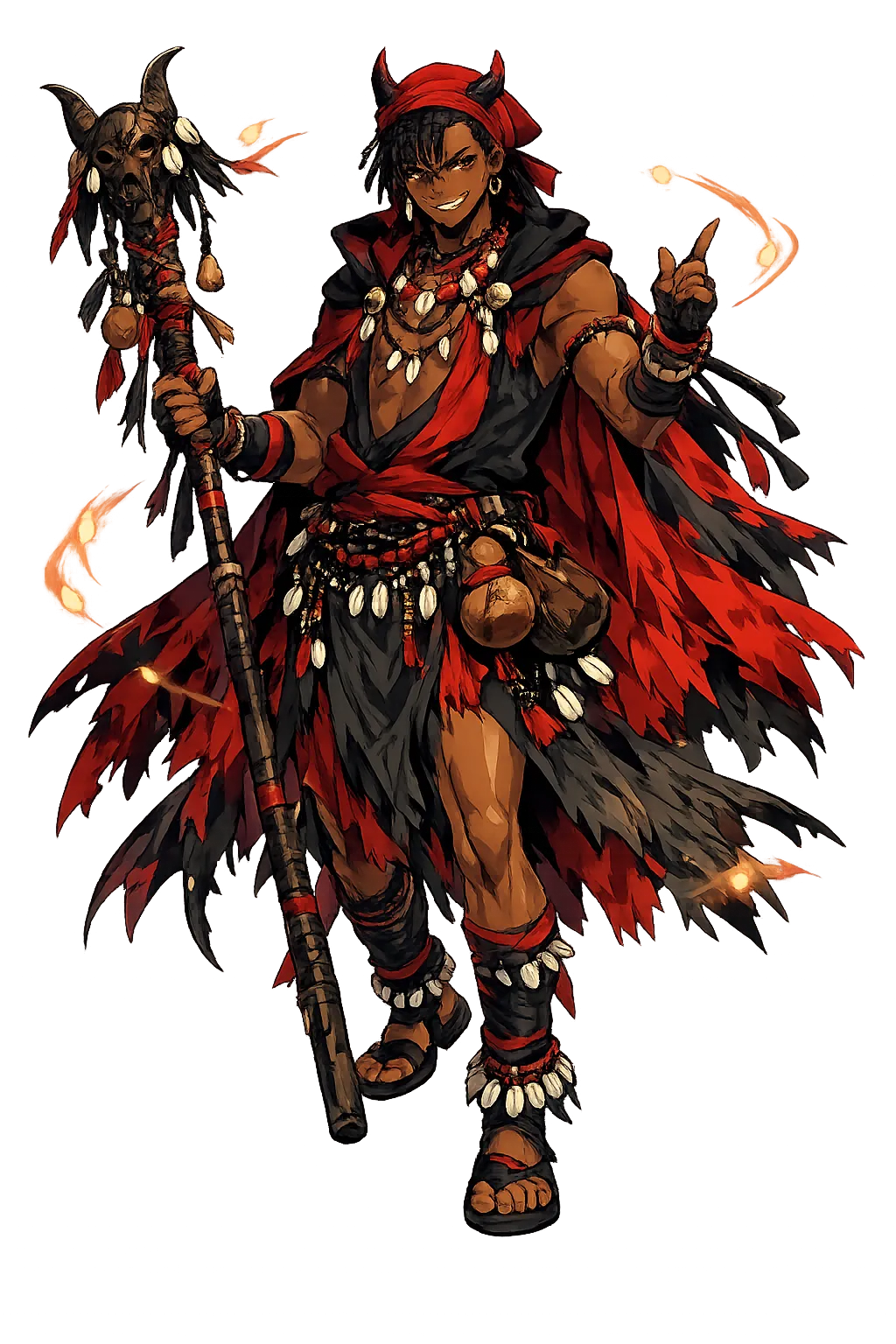
From Yoruba (modern Latin orthography) to Unicode: the journey of Ẹṣù
Long before it was a domain, this name traveled through scripts. Ẹṣù begins in Yoruba (modern Latin orthography), passes through scholarly transliteration, and ends — for now — inside the punycode machinery of the global DNS. Each stage of that journey preserves some information and loses some, and the craft of restoration is knowing exactly which marks matter. This post follows the name stage by stage: the original script, the reconstructed pronunciation, the mythological record, the material evidence, and finally the Unicode form that carries all of it into the address bar. Think of it as a biography of a name, told through its spelling.
At a Glance
- Restored name: Ẹṣù
- ASCII form: eshu
- Meaning: "Divine trickster"
- Domain of influence: Trickery, Crossroads, Messenger
- Pantheon: Yoruba
- Restoration: Preserves stress
- Original script: Ẹ̀ṣù (Yoruba (modern Latin orthography))
- Live domain: ẹṣù.com
Overview
Ẹṣu (eshu) — Trickery, Crossroads, Messenger · Divine trickster — belongs to the Yoruba tradition, where it is catalogued under the domain "Trickery, Crossroads, Messenger". The name means "Divine trickster".
Ẹṣu is the divine linguist, the trickster who stands at the crossroads where choices divide. He is the messenger who carries sacrifices from humans to the orishas, and the one who tests the proud by showing them the consequences of their own words. Without Ẹṣu, no prayer reaches the gods; with Ẹṣu, no promise is safe from misinterpretation.
He is neither good nor evil in the Christian sense. He is the principle of indeterminacy — the moment before a choice, the pun that undoes a contract, the road not taken.
PuniCodex restores the name as Ẹṣu and serves its temple at ẹṣu.com. The restoration preserves the subscript dots of the scholarly transliteration — distinctive features the ASCII form loses —. The plain ASCII form eshu survives as a modern convenience imposed by the early domain-name system; the restoration, not the fallback, is the form the project defends as philologically complete.
The Name
No indigenous written attestation survives for this name; Ẹṣu is a scholarly transliteration of the reconstructed spoken form. Etymologically the name means "Divine trickster".
The ASCII form eshu survives only because the early domain-name system could not carry diacritics; it is a technological compromise, not an ancient spelling. The Unicode restoration Ẹṣu recovers the full diacritic detail of the scholarly transliteration directly in the address bar. The restoration preserves the subscript dots of the scholarly transliteration — distinctive features the ASCII form loses —.
The letter-by-letter transformation runs:
- e → Ẹ — E with dot below
- s → ṣ — S with dot below
- h → — — Not written
- u → u — Same
The project holds the domain ẹṣu.com (xn--u-hrm7o.com) as the canonical home of this name.
The Original Script
The Yoruba language had no phonetic writing system before the nineteenth century; the name Ẹṣu and his praise names — Ẹlẹ́gbára, Bàrà — were transmitted orally in the Ifá corpus, in oríkì praise poetry, and in the invocations that open every rite. The first printed records of the language are mission vocabularies: John Raban's A Vocabulary of the Eyo or Aku (1830–1832), then Samuel Ajayi Crowther's A Vocabulary of the Yoruba Language (1843) and his Grammar and Vocabulary of the Yoruba Language (1852).
Modern standard Yoruba orthography, codified from Ayo Bamgbose's 1965 study and the 1966 Yoruba Orthography Committee, writes the name Èṣù: ẹ with a sub-dot marks the open vowel [ɛ] against e [e], ṣ with a sub-dot marks the fricative [ʃ] against s [s], and grave accents mark the low tones. The temple form Ẹṣu keeps the quality dots and leaves tone unmarked; diaspora spellings such as Exu and Echu record the same spoken name through Portuguese and Spanish orthographies.
Pronunciation
The reconstructed pronunciation of the name is /ɛ̀.ʃù/ — Yoruba Reconstruction.
Phoneme by phoneme:
- Ẹ- — Open-mid front unrounded vowel [ɛ] with low tone, written with a dot below in standard Yoruba orthography.
- -ṣu — Voiceless postalveolar fricative [ʃ] with dot below, followed by close back rounded vowel [u] with low tone; standard orthography writes the name Èṣù, low on both syllables.
For the modern speaker, the closest approximation is: EH-shoo — both syllables low and level; the melody falls, it does not rise.
Kindred and historical forms of the name:
- Yoruba — Ẹṣu, the divine trickster, messenger, and guardian of the crossroads.
- Brazilian Candomblé — Exu, the opener of roads, often syncretised with the devil in popular Catholic imagination.
- Cuban Santería — Eleguá, the child-like messenger who stands at the threshold.
Ẹṣu preserves both features: the dot below ẹ marks the open vowel [ɛ] and the dot below ṣ marks the fricative [ʃ] — distinctive features the ASCII form loses; the temple form leaves tone unmarked, while standard orthography writes Èṣù with low tones on both syllables. The name is often wrongly conflated with the Christian devil; in Yoruba religion he is a necessary divine functionary, not an evil being.
Mythology
Ẹṣu's mythology is a catalogue of tricks, translations, and tests. He is the figure who makes meaning unstable and therefore alive.
Ẹṣu and the Two Friends (Ifá)
Two farmers who were close friends swore they would never quarrel. Ẹṣu, walking between their fields, wore a hat that was red on one side and black on the other. After he passed, one friend said the hat was red; the other insisted it was black. The argument grew so fierce that they came to blows. Ẹṣu then appeared and turned his hat around, showing that both were right and both were wrong. The story is a lesson in perspective and the dangers of certainty.
The Messenger Who Must Be Fed First (Cosmology)
In Yoruba ritual, Ẹṣu must be honoured before any other orisha. Sacrifices intended for Ọṣun or Ṣàngó will not reach their destination if Ẹṣu is ignored. He is the gatekeeper, the postal system of the sacred, and like any messenger he expects to be paid. To neglect him is to find that prayers go astray.
The Punisher of Pride (Trickster)
Ẹṣu specialises in bringing down the arrogant. He overhears boasts, twists promises, and arranges coincidences that expose hidden motives. His tricks are not random cruelty; they are pedagogy. The person who falls into Ẹṣu's trap usually built it themselves.
The Two Friends and the Two-Colored Hat (Ifá)
Two farmers worked adjoining fields, and they were so close that they swore an oath: whatever fortune came to one would be shared with the other. Ẹṣu, walking between their farms one day, wore a hat that was red on one side and black on the other. After he had passed, the first farmer said: 'Did you see the man in the red hat?' The second answered: 'He wore a black hat.' Each was certain; each called the other a liar; the quarrel rose from words to blows, and the friendship — and the oath — lay in ruins. Then Ẹṣu returned, turned his hat around, and showed them its two faces, and both men saw at once that each had told the truth and each had been wrong. The tale, preserved in the Odu Ifá corpus and recorded by William Bascom (Ifa Divination, 1969), is the trickster's masterpiece of instruction: certainty is the tribute certainty pays to itself, and the man who will not doubt his own eyes can be set at war with his best friend by a piece of headwear.
The Market of Discord (Ifá)
The deepest Ẹṣu narrative explains his title of linguist. Two friends quarreled so badly that they stopped speaking and divided their property down to a single disputed knot of land. Ẹṣu saw his opportunity: he went to the first man as an old friend of the second, and to the second as an old friend of the first, carrying messages between them — and deliberately garbling each one, reporting mockery where apology had been sent, until the former friends were ready to kill each other. At the height of the feud he confessed what he had done, and the two men, mortified, begged his help in making peace. Ẹṣu mediated the reconciliation — for a handsome fee — and the market where they finally met and traded again was named for him. The tale, again from the Odu corpus as recorded by Bascom, is at once sociology and metaphysics: where speech is possible, misunderstanding is a profession, and the professional who profits from confusion is also, unavoidably, the only broker of peace.
Symbols & Iconography
The iconography associated with Ẹṣu concentrates in a small set of recurring attributes, each a compressed statement about the name:
- Crossroads stone — A small cement head or stone placed at doorways and intersections as his dwelling.
- Red and black beads — The colours of danger, desire, and the boundary between life and death.
- Cigar and rum — Pleasures of the threshold; he accepts what others deny.
- Phallus or trickster stick — Vital force, mischief, and the disruptive energy that starts change.
In Yorubaland his images are among the most abundant of any power's: carved wooden figures studded with cowries — the money of the road — stood in shrines and at town gates, and field ethnography recorded laterite and stone Ẹṣu at compound thresholds. Candomblé preserves the same logic of placement: Exu's consecrated seat is set outside the inner sanctuary, at the entrance of the cult house, because the messenger belongs to the threshold and not the throne.
Archaeology & Evidence
Ẹṣu is among the most materially represented of all Yoruba powers. His images — carved wooden figures, often male, frequently studded with cowries and paired with clubs or staffs — have been collected and documented by ethnographers since the nineteenth century, alongside the humbler and equally characteristic form of the laterite lump or stone set at the town gate, the market entrance, or the compound threshold and anointed with palm oil at the start of undertakings.
The diaspora continued the material tradition without interruption: Eleguá's small cement heads behind Cuban doors and Exu's gated seat at the entrance of Candomblé houses descend directly from the Yoruba threshold stone. Colonial and missionary observers, mistaking the figure for the devil, often destroyed or demonised such images — a hostile reception that itself became part of the record.
Realm & Domain
Ẹṣu is the divine linguist, the trickster who stands at the crossroads where choices divide. He is the messenger who carries sacrifices from humans to the orishas, and the one who tests the proud by showing them the consequences of their own words. Without Ẹṣu, no prayer reaches the gods; with Ẹṣu, no promise is safe from misinterpretation.
He is neither good nor evil in the Christian sense. He is the principle of indeterminacy — the moment before a choice, the pun that undoes a contract, the road not taken.
Crossroads
Every intersection is his altar; every choice is his domain.
Divine Messenger
He carries prayers and sacrifices to the orishas and brings their answers back.
Trickster
He exposes hypocrisy and punishes those who forget that language has two edges.
Opener of Roads
No enterprise begins safely without his permission; he removes or places obstacles.
Across Cultures
Colonial missionaries and enslavers misunderstood Ẹṣu as the devil, an equation that has caused centuries of distortion. In Brazilian Candomblé he became Exu, syncretised with devils and trickster saints but still honoured as essential to ritual. In Cuban Santería he split into Eleguá, the child-like road-opener, and Exú, the more dangerous trickster. The Yoruba original is not demonic; he is the necessary principle of ambiguity that makes choice, language, and sacrifice possible.
Kindred figures in the PuniCodex cross-tradition index include Hermês and Íris, each linked through messenger / travel / commerce.
Cultural Legacy
Ẹṣu's legacy is complex. On one hand, he is one of the most misunderstood African deities in the world, repeatedly equated with Satan by outsiders — an equation Idowu corrects explicitly, insisting that the Yoruba figure is a divine functionary and no enemy of God. On the other hand, he is indispensable to Afro-Atlantic religion and a powerful figure in African diaspora thought: in The Signifying Monkey (1988), Henry Louis Gates Jr. made Esu-Elegbara the trope of interpretation itself — the double-voiced, indeterminate reader stationed at the crossroads of the Black literary tradition.
In Brazil, Exu's demonisation in the popular Catholic imagination has made him a rallying point in campaigns against intolerance toward Candomblé and Umbanda, where he remains the indispensable opener of every rite. In ritual, he remains the first orisha honoured in every ceremony.
The Scholarly Record
The account of Ẹṣu given in this edition rests on the witnesses and reference works listed below. Bascom's field studies document his cult and his divinatory role; Idowu supplies the theological correction of the devil equation; Gates carries the figure into literary theory.
- Bascom, William, Ifa Divination: Communication Between Gods and Men in West Africa, Indiana University Press, 1969 — field documentation of Ẹṣu's place in the divination system. Full text
- Gates, Henry Louis, Jr., The Signifying Monkey: A Theory of Afro-American Literary Criticism, Oxford University Press, 1988 — Esu-Elegbara as the figure of interpretation in the Black Atlantic tradition. Full text
- Idowu, E. Bolaji, Olódùmarè: God in Yoruba Belief, Longmans, 1962 — the theological account of Èṣù, including the explicit denial that he is the devil. Full text
- Mason, John, Four New World Yoruba Rituals, Yoruba Theological Archministry — diaspora ritual practice.
- Verger, Pierre, Notes sur le Culte des Orisa et Vodun, IFAN, Dakar, 1957 — ethnography of orisha cults in West Africa and Bahia.
- Murphy, Joseph M., Santería: An African Religion in America, Beacon Press, 1988 — Eleguá and the road-opening rites of Cuban Santería. Full text
A Meditation
Ẹṣu is the god of the threshold — not because he prevents passage but because passage requires him. Every crossroads is a small death and a small birth: you cannot take both roads, and the road you take becomes your life. Ẹṣu stands there laughing because he knows that the choice is always partly arbitrary and partly inevitable.
To honour him is to admit that we do not control meaning. Our words go places we did not send them; our sacrifices are intercepted by our own pride; our certainties look different from the other side of the hat. Ẹṣu is not the enemy of clarity but its guardian. He makes sure that no one gets too clear too soon, because absolute clarity is usually a form of blindness.
The Unicode Restoration
Ẹṣù preserves stress. The ASCII fallback eshu still resolves everywhere, but it is the restored form that carries the name's full information. Across the 4 characters of the name, the restoration adjusts 4: 1 mark of stress (ù); 3 further adjustments (Ẹ, ṣ, h). That is the whole thesis of this temple: the marks are the message.
The Domain Name
The restored name is live as a working domain: ẹṣù.com, which the DNS carries in punycode form as xn--qda371mmha.com — an ASCII-compatible encoding that lets a non-ASCII name travel the global network without breaking older infrastructure. The visitor sees Ẹṣù; the machines see the encoding. That duality is the engineering compromise on which the entire restoration rests, and it is why a name written the way its own tradition wrote it in Yoruba (modern Latin orthography) can now be typed into any browser on earth.
Why This Restoration Matters
Every stage of the journey from Yoruba (modern Latin orthography) to Unicode was an act of care: the scribe who first wrote the name, the lexicographer who glossed it, the engineer who taught the DNS to carry it. The PuniCodex restoration is the latest stage, not the last word — the Scholarly Edition is revised as the evidence improves. What does not change is the principle: a name deserves to be written the way its own tradition wrote it. Ẹṣù in the address bar is that principle, made routable.
Explore Further
This post is one doorway into the temple. The home page carries the full character breakdown and the ambient canvas; the lore page tells the myths in long form; the Scholarly Edition preserves the sources, pronunciation data, and revision history; and the patron wall supports the restoration directly. For the wider map, browse the Lexicon, explore the Pantheon, or return to the PuniCodex blog.
Related Names
Sources
The full scholarly apparatus — every citation, revision, and review — lives in the Scholarly Edition. Key references for this post:
- Idowu, Olódùmarè: God in Yoruba Belief, Longmans, 1962.
- Crowther, A Grammar and Vocabulary of the Yoruba Language, Seeleys, 1852.
- Abraham, Dictionary of Modern Yoruba, University of London Press, 1958.
- Bascom, The Yoruba of Southwestern Nigeria, Holt, Rinehart and Winston, 1969.
- Gates, The Signifying Monkey, Oxford University Press, 1988.
- Bascom, William, Ifa Divination: Communication Between Gods and Men in West Africa, Indiana University Press, 1969.
- Bascom, Ifa Divination.
- Gates, The Signifying Monkey.
- Idowu, Olódùmarè: God in Yoruba Belief.
- Murphy, Santería: African Spirits in America.
- Lexicon authorities for this entry: Abraham.