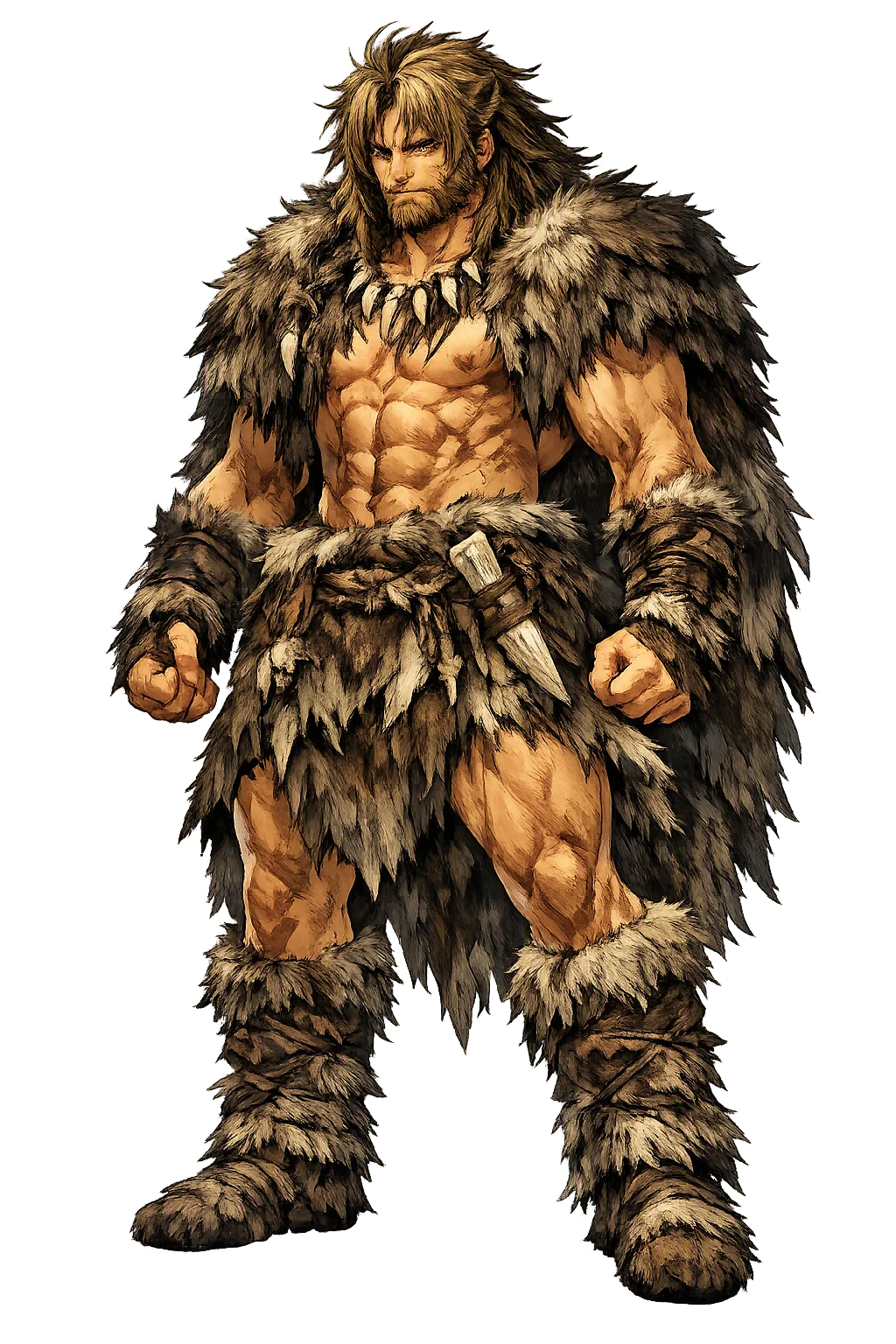
Stories of Enkidu
Enkidu's story is told in Sumerian poems and in the Standard Babylonian Epic of Gilgamesh. He is not a king or a god but the necessary other: the mirror in which Gilgamesh first sees himself, and the corpse that teaches him that no human life is endless.
When the people of Uruk cry out against Gilgamesh's tyranny, the gods instruct the birth-goddess Aruru to create a rival. She washes her hands, pinches off clay, and casts it into the steppe — and Enkidu is born, a wild man shaggy with hair, clothed in pelts like an animal, knowing neither people nor bread nor beer. He eats grass with the gazelles, jostles the beasts at the watering hole, and frees the game from the hunters' traps until a trapper, losing his livelihood, carries the complaint to Gilgamesh in Uruk (Epic of Gilgamesh, Tablet I; the older Sumerian cycle already knows him as Bilgames's companion, ETCSL 1.8.1.4–1.8.1.5).
The epic's first move is to make the problem and its answer from the same substance: tyrant and remedy are both molded, one by a mother, one by a goddess.
Gilgamesh sends the temple-woman Shamhat to the watering hole. For six days and seven nights she lies with Enkidu in the reeds; afterward the gazelles bolt from him, and the wild beasts of the steppe flee his side — he has crossed out of nature and cannot return. She feeds him bread and strong drink, clothing his nakedness, and he becomes her pupil: speech, city ways, the wearing of garments. Shepherds take him in and teach him to guard the flocks; his strength, once spent freeing game, now drives lions and wolves from the fold. Then Shamhat tells him of Gilgamesh, of the king who oppresses Uruk, and she leads him by the hand toward the city gates (Epic of Gilgamesh, Tablet I).
Civilization arrives as knowledge and loss together: he gains a tongue and loses the herd, traded in a single week.
At the door of a bridal chamber Gilgamesh is about to exercise his royal right — to lie with a bride before the groom — when a stranger bars the way. They grapple in the street like two bulls, and the doorposts shatter under the force of it, until Gilgamesh throws the challenger and, breathless, stands over him. Enkidu yields with a sentence that turns the epic: 'There is no mother who bore me who can match your mother' — he acknowledges the king's greater lineage, and Gilgamesh, hearing it, embraces him as a brother (Tablet II). The tyrant has met his equal at last, and the equal has found a purpose: each becomes what the other lacked.
The fight is the friendship: the epic founds its deepest bond not on agreement but on a drawn match between equals.
Gilgamesh proposes the expedition that will define them: to the far Cedar Forest, to fell its sacred timber and kill its warden, Humbaba, the monster Enlil set there 'to roar like a storm-flood' and keep men at bay. Enkidu knows the country and argues against the journey — 'my friend, we have reduced the forest [in old days]... how shall we answer?' — but he will not let his friend go alone. The elders of Uruk, seeing who loves whom, charge Enkidu with a single duty: protect the king. After weeks of marching the friends corner Humbaba, and the sun-god Shamash binds him with thirteen winds; disarmed, the monster pleads for his life. It is Enkidu who urges the killing blow (Tablets III–V).
The victory is the transgression: by slaying Enlil's warden they sign the warrant one of them will pay for.
Ishtar offers herself to Gilgamesh; he answers with a catalogue of her ruined lovers and sends her off in fury. She climbs to heaven and demands the Bull of Heaven from Anu, threatening to smash the gates of the underworld and loose the dead upon the living if refused. Anu warns that the bull means seven years of famine; Ishtar answers that she has stored grain against it. The bull descends on Uruk, and at each snort the earth opens a pit that swallows a hundred young men. The friends close on it together: Enkidu seizes the beast, Gilgamesh strikes, and it falls. Then Enkidu tears off the bull's right thigh and hurls it into Ishtar's face — 'had I caught you too, I would have treated you the same' — and the gods assemble and decree that, for these two offenses, one of the pair must die (Tablet VI).
The choice of Enkidu — the lesser, the newer man — is the epic's first great injustice, and its engine.
Enkidu sickens for twelve days, and his dreams run ahead of him. In the second he sees the underworld: the House of Dust, where the dead wear feathers like birds, eat dust and clay for sustenance, and sit in darkness; he is taken before Queen Ereškigal, and the Anunnaki gods pronounce his fate. Waking, he curses the trapper and Shamhat who civilized him; then Shamash speaks from heaven — Shamhat gave you bread fit for gods and a king for a brother — and Enkidu turns his curse to a blessing. He dies in Gilgamesh's arms. His friend covers the face like a bride's, rips his hair, heaps dust on his head, and roams the steppe until, on the seventh day, a maggot falls from the corpse's nose — and Gilgamesh understands (Tablets VII–VIII).
Enkidu's last service is to be the corpse that teaches: the quest for eternal life begins at a friend's dead face.
Wilderness, Friendship, Mortality
Enkidu is the man who began as a beast and became a brother. Molded from clay by the goddess Aruru, he ran with gazelles, drank at the watering hole, and broke the traps of the hunters until a woman taught him to be human. His friendship with Gilgamesh is the pivot on which the Mesopotamian epic turns: it transforms a tyrant into a seeker, and it ends with the first great lament for a dead friend in world literature.
Born from clay and running with animals, he is the untamed self before language, bread, and law.
His bond with Gilgamesh is the epic's moral center; they fight, embrace, and never leave one another.
He fights beside Gilgamesh against Humbaba, the demon-warden of the sacred timber.
His death — chosen by the gods as punishment — sets Gilgamesh on the quest for eternal life.
From the original script to the living URL
𒂗𒆠𒄭
The name in its original Mesopotamian form. Enkidu (𒂗𒆠𒄭) is attested in the source tradition — “Lord of the pleasant place”. Its original diacritics and script distinctions carry the full phonetic and orthographic weight of the source tradition.
enkidu
The plain enkidu form is identical to the Unicode restoration. Because this name is already written in Latin letters, no diacritics, stress, or script information were lost — only capitalization differs.
Enkidu
The Unicode restoration does not need to recover lost marks for Enkidu. Its value is canonical spelling and consistent cataloguing, not the reconstruction of erased orthography. The domain is readable as-is to both DNS and humanity.
Enkidu.com
This restoration is written entirely in ASCII letters — no Punycode encoding stands between Enkidu and the DNS. The domain reads identically to machines and to human eyes.
Owned, ideal, and ASCII forms of Enkidu
Enkidu
Restores 𒂗𒆠𒄭. The full Unicode restoration. enkidu.com is not in the PuniCodex collection — it is watched for release; if it drops, this temple upgrades to an owned flagship.
How Enkidu was spoken
How Enkidu travels from ancient script to the modern URL
The lore you have read is the living myth. Extended Lore opens the scholarly vault beneath it: the cult and its material remains, a history of the image, the name after antiquity, a meditation on what the name still means, and the full scholarly apparatus — etymology, orthography, sources.
Enter Extended Lore