PuniCodex

Extended Lore

𐎛𐎍 Ēl

Etymology · Orthography · Cult · Iconography · Reception · Sources

Tier 1 Ēl.com
Ēl — Supreme God, Father of Gods
01

Quick Facts

Essential information about Ēl, Supreme God, Father of Gods

Original Script𐎛𐎍
Unicode RestorationĒl
Reconstructed Pronunciation/ʔeːl/
PantheonCanaanite
DomainSupreme God, Father of Gods
MeaningThe high god of the Canaanite pantheon; the common Semitic word for "god" and a divine name
ClassificationTier 1
Primary DomainĒl.com
Sacred SymbolsBull, Grey beard, Source of rivers, Winged sun or throne
02

Etymology & Word Family

From original script to Unicode restoration

Proto-afro-asiatic *ʾil- god, divine power
Original Script 𐎛𐎍 Ēl — "The high god of the Canaanite pantheon; the common Semitic word for "god" and a divine name"
Unicode Restoration Ēl Restored stress, length, and script
Modern ASCII el Plain-ASCII fallback

From Common Semitic ʾil-/ʾēl, with long /ē/ preserved by the macron

03

Unicode Character Breakdown

Character-by-character philological analysis

CharacterUnicodeNameBlockPhonetic Role
ĒU+0112Latin Capital Letter E with MacronLatin Extended-AMacron marks long /ē/; capitalized in the restoration
lU+006CLatin Small Letter LBasic LatinSame

The Tier 1 classification reflects how much of the original phonology this restoration preserves — stress and vowel length for Greek names, distinctive letters and diacritics for every other tradition.

04

Cult & Worship

How the sacred was kept — rites, sanctuaries, remains

The Cult

El’s cult was everywhere in the Levant and almost nowhere in stone. At Ugarit, the excavated sanctuaries belong to Baal and to Dagan; no temple of El has been securely identified, so his worship is documented in tablets rather than walls — the mythic texts themselves are our only liturgy, and one celebrated tablet (KTU 1.23) binds his procreation to an actual first-fruits rite. His southern sanctuaries are named in the Bible: Bethel, “the house of El”, with its patriarchal cult; the temple of El-Berith at Shechem where Abimelech’s enemies took refuge (Judges 9:46); the altar El-Elohe-Israel raised at the same city (Genesis 33:20). The cult outlived Ugarit’s fall by centuries — the eighth-century Karatepe bilingual invokes El as creator of the earth, and Phoenician and Punic parents compounded his name in their children’s for another thousand years. A god of decrees, he was worshipped wherever his word had once been law.

In the Earth

At Ugarit the Baʿal Cycle tablets (KTU 1.1–1.6) and the Epic of Keret (KTU 1.14–1.16) name ʾil as supreme judge and royal patron. The Karatepe bilingual invokes El as creator of the earth. Kuntillet ʿAjrud and Khirbet el-Qom inscriptions preserve El names in an Israelite religious context, while Tel Arad ostraca, Shechem, and Jerusalem temple texts show his continued prestige. His name underlies Biblical ʾĒl, ʾĒl ʿElyôn, and theophoric names such as Israel and Gabriel.

05

Iconography

How Ēl was imaged across the ages

The Image

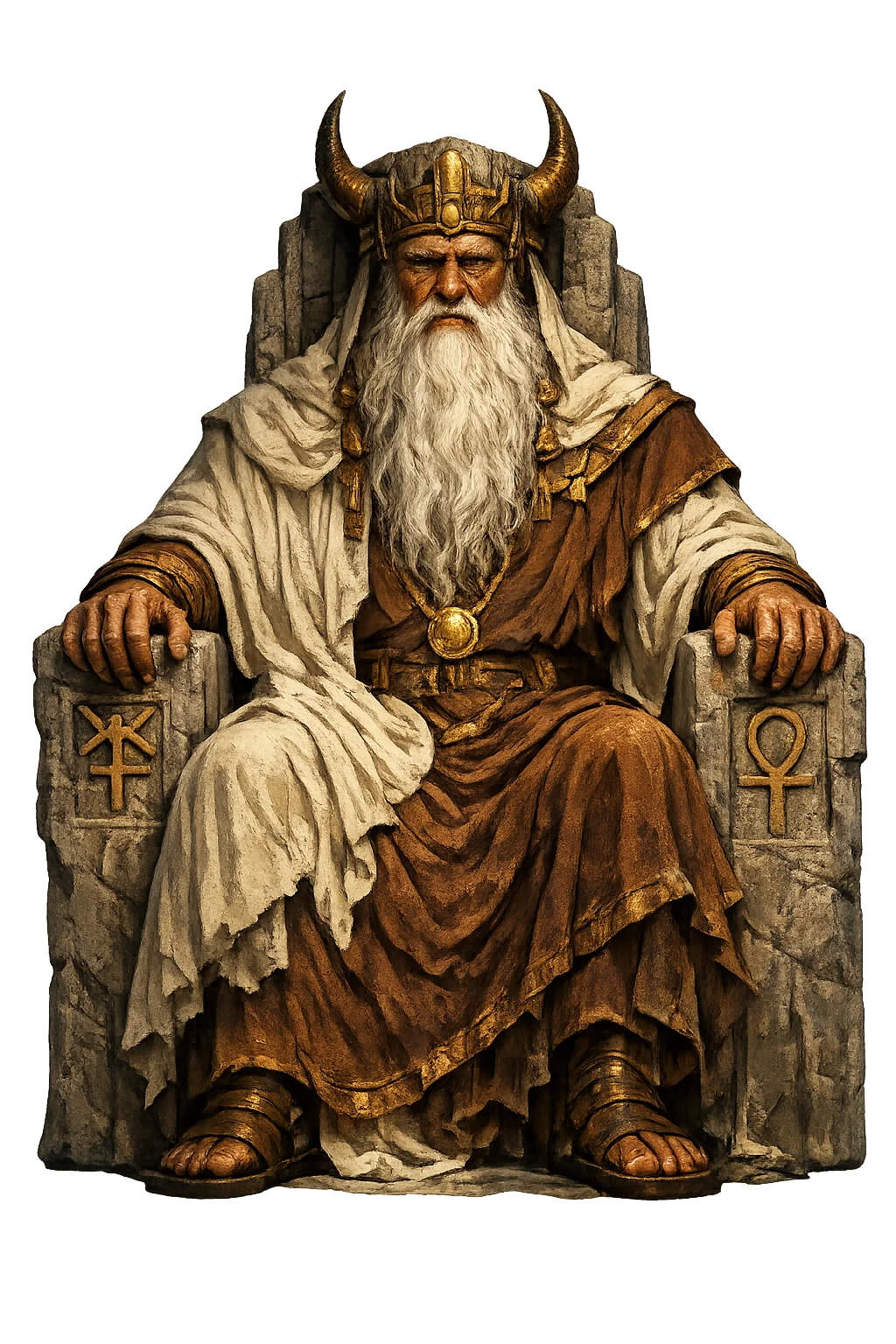
No certain portrait of El survives — which is itself a theological fact. Ugarit’s one iconic stela went to Baal, thunderbolt in hand; the high god kept his distance even from stone. The leading candidate is a thirteenth-century BCE basalt stela from Ras Shamra, now in the Louvre: an enthroned, bearded god with hand raised toward a smaller figure, conventionally read as El blessing a king — the identification is stylistic, not inscribed, and specialists rightly warn that not every enthroned god is El. A gilt-bronze seated statuette from Ugarit, bearded and capped, now in Damascus, is pointed the same way. What the texts supply is a coherent portrait never yet found in paint or relief: the white beard of the father of years, the bull of El’s fertility, the cup of blessing lifted at the tent-shrine where the cosmic rivers rise. Later ages never repaired the gap — Israelite religion forbade the image, and the god who needed no statue became the god of every scripture.

06

Reception & Transformation

The name after its own age — transmission, translation, survival

Afterlives

El’s transmission is a relay run by three carriers: the Phoenicians, the Bible, and the decipherers. The Phoenicians carried his name around the Mediterranean — carved in the Corpus Inscriptionum Semiticarum from the 1880s onward, compounded in hundreds of theophoric names — and preserved, in the fragments of Sanchuniathon quoted by Eusebius, a memory of the high god that Renaissance and Enlightenment readers devoured as “Phoenician theology”. The Bible carried him further than any empire: El, El Elyon, El Shaddai, and El-Berith passed through the Septuagint’s theos and Jerome’s Deus into the bloodstream of three scriptural civilizations, while the Masoretic manuscripts guarded the vowels later linguists would need. When Schaeffer’s team struck Ugarit’s tablets in 1929 and Bauer and Dhorme broke the cuneiform alphabet within two years, the last runner took the baton: Albright’s school, then Frank Moore Cross’s Canaanite Myth and Hebrew Epic (1973) and Mark Smith’s Origins of Biblical Monotheism (2001), placed the old high god at the center of monotheism’s genealogy. The art-historical afterlife is small but pointed: the Louvre’s enthroned stela, frontispiece of a generation of textbooks, gave a face to the god who had refused one for three millennia.

Identifications Across Traditions

Ēl is the common Semitic god par excellence. His name underlies Hebrew ʾĒl and its compounds (Israel, Gabriel, Michael), and it survives in Arabic Allāh (< al-ʾilāh, 'the God'). In the Greek world, the Phoenician high god was identified with Kronos, the aged father of Zeus, while Baꜥal was compared to Zeus himself. In Hurrian and Hittite treaties, Ēl appears as Elkunirša, paired with Asherah/Ašertu. The biblical tradition eventually absorbed Ēl into Yahweh: many of Israel's oldest poems use ʾĒl as a name or title for their own god, and the epithet ʾĒl Shaddai may preserve a Canaanite title of the high god.

Modern Legacy

Ēl did not disappear; he was subsumed. His name lives in the word 'God' itself across the Semitic languages, in countless theophoric personal names, and in the biblical title El Shaddai. The God of Abraham, Isaac, and Jacob is partly shaped by the old Canaanite high god: distant, paternal, creator, judge. In modern religious studies, Ēl has become a test case for how monotheism emerged not by inventing a new deity but by elevating and narrowing an old one. To name Ēl is therefore to name an ancestor shared by Judaism, Christianity, and Islam — and by the Canaanite religion they eventually superseded.

07

The Meditation

What Ēl means — beyond the dictionary

Ēl is the god of 'and then what?' He does not rush into battle; he sits at the source of the rivers and lets the younger gods come to him. His authority is so settled that he can afford to be slow, even tipsy, even outmaneuvered by his own wife and children. Yet when he speaks, the cosmos arranges itself around his word.

There is a kind of spiritual maturity in Ēl that the modern world often undervalues. He represents the authority that does not need to prove itself, the father who does not compete with his children, the creator who can delegate the storm to Baꜥal without jealousy. To meditate on Ēl is to ask whether our own craving for action, novelty, and recognition allows room for the older, slower power that holds everything together.

08

Frequently Asked Questions

Common questions about Ēl, Supreme God, Father of Gods, and Unicode restoration

01How do you pronounce Ēl?

In reconstructed pronunciation, Ēl is /ʔeːl/ — approximately 'AYLE' — like 'ale' with a long vowel and a slight glottal catch at the beginning; the name is short and resonant.

02What does Ēl mean?

Ēl means The high god of the Canaanite pantheon; the common Semitic word for "god" and a divine name in the canaanite tradition.

03What are the symbols of Ēl?

Ēl is associated with Bull ('Bull El' — ṯr ʾil — the patriarch's strength and fertility concentrated in a single animal image), Grey beard (ʾab šnm, 'father of years' — the venerable wisdom that outlasts every storm god), Source of rivers (The ʾapq rḥm, the confluence of the cosmic freshwater springs beneath his tent), Winged sun or throne (The exalted kingship of the divine council over which he presides).

04Why are there different spellings of Ēl?

Each form is a historically attested restoration rather than a mistake: ēl is the owned form (Lowercase display form of the owned domain). PUNICODEX registers the full set so the tradition is preserved under every defensible spelling.

05Why restore Ēl in Unicode?

Plain ASCII el strips the stress, length, and script that make the name specific. Unicode restoration returns the name to its original written dignity.

06What is the most important myth about Ēl?

“The Kingmaker of the Assembly” — the Kingship story that anchors the mythology of Ēl, told in full on the lore page.

09

Scholarly Sources

The philological foundations of this restoration

Every claim on this page is grounded in established scholarship. The orthographic restorations follow disciplinary convention. The etymological chain follows the best available reference works. This is not invention — it is resurrection through scholarship.

◈

Lexicography & Philology

  • Ugaritic texts
  • CIS
  • Coogan
  • Smith
  • Cross
◎

Primary Texts

  • KTU
  • KTU (Ugaritic texts)
  • KTU 1.1–1.6 (Ugaritic Baal Cycle: El's decrees and divine council)
  • KTU 1.14–1.16 (Epic of Keret)
  • Hebrew Bible, Genesis 14:18–22 (El Elyon, Melchizedek of Salem)
  • Hebrew Bible, Psalm 82; Deuteronomy 32:8–9 (El/Elyon and the divine council)
◉

Archaeology & Art History

  • Material evidence — iconography, inscriptions, and temple archaeology — for Ēl and related cults.
✦

Religious Studies

  • CIS
  • Coogan, Stories from Ancient Canaan
  • Smith, The Origins of Biblical Monotheism
  • Cross, Canaanite Myth and Hebrew Epic
  • Wyatt, Religious Texts from Ugarit
Return

The Surface Awaits

You have traced the name from its earliest attestation to its Unicode restoration. Now return to the myth. The story is where the name lives.

Back to Lore
Ēl mascot