
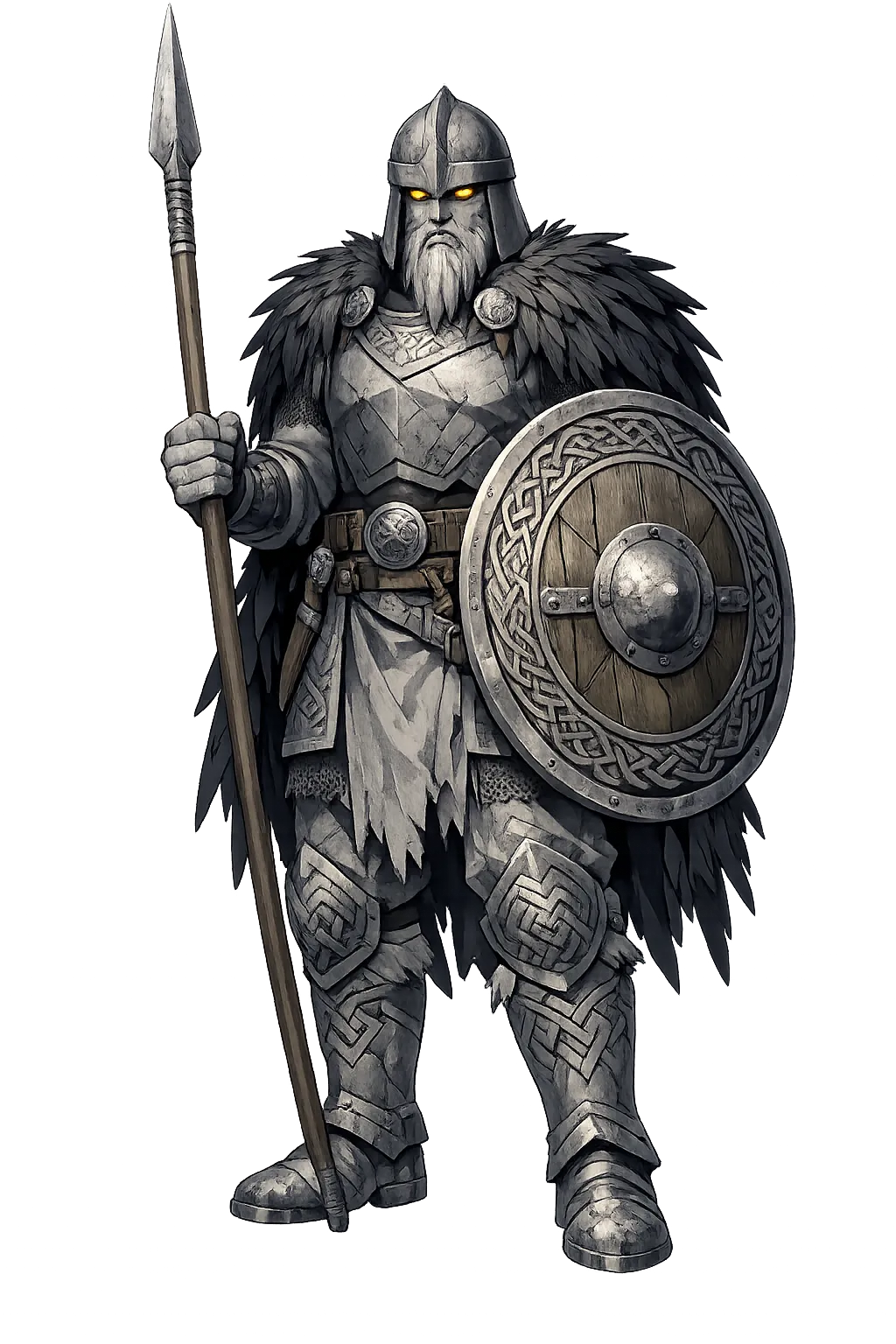
Eggþér: canonical, contested, and the false forms on record
Evidence dossier 139 — Eggþér. Every exhibit catalogued, every ruling stated with its grounds.
At a Glance
- Canonical form: Eggþér
- Original script: ᛁᚴᚴᚦᛁᚱ
- Pantheon: Norse
- Convention: normalized Old Norse spelling — þ, ð, ǫ, æ and length marks preserved as the editions print them
- False forms on record: 3
- Contested forms: none attested
- Series: The Canonical Register, No. 139 of 546
The Evidence
Exhibit 1 — the attestation. The attested form is ᛁᚴᚴᚦᛁᚱ, from the tradition's own record. The canonical transliteration is Eggþér.
Exhibit 2 — the preserved marks. e → é (Acute on e). Each is verifiable against the sources named in the attestation.
Exhibit 3 — the flattened form. The plain form eggther is not false — it is a fallback, and the register is exact about what that means. In systems that cannot carry diacritics (legacy databases, older tooling, parts of the address-bar pipeline) the flattened form is the accepted vehicle, and the rulebook names it explicitly as the final rung of the fallback hierarchy: full restoration first, circumflex where attested, macron-only by the academic standard, an attested variant, and only then plain ASCII.
What the fallback status forbids is promotion: eggther may carry the name where marks are impossible, but it may not represent the name where marks are possible. Every mark it drops — e → é — is a fact the sources recorded. A fallback is a vehicle, never the primary.
Exhibit 4 — struck from the record: Eggthér. Origin: the publisher compromise — older books and hurried websites that print the "English equivalent" as if it were the name itself. Grounds: every substitution here (þ→th) is a romanization of convenience, not an attested spelling — it teaches the reader to guess, not to read.
Exhibit 5 — struck from the record: Eggpér. Origin: the near-miss — a form that looks right at a glance and circulates on wikis and forums. Grounds: a plosive for the fricative þ — thorn is not a fancy p.
Exhibit 6 — struck from the record: eggter. Origin: the anglicized respelling — the name written the way English guesses it sounds. Grounds: rewrites attested consonant clusters to fit English spelling habits; every cluster simplified this way erases a letter the sources write.
Exhibit 7 — the physical record. No archaeological find can be linked to Eggþér directly. His myth belongs to the manuscript tradition of the Eddas — the Codex Regius (GKS 2365 4to, c. 1270) and Hauksbók (AM 544 4to). The mound on which he sits, however, recalls the thousands of Bronze- and Iron-Age burial mounds of Scandinavia, which stood in the landscape as places where the dead remained present and watchful — the howe as both grave and lookout, the natural seat for a man whose whole office is to wait for the end and play.
Exhibit 8 — the continuing record. Eggþér remains obscure outside specialist scholarship, but the image of a musician playing at the end of the world has proved indestructible. Wagnerian opera, Romantic painting, twentieth-century fantasy, and apocalyptic poetry have all borrowed the motif of the calm artist amid catastrophe — from the fiddler-on-the-roof tradition of eastern Europe to the countless novels and films that score doomsday with a solo instrument.
The Convention's Own History
The Poetic Edda survives essentially in one manuscript — the Codex Regius, c. 1270 — and normalized Old Norse spelling descends from what that manuscript and its siblings actually write. Þ and ð are not decorations: they are letters of the alphabet the skalds used (and English later abandoned), and ǫ is a nasal vowel the normalization preserves because the sources carry it. The register's rule is the manuscript's rule: spell the names the way the tradition that sang them wrote them down.
The Protocol's Position
Can the canonical form live in the address bar? Almost always, yes. IDNA 2008 admits every mark this register defends — the DNS stores them as `xn--` punycode and modern browsers render them natively. The real frictions are practical, not legal: some registrars stock only part of the IDN space, so a theoretically valid name can be temporarily unbuyable; and stacked combinations (an acute riding a macron) remain awkward to type on mobile keyboards even where the protocol accepts them.
The project's answer is a ranked ladder, not a compromise: the full restoration first, then attested fallbacks in descending order of completeness. The ladder's lowest rung, plain ASCII, is a vehicle for legacy systems — sanctioned, but never presented as the scholarly form.
The Verdict
Case closed on Eggþér: canonical, cited, and defended. The keyboard form eggther rides as the sanctioned fallback — and stays in that lane. The register's files remain open: if a source surfaces that changes any line of this entry, the entry changes. Until then, the temple at /eggther/ holds the canonical form.
The docket for this ruling: 3 false forms ruled against, Eggthér first on the docket; 1 preserved mark verified: e → é; no contested forms attested.
The Register Continues
This is one of 546 entries in the Canonical Register — the authoritative reference for every flagship temple. The temple's founding dispatch tells the name's story; its Restoration File details the marks; its Resonance File reads the archetype into the industries. The blog index holds the whole archive, and the Rulebook states the convention this register enforces.
Continue the register — previous entry: Efnysien (read it) · next entry: Eingana (read it).
The Canonical Register is written from the same canonical record as the lexicon itself. If a false form is missing from this page, it is because the evidence does not support calling it false — or because we have not seen it yet. Show us, with a citation, and the register will answer.