PuniCodex

Extended Lore

ᛁᚴᚴᚦᛁᚱ Eggþér

Etymology · Orthography · Cult · Iconography · Reception · Sources

Tier 1 Eggþér.com
Eggþér — Watchman, Ragnarök Herald
01

Quick Facts

Essential information about Eggþér, Watchman, Ragnarök Herald

Original Scriptᛁᚴᚴᚦᛁᚱ
Unicode RestorationEggþér
Reconstructed Pronunciation/ˈeɡˌθɛːr/
PantheonNorse
DomainWatchman, Ragnarök Herald
MeaningSword guardian
ClassificationTier 1
Primary DomainEggþér.com
Sacred SymbolsHarp, Grave-mound, Sword or edge, The crimson cock Fjalarr
02

Etymology & Word Family

From original script to Unicode restoration

Original Script ᛁᚴᚴᚦᛁᚱ Eggþér — "Sword guardian"
Unicode Restoration Eggþér Restored stress, length, and script
Modern ASCII eggther Plain-ASCII fallback

The name Eggþér carries the orthographic signature of the norse tradition: ᛁᚴᚴᚦᛁᚱ. Unicode restoration recovers what ASCII flattens.

03

Unicode Character Breakdown

Character-by-character philological analysis

CharacterUnicodeNameBlockPhonetic Role
EU+0045Latin Capital Letter EBasic LatinSame
gU+0067Latin Small Letter GBasic LatinSame
þU+00FELatin Small Letter ThornLatin-1 SupplementThorn
—N/ADropped characterNorse orthographyNot written
éU+00E9Latin Small Letter E with AcuteLatin-1 SupplementAcute on e
rU+0072Latin Small Letter RBasic LatinSame

The Tier 1 classification reflects how much of the original phonology this restoration preserves — stress and vowel length for Greek names, distinctive letters and diacritics for every other tradition.

04

Cult & Worship

How the sacred was kept — rites, sanctuaries, remains

The Cult

There was no cult of Eggþér, and honesty requires saying so plainly: he is a one-stanza figure. Völuspá 42–43 gives him no sanctuary, no offering, no priesthood — only a seat on a burial mound and a song. What the scene preserves is not ritual but the landscape of one: the Bronze- and Iron-Age howes of Scandinavia were the dead's houses and watch-posts, and placing the herdsman on a mound roots his omen in real funerary topography. Everything beyond that stanza — his office, his worship, his calendar — is silence. The mound is his temple because the mound is all the poet gave him.

In the Earth

No archaeological find can be linked to Eggþér directly. His myth belongs to the manuscript tradition of the Eddas — the Codex Regius (GKS 2365 4to, c. 1270) and Hauksbók (AM 544 4to). The mound on which he sits, however, recalls the thousands of Bronze- and Iron-Age burial mounds of Scandinavia, which stood in the landscape as places where the dead remained present and watchful — the howe as both grave and lookout, the natural seat for a man whose whole office is to wait for the end and play.

05

Iconography

How Eggþér was imaged across the ages

The Image

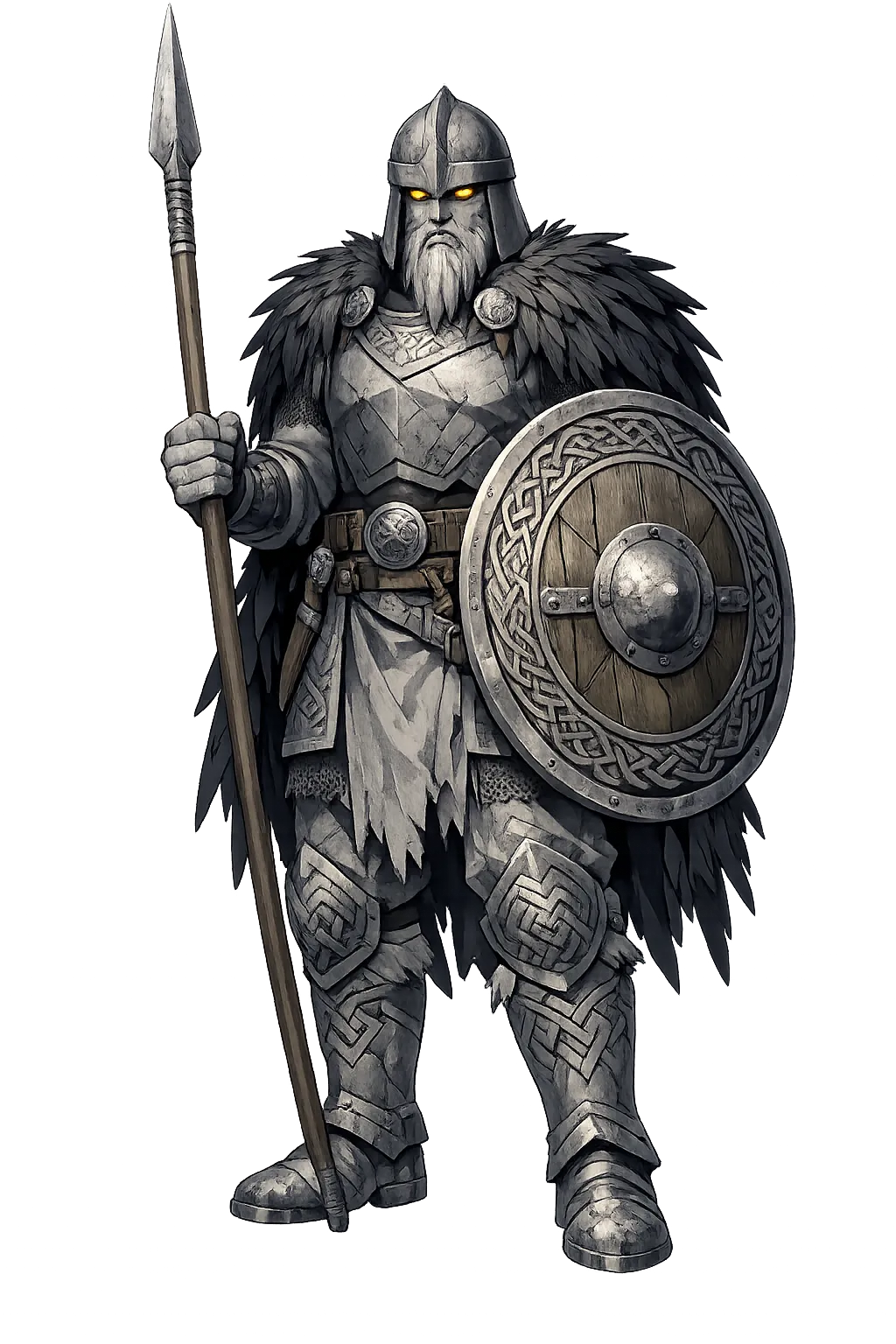
No image of Eggþér survives, and none is likely ever to have existed while the tradition lived — his entire portrait is three textual strokes: a man on a howe, a harp in his hands, a giantess keeping glad watch beside him. Viking-Age and Migration-period art at least gives his instrument a body: the Gotland picture stone at Ardre carves a harpist — Gunnarr among the serpents — and the graves of Trossingen and Sutton Hoo held real lyres across the Germanic world. No figure, however, can be tied to Eggþér himself, and the mound needs no archaeology to identify: thousands still rise across Scandinavia. If a reader pictures him, the verse supplies the icon — pastoral calm framed by burial architecture, a musician half turned toward the end of the world.

06

Reception & Transformation

The name after its own age — transmission, translation, survival

Afterlives

Eggþér's transmission is a bibliographic life. He enters history in the Codex Regius of the Poetic Edda (c. 1270), while the Hauksbók recension compresses his stanza to a shadow. The bishop Brynjólfur Sveinsson sent the Codex Regius to Copenhagen in 1662, and the 1787 editio princeps of 'Sæmund's Edda' gave the passage its first printed life; nineteenth- and early-twentieth-century translators — Benjamin Thorpe, then Olive Bray's 1908 verse rendering — carried it into English. The philologists then set to work: is Eggþér 'edge-servant' or a genuine giant-name? Cleasby–Vigfusson's 1874 dictionary proposed the famous parse that Simek and Lindow still leave open. Sigurður Nordal's 1927 edition of Völuspá made the stanza's doom-chronology canonical, and Ursula Dronke's 1997 commentary weighed the crux with characteristic care; the standard reference shelves of our day file him faithfully as the herdsman on the mound. A figure of three lines has thus accumulated two centuries of apparatus — proof of how little it takes, placed at the right moment, to demand exegesis forever.

Identifications Across Traditions

Eggþér has no clear counterpart outside Norse tradition. His closest relatives are other liminal apocalyptic figures: Heimdallr, who watches at the world's edge and will blow the Gjallarhorn; the giant Hrymr, who steers Naglfar; and the unnamed giantess who keeps watch on the howe beside him. Some interpreters compare him to death-herdsmen and wild-hunt figures in wider Germanic folklore — beings who pasture the dead the way a man pastures cattle. The scene in Völuspá may also owe something to the apocalyptic imagery shared across Christian and Near Eastern traditions current when the poem was composed, though its pastoral details are distinctively Norse: where another culture sends trumpets, the North sends a harp and three cocks.

Modern Legacy

Eggþér remains obscure outside specialist scholarship, but the image of a musician playing at the end of the world has proved indestructible. Wagnerian opera, Romantic painting, twentieth-century fantasy, and apocalyptic poetry have all borrowed the motif of the calm artist amid catastrophe — from the fiddler-on-the-roof tradition of eastern Europe to the countless novels and films that score doomsday with a solo instrument. For modern readers of Völuspá, Eggþér embodies the poem's strangest gift: the end of everything announced not by thunder but by a harp, and received not with terror but with cheerfulness. He is the patron, if he is a patron of anything, of grace under the final sentence.

07

The Meditation

What Eggþér means — beyond the dictionary

Eggþér is the musician at the edge of the world. While gods and giants arm for the final battle, he sits on a mound and plays. His song is not a call to arms; it is an acknowledgment that the old order is finished and something else — even if that something is silence — is about to begin.

In a culture obsessed with heroic action, Eggþér's passivity is striking. He does not choose sides; he bears witness. Perhaps that is his function: to remind us that not every response to catastrophe is combat. Some truths can only be told in music, at the boundary between what was and what will never be again. The Edda's poets, who gave their apocalypse a poet's vocation, surely knew it: someone must be left on the mound, plucking, when the bonds break.

08

Frequently Asked Questions

Common questions about Eggþér, Watchman, Ragnarök Herald, and Unicode restoration

01How do you pronounce Eggþér?

In reconstructed pronunciation, Eggþér is /ˈeɡˌθɛːr/ — approximately 'EGG-thair' — crisp 'egg' with a held g, then the breathy 'th' of 'thin' and a long, stressed 'air' ending in a light r.

02What does Eggþér mean?

Eggþér means Sword guardian in the norse tradition.

03What are the symbols of Eggþér?

Eggþér is associated with Harp (The instrument whose music accompanies the fall of the gods — art outliving the world that art served), Grave-mound (A seat of death-omens and boundary-crossing between worlds), Sword or edge (If the name contains the element egg, 'edge', it hints at the blade that cuts the old world apart), The crimson cock Fjalarr (In the same Völuspá sequence the red cockerel crows — Eggþér's music belongs to the chorus of alarms).

04Why restore Eggþér in Unicode?

Plain ASCII eggther strips the stress, length, and script that make the name specific. Unicode restoration returns the name to its original written dignity.

05What is the most important myth about Eggþér?

“The Herdsman on the Howe” — the Völuspá 42 story that anchors the mythology of Eggþér, told in full on the lore page.

09

Scholarly Sources

The philological foundations of this restoration

Every claim on this page is grounded in established scholarship. The orthographic restorations follow disciplinary convention. The etymological chain follows the best available reference works. This is not invention — it is resurrection through scholarship.

◈

Lexicography & Philology

  • Cleasby-Vigfusson
  • Zoëga
◎

Primary Texts

  • Poetic Edda: Völuspá 42–43 (Codex Regius; cf. the Hauksbók recension)
  • Dronke, Ursula, The Poetic Edda, Vol. II: Mythological Poems (1997)
◉

Archaeology & Art History

  • Material evidence — iconography, inscriptions, and temple archaeology — for Eggþér and related cults.
✦

Religious Studies

  • Cleasby & Vigfusson, An Icelandic-English Dictionary (1874), s.v. egg, þjónn
  • Simek, Rudolf, Dictionary of Northern Mythology (1993)
  • Lindow, John, Norse Mythology: A Guide (2001)
  • Zoëga, A Concise Dictionary of Old Icelandic (1910)
Return

The Surface Awaits

You have traced the name from its earliest attestation to its Unicode restoration. Now return to the myth. The story is where the name lives.

Back to Lore
Eggþér mascot