
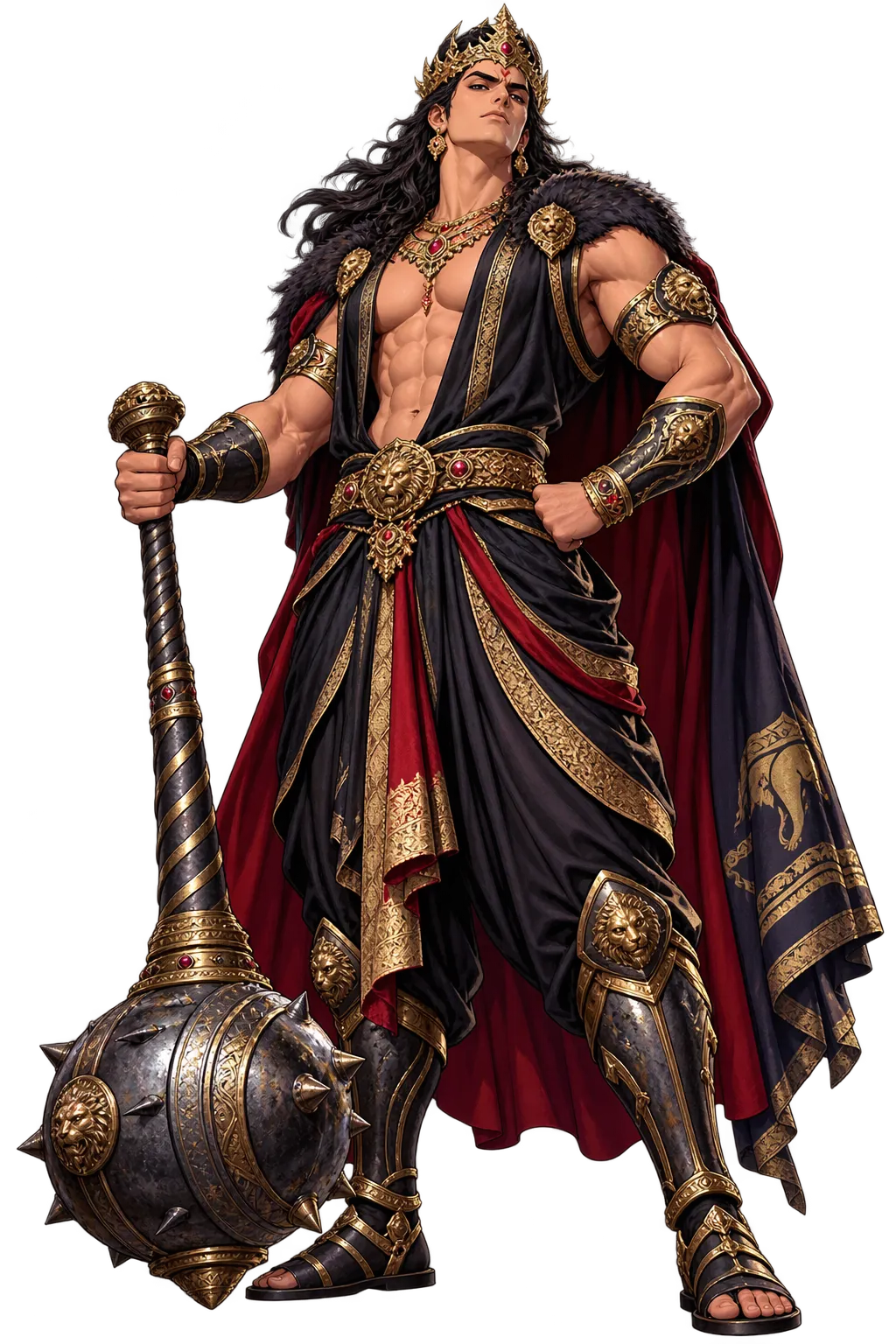
The appointments Duryodhana made — and who is keeping them
One myth is a story. A cycle of myths is a specification. Read Duryodhana's cycle in order and the industries fall out of it one by one.
At a Glance
- Temple: Duryodhana
- Pantheon: Sanskrit
- Domain of influence: Ambition, Rivalry, War
- Pattern seats: 3
- Sectors touched: Culture & Entertainment · Commerce & Governance
- Strongest seat: Gaming, Fantasy & Entertainment IP
- Series: The Resonance Files, No. 145 of 597
The Cycle, Read Forward
Gaming, Fantasy & Entertainment IP — through The Ball of Flesh
Gandhārī carried her pregnancy two years; delivered of a hard mass of flesh, she was about to cast it away when Vyāsa ordered it divided — a hundred pieces in oil-jars, and one more that became Duhśalā. Duryodhana’s birth-omen — braying donkeys, circling vultures — had the elders counselling his abandonment; Dhṛtarāṣṭra’s love overruled the omen, and the epic marks the moment the world’s fate turned.
The atlas states the seat in one line: The Mahābhārata's tragic antagonist — wayang, film, and novel keep re-adjudging his claim. The story above is the long version of the same sentence. Industries do not invent their archetypes; they inherit them and call them best practice.
Leadership, Governance & Public Administration — through The Dice Game
At Śakuni’s loaded board, Duryodhana won the Pāṇḍavas’ kingdom, their liberty, and their queen — and ordered Duḥśāsana to drag Draupadī to the court. Her question — what did you stake first, the kingdom or me?
The atlas states the seat in one line: The crown prince whose claim was legally arguable — governance's tragic case-study in succession. The story above is the long version of the same sentence. Industries do not invent their archetypes; they inherit them and call them best practice.
Sports, Fitness & Competition — through The Embassies and the Refusal
Krishna came in peace, then as war-herald; the Pāṇḍavas asked for five villages. ‘I will not give the Pāṇḍavas land equal to the point of a needle’ — Duryodhana’s answer to Krishna’s peace-mission is the epic’s hinge.
The atlas states the seat in one line: The mace-duel with Bhīma — sport and fate sharing one field. The story above is the long version of the same sentence. The trade thinks it is optimizing a process. It is re-enacting a charter.
The Theme That Runs the Cycle
Duryodhana’s mythology is the Mahābhārata read from the losing side: the crown prince displaced by cousins the law favoured, the commander whose every general was better than his cause. The epic gives him the war’s best exit-line and its most human griefs — for Karṇa, for his sons, and for the pride he would not trade for peace.
The Method, Stated Plainly
The atlas is not a horoscope. Seats are earned from the sources — argued, weighted, published — and every one of them can be challenged at the methodology page. A match that cannot survive an argument does not survive review. That is the whole trick: the patterns are claims, and claims can be tested.
For the Ones Who Work There
If you work in gaming, fantasy & entertainment ip, leadership, governance & public administration, or any trade this temple holds a seat in, this is the honest version of what a placement means: your industry beside the story it has been re-telling all along — on the temple floor itself, before an audience that came specifically to read it. The patron tier and the advertising terms describe the mechanics; the resonance above describes the fit.
The File Continues
One of 597 Resonance Files — the series where the pantheon goes to work. Read the founding dispatch for the name, the Restoration File for the spelling, or the whole archive end to end.
Continue the series — previous: Durgā (read it) · next: Ēa (read it).
The Resonance Files are argued from the same canonical record as the pattern atlas itself: the lexicon, the lore catalog, and the cited sources. Every seat can be challenged at the methodology page — and the challenge is the point.