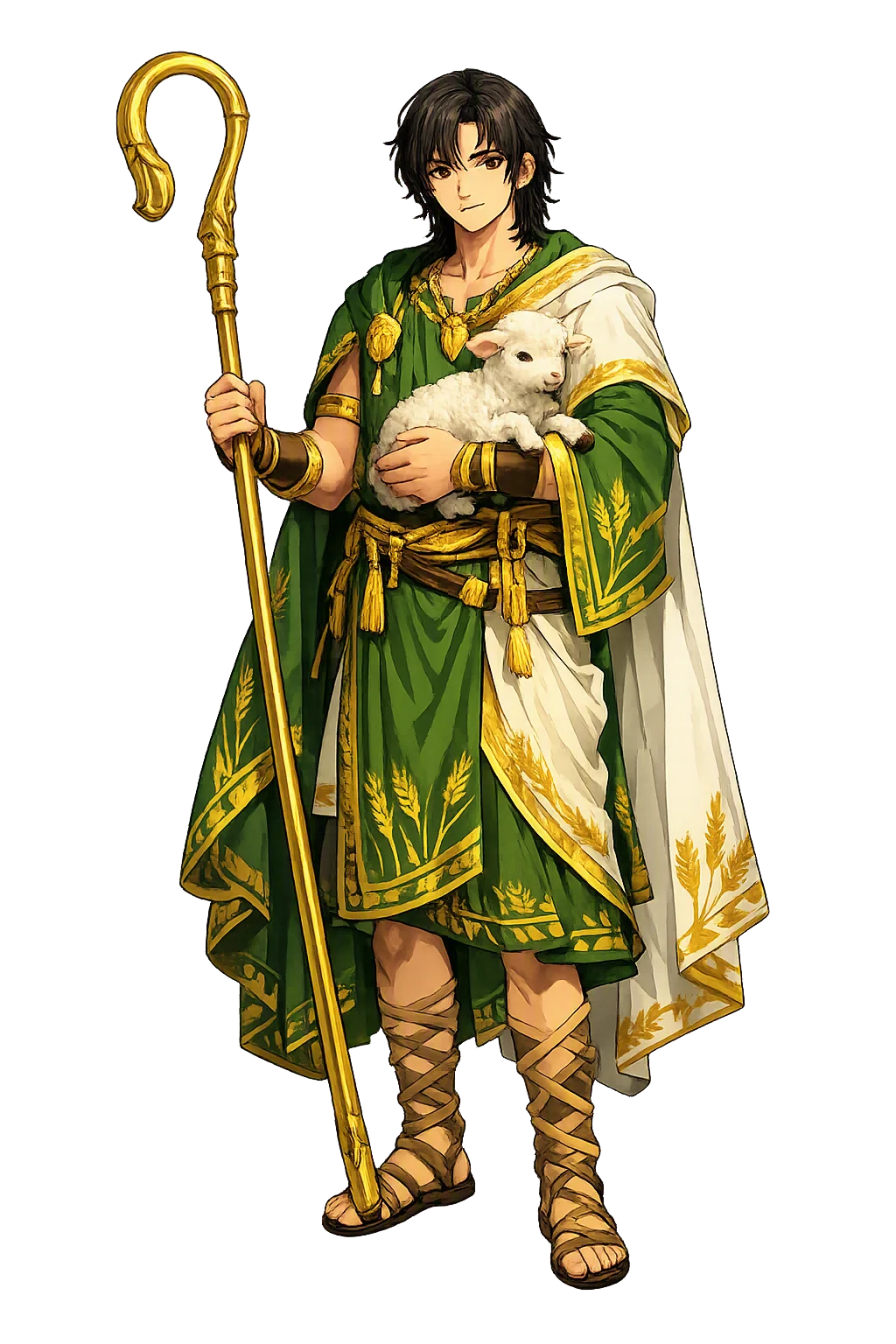
Stories of Dumuzid
Dumuzid's myths are woven through the great Sumerian literary corpus: courtship songs, sacred-marriage hymns, the Descent of Inanna, and the laments for his death. They turn on the tension between abundance and loss, intimacy and exile, the green world and the dark earth.
In the Sumerian poem Dumuzi and Enkimdu (ETCSL 4.08.33), Inanna must choose between two suitors: Dumuzid, the shepherd, and Enkimdu, the farmer. The shepherd boasts of what the flock gives — milk, cheese, butter, and wool — and lays his fatted sheep before the goddess; the farmer counters with what the field gives — grain, bread, and beer. Inanna declares for the shepherd, and the humiliated Enkimdu, far from nursing the quarrel, offers Dumuzid gifts from his produce; Dumuzid urges the goddess to accept them, and the two rivals exchange tokens and part as friends. The poem is a charter of economic prestige: in early Mesopotamia the contest between pastoral and agricultural wealth was serious enough to require a divine adjudication — and the verdict elevates the perishable, living abundance of the flock above the stored surplus of the granary, while prescribing reconciliation between the two economies it judges.
The sacred-marriage songs (ETCSL 4.08.01–04) celebrate Dumuzid as the bridegroom of Inanna. The king of Uruk embodies Dumuzid, while the goddess embodies the city and the land; the wedding is sung in the first person, the king speaking as the god and the priestess as the goddess. Their union is not merely symbolic: it guarantees the me of fertility — the sprouting of grain, the filling of folds, the rising of the river — and the legitimacy of the reigning king, whose rule is annually renewed in the bridal chamber. A storehouse record from the reign of Ibbi-Sin even notes rations issued 'when the king married the goddess Inanna,' showing the rite anchored in court practice as well as in song. The wedding is the charter of Sumerian kingship itself: the king does not merely govern the city — he marries its goddess, and the marriage is what the harvest reenacts.
In the Descent of Inanna (ETCSL 1.4.1), Inanna passes the seven gates of the underworld, is stripped of a garment at each, and is judged and killed by Ereshkigal — her corpse hung from a peg — until Enki's emissaries revive her with the water and plant of life, on condition that she send a substitute in her place. The galla demons escort her up the great stair, seizing anyone she fixes with the eye of death. Inanna finds Dumuzid not in mourning but dressed in his splendor, seated upon her throne; she fixes him with that look and names him. The demons drag him down, but his sister Geshtinanna offers to share his fate: Dumuzid will spend half the year in the underworld, Geshtinanna the other half. This is the Sumerian explanation of summer's parch and winter's return — and its grim economy is the myth's point: love that does not grieve at loss becomes the price of loss.
Sumerian city laments (e.g., The Death of Dumuzid, ETCSL 4.08.32) mourn the shepherd's death in detail that reads like a city emptied of its heart: the milk-churn lies idle, the sheep wander the fold searching for their shepherd, the cow lows for its calf, and the women of the city beat the lament-drum and tear their hair. In Akkadian tradition the rite became the weeping for Tammuz, and the biblical prophet Ezekiel witnesses women 'weeping for Tammuz' at the Jerusalem temple gate (Ezekiel 8:14) — a Mesopotamian rite transplanted to the Levant. The Gilgamesh epic lists Dumuzi among Ishtar's doomed lovers (Tablet VI). The tears are not only grief; they are a petition for the god's return and the restoration of vegetation — mourning practiced as agriculture, grief as the one ritual guaranteed to summon the green world back.
In the Sumerian poem Dumuzid's Dream, the shepherd wakes from a nightmare — drooping milk-churns, smashed cups, rushes rising from the ground — omens his sister Geshtinanna reads correctly: the galla, the underworld's pitiless demons, are coming for him. Dumuzid flees, hiding in the ditches, then transforming as the demons close in — a bird, a gazelle — while the old woman Belili betrays his hiding place for a gift. Caught, he is bound and beaten; Geshtinanna mourns at the demons' feet until the sentence is divided between them. The poem is the myth's night-side: the descent of Inanna told from the substitute's point of view, and its honesty is its lesson — the dying god is not a willing sacrifice but a beloved man who runs, hides, and is taken anyway.
Shepherds, Vegetation, and the Sacred Marriage
Dumuzid is the Sumerian shepherd made divine — the 'faithful son' whose name joins dumu ('son') and zid ('true, faithful, right'). He is the lord of the sheepfold, the provider of milk and wool, and the bridegroom of Inanna in the sacred marriage that guarantees the land's fertility. Unlike the storm-gods who rule by force, Dumuzid reigns through the gentle goods of the pasture: grass, water, flock, and the cyclic return of vegetation.
His myth is also the myth of seasonal loss. In the Descent of Inanna he is chosen to take the goddess's place in the underworld for half the year, so that life and death may alternate on earth. Dumuzid is therefore not only the patron of shepherds but the archetype of the dying-and-rising vegetation god, mourned as Tammuz across the ancient Near East.
Patron of shepherds, milk, cheese, and wool; the pastoral economy of Sumer consecrated in one figure.
His wedding songs praise the date palm, the garden, and the sprouting reed — the green world as bridal gift.
The union of Dumuzid and Inanna legitimates kingship and assures fertility; every New Year reenacts their cosmic wedding.
Half the year in the underworld, half on earth with his sister Geshtinanna — the seasonal cycle made myth.
From the original script to the living URL
𒀭𒌉𒍣
The name in its original Mesopotamian form. Dumuzid (𒀭𒌉𒍣) is attested in the source tradition — “Faithful son”. Its original diacritics and script distinctions carry the full phonetic and orthographic weight of the source tradition.
dumuzid
The plain dumuzid form is identical to the Unicode restoration. Because this name is already written in Latin letters, no diacritics, stress, or script information were lost — only capitalization differs.
Dumuzid
The Unicode restoration does not need to recover lost marks for Dumuzid. Its value is canonical spelling and consistent cataloguing, not the reconstruction of erased orthography. The domain is readable as-is to both DNS and humanity.
Dumuzid.com
This restoration is written entirely in ASCII letters — no Punycode encoding stands between Dumuzid and the DNS. The domain reads identically to machines and to human eyes.
Owned, ideal, and ASCII forms of Dumuzid
Dumuzid
Restores 𒀭𒌉𒍣. The full Unicode restoration. dumuzid.com is not in the PuniCodex collection — it is watched for release; if it drops, this temple upgrades to an owned flagship.
How Dumuzid was spoken
How Dumuzid travels from ancient script to the modern URL
The lore you have read is the living myth. Extended Lore opens the scholarly vault beneath it: the cult and its material remains, a history of the image, the name after antiquity, a meditation on what the name still means, and the full scholarly apparatus — etymology, orthography, sources.
Enter Extended Lore